EasyManua.ls Logo

Electro-Voice X6 - Crossover Network Applications and Diagrams; Model X825 and X36 Crossover Applications; Model X336 and X2635 Crossover Applications; Typical Wiring Diagram Configurations

Electro-Voice X6
2 pages
Print Icon
To Previous Page IconTo Previous Page
Loading...
M'(U«
JAVA
'.!•
r.«
a
mi
mn
ifduri*
w:*
4
.'
8
<
U
U4IA
«
rfl
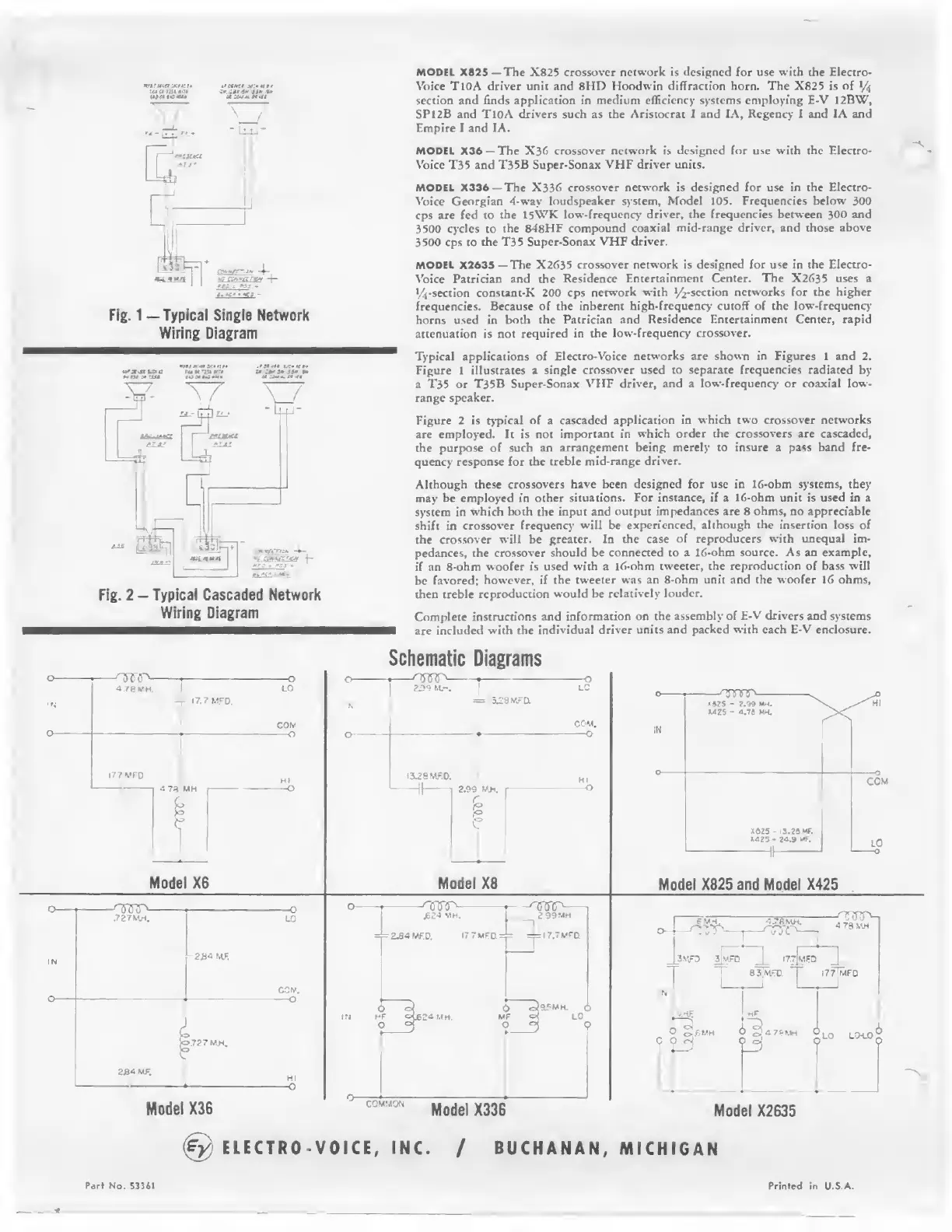
Fig.
1
Typical
Single
Network
Wiring
Diagram
MM
tom
ZUtlH
s.
IL
3
U
a
Fig.
2
Typical
Cascaded
Network
Wiring
Diagram
MODEL
X825
The
X825
crossover
network
is
designed
for
use
with
the
Electro-
Voice
TlOA
driver
unit
and
8HD
Hoodwin
diffraction
horn.
The
X825
is
of
*/4
section
and
finds
application
in
medium
efficiency
systems
employing
E-V
12BW,
SPI2B
and
TlOA
drivers
such
as
the
Aristocrat
I
and
LA,
Regency
I
and
1A
and
Empire
I
and
IA.
MODEL
X36
The
X36
crossover
network
is
designed
for
use
with
the
Electro-
Voice
T35
and
T35B
Super-Sonax
VHF
driver
units.
MODEL
X336
The
X336
crossover
network
is
designed
for
use
in
the
Electro-
Voice
Georgian
<f-wav
loudspeaker
system.
Model
105.
Frequencies
below
300
cps
are
fed
to
the
15WK
low-frequency
driver,
the
frequencies
between
300
and
3500
cycles
to
the
848HF
compound
coaxial
mid-range
driver,
and
those
above
3500
cps
to
the
T35
Super-Sonax
VHF
driver.
MODEL
X2635
The
X2635
crossover
network
is
designed
for
use
in
the
Electro-
Voice
Patrician
and
the
Residence
Entertainment
Center.
The
X2635
uses
a
•4-section
constant-K
200
cps
network
with
•/^-section
networks
for
the
higher
frequencies.
Because
of
the
inherent
high-frequency
cutoff
of
the
low-frequency
horns
used
in
both
the
Patrician
and
Residence
Entertainment
Center,
rapid
attenuation
is
not
required
in
the
low-frequency
crossover.
Typical
applications
of
Electro-Voice
networks
are
shown
in
Figures
1
and
2.
Figure
1
illustrates
a
single
crossover
used
to
separate
frequencies
radiated
by
a
T35
or
T
35
B
Super-Sonax
VHF
driver,
and
a
low-frequency
or
coaxial
low-
range
speaker.
Figure
2
is
typical
of
a
cascaded
application
in
which
two
crossover
networks
are
employed.
It
is
not
important
in
which
order
the
crossovers
are
cascaded,
the
purpose
of
such
an
arrangement
being
merely
to
insure
a
pass
band
fre¬
quency
response
for
the
treble
mid-range
driver.
Although
these
crossovers
have
been
designed
for
use
in
16-ohm
systems,
they
may
be
employed
in
other
situations.
For
instance,
if
a
16-ohm
unit
is
used
in
a
system
in
which
both
the
input
and
output
impedances
are
8
ohms,
no
appreciable
shift
in
crossover
frequency
will
be
experienced,
although
the
insertion
loss
of
the
crossover
will
be
greater.
In
the
case
of
reproducers
with
unequal
im¬
pedances,
the
crossover
should
be
connected
to
a
16-ohm
source.
As
an
example,
if
an
8-ohm
woofer
is
used
with
a
16-ohm
tweeter,
the
reproduction
of
bass
will
be
favored;
however,
if
the
tweeter
was
an
8-ohm
unit
and
the
woofer
16
ohms,
then
treble
reproduction
would
be
relatively
louder.
Complete
instructions
and
information
on
the
assembly
of
E-V
drivers
and
systems
are
included
with
the
individual
driver
units
and
packed
with
each
E-V
enclosure.
Schematic
Diagrams
Model
X6
O—
IN
?39
M_^.
=
5i28WFa
COM.
I3J28
MF.D.
2.99
Mii.
&
HI
-O
Model
X8
Model
X825
and
Model
X425
=4=
234
MF.D.
17
7
MFD
=i=
I
7.7
MFD
j624
MH.
n,
6
IN
HF
<?
-'Ttfir—
2
99MH
IF
&JdZA
MH.
Model
X36
TTinrs
.
3
MFD
3)m.FD
!77|MFD
J
83iMFD.
"T
I7
tTmFQ
J
L—J
6
395MH.
(_
*f
lo
?_
3
?
O
SfiMH
6
O
c>4.76MH
v
*'L0
I
Qh
O
Q
ojSj
0j=j
V
J
L
'
>LO
<
?
COMMON
Model
X336
Model
X2635
£y
ELECTRO-VOICE,
INC.
/
BUCHANAN,
MICHIGAN
Pari
No.
53341
Printed
in
U.S.A.

Related product manuals