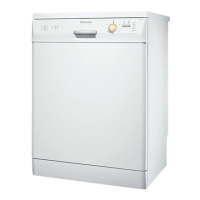
This document is an instruction manual for an Electrolux dishwasher, model ESF 662. It provides comprehensive information on its installation, operation, maintenance, and troubleshooting.
Function Description:
The Electrolux ESF 662 is a dishwasher designed to clean dishes, cutlery, pots, pans, and glasses. It incorporates a water softener system to remove minerals and salts from the water supply, which can negatively impact washing performance. The appliance offers various washing programs tailored to different levels of soil and types of load, including options for prewash, economy, and quick wash cycles. It automatically adds rinse aid during the final rinse to ensure spot and streak-free drying. The dishwasher is designed for ease of use with a clear control panel and adjustable features like the upper basket height and rinse aid dosage.
Important Technical Specifications:
- Dimensions:
- Width: 60 cm
- Height with worktop: 85 cm
- Height without worktop: 82 cm
- Max depth: 60 cm
- Max depth with open door: 120 cm
- Electrical Connection:
- Voltage: 220/230 V - 50 Hz
- Power of heating element: 1900 W
- Overall power: 2100 W
- Water Supply Pressure:
- Minimum: 0.5 bar
- Maximum: 8 bar
- Capacity (Standard IEC): 12 place settings
- Consumption:
- Water: 22 liters
- Electricity: 1.5 kW/h
Usage Features:
- Control Panel: Features an On/Off indicator light and pushbutton, washing temperature selection buttons (65°C, 55°C), a program guide, a door handle, a START program marker, a program selector dial, and a program sequence indicator (Prewash/Rinse and Hold, Wash, Cold rinse, Hot rinse, Hot air drying).
- Water Softener: Adjustable to five levels based on water hardness, requiring salt from level 2 upwards. Adjustment involves turning a selector and potentially drilling a membrane for higher hardness levels.
- Rinse Aid Dispenser: Holds approximately 110 ml of rinse aid, sufficient for 16-40 dishwashing programs. The dosage is adjustable via a 6-position selector to prevent water drops or lime spots.
- Detergent Dispenser: Designed for specific dishwasher detergents, with markings for 15g (MIN) and 30g (MAX) to aid in correct dosing. Instructions are provided for both powder and tablet detergents.
- Loading:
- Lower Basket: Designed for saucepans, lids, plates, salad bowls, and cutlery. Serving dishes and large lids should be placed around the edge to ensure free rotation of the upper spray arm.
- Cutlery Basket: Removable, with recommendations to place handles downwards (or upwards if obstructing the spray arm). Sharp items like carving knives should be placed horizontally in the upper basket. Silver cutlery should be separated from steel cutlery to prevent blackening.
- Upper Basket: Designed for dessert plates, saucers, dinner plates (up to 24 cm), salad bowls, cups, and glasses. Glasses with long stems can be placed upside down in raised cup racks. Larger plates (up to 24 cm) should be loaded in the front part. Light items should be secured to prevent movement.
- Adjustable Upper Basket: Can be moved to a higher position to accommodate very large plates (27-31 cm) in the lower basket. In the higher position, the top basket only fits plates up to 20 cm, and cup racks cannot be used.
- Washing Programs: A chart details programs like "Normal 65°C with Prewash," "Normal 65°C no Prewash," "Economy 55°C with Prewash," "Economy 55°C no Prewash," "Quick 55°C," and "Rinse and Hold." Each program specifies the degree of soil, type of load, starting position of the programmer, required pushbuttons, recommended detergent quantity, and cycle description.
- Operating Sequence: Step-by-step instructions cover checking filters, rinse aid, and salt; loading dishes; ensuring spray arm rotation; measuring detergent; closing the dispenser; setting the program; starting the machine; and switching off at the end of the cycle. Safety warnings are provided regarding opening the door during hot phases.
- Energy Saving Tips: Includes advice on waiting for a full load, using the Rinse and Hold program for heavily soiled dishes, avoiding prewashing under running water, and selecting "Economy" or "Quick" programs for lightly soiled dishes.
- Items Not Suitable for Dishwashers: A list of items that should not be washed in the dishwasher, such as those with wooden/horn handles, bronze cutlery, aluminum ware, crystal ware, leaded glass, plastic items, antique/fine decorated china, and iron/cast iron objects.
Maintenance Features:
- Internal Cleaning: Regular cleaning of door seals, detergent, and rinse aid dispensers with a damp cloth. A maintenance wash (65°C program without dishes) is recommended every three months.
- Central Filters: Should be inspected and cleaned after each wash. Involves removing food scraps with a brush under running water. The filters (B and C) are removed by lifting the outer one (B) and pressing tongues (D) for the smaller filter (C).
- Large Filter: Should be cleaned monthly. Involves removing the spray arm, turning ring (F) anticlockwise, and sliding the filter (A) out. Cleaning is done with a brush under running water.
- External Cleaning: Clean external surfaces and control panel with a damp soft cloth and neutral detergents. Avoid abrasive products or solvents.
- Prolonged Periods of Non-Operation: Advised to unplug, turn off water, fill rinse aid dispenser, leave door ajar, and ensure the inside is clean.
- Frost Precautions: Avoid placing the machine below 0°C. If unavoidable, empty the machine, close the door, and disconnect/empty the water inlet pipe.
- Moving the Machine: Instructions include unplugging, turning off water, removing water inlet/discharge hoses, and pulling the machine out. Avoid over-tilting during transport.
Installation Features:
- Water Supply Connections: Can be fed with hot (max 60°C) or cold water, though cold water is advised. Hoses can be turned left or right. The locknut must be correctly fitted to prevent leaks. Avoid kinks in hoses. If connecting to new pipes, run water for a few minutes first. The coupling nut fits a 3/4 inch gas thread spout or quick-coupling tap.
- Water Outlet Hose Connection: Can be connected to the sink outlet siphon, hooked over the sink edge with a plastic guide, or to a standpipe (minimum internal diameter 4 cm). The waste connection height should be between 30 cm (minimum) and 100 cm (maximum). Drain hose extensions should not exceed 2 meters. The sink plug must not be in place during draining.
- Electrical Connection: Requires checking mains voltage, meter, fuses, and wall socket compatibility with the appliance's load. The appliance must be earthed.
- Adjusting the Worktop: The worktop can be moved forward or backward by 25 mm to align with kitchen units by unscrewing and retightening two rear retaining screws.
- Fitting Under a Counter: The machine's worktop can be removed to install it under a sink unit or existing top, provided dimensions match the specifications. Involves unscrewing rear retaining screws, pulling the worktop, and sliding it out. Height and leveling should be adjusted with adjustable feet, ensuring hoses are not kinked.
- Levelling: Essential for correct door closure and sealing. Adjustable feet allow for perfect leveling.
The manual emphasizes safety instructions throughout, including warnings about moving the heavy appliance, modifying specifications, child safety, detergent use, and servicing by authorized engineers. It also promotes environmental conservation by highlighting recyclable materials and proper disposal methods.

 Need help?
 General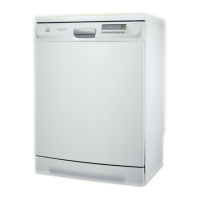


 To Next Page