This document is an installation and instruction manual for Electrolux washing machines, specifically models EW 705 F and EW 803 F. It provides comprehensive information on the appliance's function, technical specifications, usage, and maintenance.
Function Description
The Electrolux washing machines EW 705 F and EW 803 F are designed for washing various types of laundry, including cotton, linen, synthetics, delicate fabrics, and wool. They offer a range of washing programs and temperature settings to cater to different fabric types and soil levels. The machines feature a washing powder dispenser drawer with separate compartments for prewash, main wash, bleach, and softener. Control is managed through a temperature selection dial, a programme selection dial, and various buttons for specific functions like "RINSE HOLD," "HALF LOAD," and "NO SPIN." A pilot lamp indicates when the machine is in operation. The door is equipped with a safety device that releases 1-2 minutes after the program ends.
Important Technical Specifications
Both models, EW 705 F and EW 803 F, share identical technical specifications:
- Dimensions:
- Height: 85 cm
- Width: 60 cm
- Depth: 52 cm
- Voltage/Frequency: 220-230V / 50Hz
- Maximum Power Absorbed: 2250 W
- Fuse Minimum Power: 10 A
- Water Pressure:
- Min: 5 N/cm²
- Max: 80 N/cm²
- Maximum Recommended Load:
- Cotton, linen: 5 kg
- Synthetics, delicate fabrics: 2 kg
- Wool: 1 kg
- Spin Speed (Maximum):
- EW 705 F: 600 rev./min.
- EW 803 F: 800 rev./min.
The appliance conforms to E.E.C. directive N. 87/308 of 2/6/87 regarding the suppression of radio interference.
Usage Features
The manual outlines a clear operation sequence:
- Place the laundry in the drum: Open the loading door, place garments flat, and close the door securely.
- Measure out the washing powder: Pull out the drawer, measure detergent into the compartment marked with the main wash symbol. If prewash is selected, place powder in the prewash compartment.
- Measure out the additives: Pour softener into its compartment and, if required, bleaching agent into its compartment, ensuring not to exceed the maximum level.
- Select the temperature: Press and turn the thermostat dial to the desired temperature. Recommended temperatures for various laundry types are provided in the program tables. A cold wash setting (position '*') is available for lightly stained laundry to save electricity.
- Press the button/s required: Select any additional functions like "RINSE HOLD," "HALF LOAD," or "NO SPIN."
- RINSE HOLD: Blocks water drainage of the last rinse for synthetic or delicate fabrics to prevent creasing. Press again to drain water.
- HALF LOAD: Reduces water consumption on the rinse cycle for smaller loads of cottons or linens (max 2.5 kg). Can be used with Programme F for rinsing small loads.
- NO SPIN: Excludes all spin phases for particularly delicate cotton or linen clothes.
- Select the programme: Press and turn the programme dial clockwise to the desired washing programme.
- Start the machine: Plug into the mains, turn on the water tap, check drain hose positioning, and pull the programme selector dial outwards. The pilot light will illuminate.
- At the end of the programme: The machine stops automatically, and the pilot light goes out. Push the programme selector dial in. The door releases 1-2 minutes after the program. Unplug the appliance, turn off the water tap, depress any active buttons, open the door, and remove laundry. Leave the door ajar to allow vapor to escape.
Washing Hints:
- Sorting: Consult clothes labels for symbols. Do not mix coloured garments with whites. Treat anticrease materials as synthetics, and non-resistant fabrics as delicate. Use the specific wool program for "pure new wool" garments.
- Prewash: Generally not needed, but useful for very soiled laundry.
- Temperatures: Wash white fabrics at 60°C instead of 95°C for energy saving, unless heavily soiled. Colour-resistant fabrics can be washed at 40°C. Dark coloured synthetics, delicate fabrics, and wool should be washed below 40°C. The user is responsible for damage from incorrect temperature selection.
- Load: Max 5 kg for cotton/linen, 2 kg for synthetics, 1 kg for wool. For practical loading: drum full without pushing for cotton/linen; not more than two-thirds full for resistant synthetics; not more than half full for delicate fabrics/wool.
- Before loading: Mend tears, fasten/remove loose buttons, close poppers/zips, empty pockets, remove curtain hooks. Wash new coloured items separately. Treat difficult stains with stain remover before washing. Ensure volatile cleaning fluids evaporate before washing.
- Detergents: Use powder or liquid detergents suitable for washing machines. Avoid soap or hand-washing products. Liquid detergents are recommended for low temperatures (30-40°C), while powder detergents are better for higher temperatures (60-95°C). Powder detergent is required for prewash. Use specific products for machine-washable coloured, delicate, and wool fabrics. Liquid softener can prevent static electricity in synthetic fabrics.
- Concentrated powder detergents: Measure directly into the drum before loading. Avoid prewash programs when using concentrated detergents. Do not use proportioners supplied with detergents inside the drum.
- Quantity of detergent: Follow manufacturer's instructions, adjusting for water hardness and load size (reduce by 25% for half loads). Increase quantity for hard water or use a softening agent.
International Wash Care Symbols:
The manual includes a comprehensive chart of international wash care symbols covering:
- Washing: Strong wash (95°C, 60°C, 40°C, 30°C), Delicate wash (95°C, 60°C, 40°C, 30°C), Hand wash, Do not wash.
- Bleaching: Bleach in cold water, Do not bleach.
- Ironing: Hot iron max 200°C, Warm iron max 150°C, Lukewarm iron max 110°C, Do not iron.
- Dry Cleaning: Dry cleaning in all solvents, Dry cleaning in perchlorethylene petrol pure alcohol R111 and R113, Dry cleaning in petrol pure alcohol and R113, Do not dry clean.
- Drying: Flat, On the line, On clothes hanger, Normal drying, Delicate drying, Tumble dry, Do not tumble dry.
Maintenance Features
Regular maintenance ensures optimal performance and longevity of the appliance:
- External cleaning: Clean the machine exterior with lukewarm water and detergent. Rinse with clean water and dry with a soft cloth. Do not use abrasive products, methylated spirit, diluents, or similar products.
- Cleaning the washing powder dispenser drawer: Periodically flush the drawer under a fast running tap to remove detergent and softener deposits. To remove the drawer completely, press the left end button. The upper part of the additive compartment can be removed for easier cleaning.
- Cleaning the drawer recess: Clean detergent deposits in the drawer recess using an old toothbrush. Replace the drawer and run a rinse cycle without clothes.
- Water drain filter: The filter collects threads and small objects. Obstruction can cause program irregularities. It should be cleaned periodically. Open the filter door, place a bowl underneath, unscrew the filter, remove it, and clean it carefully under a fast running tap.
- Water inlet filter: If the machine fills slowly, the water inlet filter may be clogged. Turn off the water tap, unscrew the inlet hose, remove the filter with pincers, clean it with a brush, and replace it, tightening the hose ring securely.
Troubleshooting ("Something Not Working?")
The manual provides guidance for common issues:
- Machine does not start up (pilot light off): Check if the door is closed, fuse is intact, and if another high-power appliance (like a tumble drier) is plugged into the same socket.
- Machine does not start up (pilot light on): Check if the water tap is on, water supply is regular, inlet hose is not bent/caught, and water inlet filter is not clogged.
- Machine empties as it fills: Check if the drain hose end is too low.
- Machine does not drain and/or spin: Check if the drain hose is caught/bent or if the drain filter is clogged.
- Machine leaks: May be due to too much washing powder, unsuitable washing powder (too much foam), or leaks from water inlet hose locking rings.
- Machine vibrates or is noisy: Verify that all internal packings have been removed, the machine is not leaning against anything, and the feet are well-grounded and lock nuts are tightened.
If problems persist after these checks, users are advised to contact an authorized Service Centre, providing the type of fault, product number, and serial number.

 Need help?
 General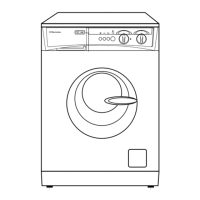


 To Next Page