EasyManua.ls Logo

Elitech CLD-100 - User Manual

Elitech CLD-100
2 pages
Print Icon
To Next Page IconTo Next Page
Loading...
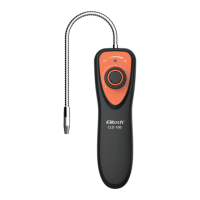
CLD-100
HALOGEN LEAK DETECTOR
Instruction Manual
General Information
Incorporated with advanced leak detection technology, CLD-100 is
Detect all kinds of halogen refrigerants
an ideal and economic halogen leak detector.Compact in appearance,
it is stable and easy to operate.
Sensitivity can be adjusted at any time and the detector can be adjusted
automatically to the best state of detection.
Inner precise IC with ultra-low circuit consumption offers more stable
function and lengthens battery life.
Two-color visual display of battery voltage.
Exce
llent sensor brings high sensitivity and longer service time.
General Information
Detection Range
Battery lndicator
The forepart light of panel indicates the leak and the battery voltage.
GREEN Battery voltage is normal, sufficient for proper operation.
ORANGE Battery voltage is approaching the lower threshold for
operation.
Replace them as soon as possible.
CFCs e.g.R12,R11,R500,R503 etc.
HCFCs e.g.R22,R123,R124,R502 etc.
HFCs e.g.R134a,R404a,R125 etc.
Blends such as AZ-50, HP62, MP39 etc.
Detect Ethylene Oxide gas leaks in hospital sterilizing equipment
(it will detect the halogena
ted carrier gas).
Detect SF-6 in high voltage circuit breakers.
Detect most gases that contain Chlorine, Fluorine and Bromine(ha
logen gases).
Detect cleaning agents used in dry cleaning applications such as
perchloroethylene.
Detect halogen gases in fire-extinguishing system.
Operating temperature:
Maximum sensitivity:
Battery life:
Response time:
Work mode:
Fixed probe length:
Warm-up time:
Reset time:
Power supply:
0 to 52(30 to 125)
6 gr/yr, for all halogenated refrigerants
approximately 20 hours in normal use.
inst
antaneous.
continuous, no limitation.
20cm.
approximately 6 seconds.
2-10 seconds.
6V DC, four AAA excellent batteries.
The CLD-100 may also be used to detect leaks in other systems and storage
/recovery containers.It will respond to all halogenated (including Chlorine and
Fluorine) refrigerants. This includes but is not limited to:
All manuals and user guides at all-guides.com
all-guides.com
Question and Answer IconNeed help?

Do you have a question about the Elitech CLD-100 and is the answer not in the manual?

Summary

General Information

Advanced Leak Detection Technology

Incorporates advanced leak detection technology for economic halogen leak detection.

Device Features and Benefits

Highlights compact design, adjustable sensitivity, stable IC, visual battery display, and high-sensitivity sensor.

Specifications and Detection Capabilities

Operating Specifications

Details operating temperature, sensitivity, battery life, response time, work mode, probe length, warm-up, reset, and power supply.

Detection Range and Applications

Lists detectable halogenated refrigerants (CFCs, HCFCs, HFCs), Ethylene Oxide, SF-6, and other halogen gases.

Battery Indicator Functionality

Explains the meaning of green and orange indicator lights for battery voltage levels.

Device Structure and Operation

Component Identification

Identifies key components: sensing tip, flexible probe, indicator light, power/sensitivity faucet, buzzer, shell, and battery compartment.

Detection Method Guidelines

Provides instructions on system preparation, probe movement, leak verification, and automotive A/C system leak testing.

Operating Instructions and Maintenance

Basic Operating Procedure

Steps for switching on, verifying battery, adjusting sensitivity, and recognizing leak alerts.

Operational Tips

Advice on sensitivity adjustment, handling windy areas, and avoiding contact with moisture/solvents.

Maintenance and Care

Guidance on keeping the sensing tip clean, replacing it, and proper storage procedures.

Important Warnings

Alerts regarding electric shock during tip replacement and warranty voidance for opening the detector.

Overview

The Elitech CLD-100 is a compact, stable, and easy-to-operate halogen leak detector, incorporating advanced leak detection technology. It is designed for detecting various halogen refrigerants and can also be used to identify leaks in other systems and storage/recovery containers that utilize halogenated gases.

Function Description

The primary function of the CLD-100 is to detect leaks of halogenated refrigerants. It can identify leaks from CFCs (e.g., R12, R11, R500, R503), HCFCs (e.g., R22, R123, R124, R502), HFCs (e.g., R134a, R404a, R125), and blends such as AZ-50, HP62, MP39. Beyond refrigerants, the device is capable of detecting:

  • Ethylene Oxide gas leaks in hospital sterilizing equipment (by detecting the halogenated carrier gas).
  • SF-6 in high voltage circuit breakers.
  • Most gases containing Chlorine, Fluorine, and Bromine (halogen gases).
  • Cleaning agents used in dry cleaning applications, such as perchloroethylene.
  • Halogen gases in fire-extinguishing systems.

The detector features an automatic circuit and a reset function, allowing it to ignore ambient concentrations of halogen gases. Upon initial power-on, the detector automatically sets itself to ignore the current refrigerant level at the tip within 6 seconds, entering an optimal detection state. This enables the user to find higher concentration leaks more conveniently. The device also features a vari-speed sensitivity adjustment, which can be adjusted during detection without interruption. When a refrigerant leak is detected, the buzzer changes to a "siren" type sound, and the indicator light flashes quickly, with the intensity of the siren correlating to the amount of leaked refrigerant.

Important Technical Specifications

  • Operating Temperature: 0°C to 52°C (30°F to 125°F)
  • Maximum Sensitivity: 6 gr/yr for all halogenated refrigerants.
  • Battery Life: Approximately 20 hours in normal use.
  • Response Time: Instantaneous.
  • Work Mode: Continuous, no limitation.
  • Fixed Probe Length: 20 cm.
  • Warm-up Time: Approximately 6 seconds.
  • Reset Time: 2-10 seconds.
  • Power Supply: 6V DC, requiring four AAA excellent batteries.

The device incorporates an inner precise IC with ultra-low circuit consumption, contributing to more stable function and extended battery life. A two-color visual display indicates battery voltage: GREEN signifies normal voltage, while ORANGE indicates the voltage is approaching the lower threshold, requiring battery replacement.

Usage Features

The CLD-100 is designed for user-friendliness.

  • Power On/Off and Sensitivity Adjustment: The device is switched on via a faucet that also controls sensitivity. Upon activation, the buzzer emits a discontinuous beep.
  • Battery Check: Users can verify the battery voltage level by observing the power indicator.
  • Sensitivity Adjustment: Sensitivity can be adjusted at any time during operation by turning the faucet clockwise for higher sensitivity or counterclockwise for lower sensitivity. It's important to note that higher sensitivity isn't always better, especially in non-fresh air environments, as it can lead to improper alarms.
  • Leak Detection Process: The detector is ready for leak detection 6 seconds after being switched on. When a leak is detected, the buzzer's sound changes to a "siren" type, and the indicator light flashes. The user should then verify the leak location by continuously detecting until the source is pinpointed.
  • Detection Method Guidelines:
    • Ensure the air conditioning or refrigeration system is charged with sufficient refrigerant (at least 340 Kpa/50 psi) and that the temperature is above 15°C (59°F) for accurate measurements.
    • Avoid contaminating the sensing tip; if the part being tested is dirty or has condensate, wipe it with a dry shop towel or blow it off with shop air. Do not use cleaners or solvents.
    • Visually inspect the entire refrigerant system for signs of lubricant leakage, damage, or corrosion.
    • Follow a continuous path around the refrigerant system to avoid missing potential leak areas.
    • Move the probe around the location at a rate of no more than 25 to 50 mm/second (1-2 in/second) and no more than 6 mm (1/4 in) from the surface for optimal detection. Slower and closer movement improves accuracy.
    • To verify an apparent leak, blow shop air into the area if necessary, then repeat checking. For very large leaks, blowing out the area can help pinpoint the exact location. Reset the probe in fresh air, then hold it close to the indicated leak source and move slowly to confirm.
    • For automotive A/C systems, test the evaporator core by running the A/C fan on high for 15 seconds, shutting it off, waiting 10 minutes for refrigerant accumulation, then inserting the probe into the fan resistor block, condensate drain hole, or other openings to the evaporator.
    • Always shut down the engine when detecting automotive A/C system leaks.
    • Perform a leak test after any service that disturbs the refrigerant system.
  • Operating Tips:
    • Adjust to higher sensitivity when leaks are hard to find, and lower sensitivity if the detector runs unstably.
    • If the buzzer alarms and the sensing tip remains at the detected part for too long, the circuit will equalize, potentially losing the alarm.
    • In windy areas, shield the potential leak area to improve detection.
    • Avoid contact between the sensing tip and moisture or solvents, as this can trigger false alarms.

Maintenance Features

Proper maintenance is crucial for prolonging the detector's lifespan and ensuring accurate operation.

  • Sensing Tip Care: Keep the sensing tip clean from dust, moisture, and grease. If dirty, it can be cleaned by immersing it in a mild solvent like alcohol for a few seconds, then cleaning with compressed air or a towel. Never use solvents such as gasoline, turpentine, or mineral spirits, as they can leave detectable residue and desensitize the detector.
  • Sensing Tip Replacement: The sensing tip will eventually wear out. Its lifespan depends on usage conditions and frequency. It should be replaced when the alarm sounds or becomes erratic in a clean environment.
  • Battery Storage: Remove batteries if the detector will be unused for a long period.
  • Troubleshooting: If the detector doesn't work, check for stable battery connection and sufficient voltage. Also, inspect the sensing tip for cleanliness and stable connection to the probe.
  • Warranty: Opening the detector by the user is beyond the warranty service.
  • Safety Warning: Always turn off the detector before replacing the sensing tip to avoid mild electric shock.

Elitech CLD-100 Specifications

General IconGeneral
BrandElitech
ModelCLD-100
CategorySecurity Sensors
LanguageEnglish