
 Need help?
Do you have a question about the Elka MK88 and is the answer not in the manual?
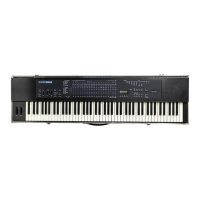
Key features and capabilities of the master control keyboard, including MIDI control, presets, and real-time functions.
Details on MIDI OUT/IN ports and how MIDI data is transmitted for controlling external equipment.
Connecting external pedals, footswitches, and RAM cartridges for expanded functionality.
Managing keyboard zones (splits) and setting their boundaries for layered sounds.
Setting transmission channels for split zones and adjusting musical pitch.
Configuring keyboard touch sensitivity and dynamic response curves.
Utilizing polyphonic aftertouch for expressive control over notes.
Assigning Footswitch, Function Keys, Pedals, Sliders, and Wheels to control functions.
Setting up delay/echo effects and recording/playing sequences.
Creating and editing names for saved setups using insert and delete functions.
Configuring MIDI data for specific performance presets.
Understanding the structure of Performance Presets and Banks.
Storing programmed settings (Split, MIDI, etc.) into memory.
Choosing and loading previously saved performance presets.
Transferring entire banks of performance presets between memories.
Protecting memory banks from accidental cancellation or modification.
Creating and storing sequences of performance presets.
Modifying performance sequences by substituting or inserting presets.
Using MIDI IN to extend the keyboard with external devices.
Defining the range for external devices used with split zones.
Programming custom commands for footswitches, keys, pedals, sliders, and wheels.
Linking MIDI controllers to specific functions and values.
Using HEX codes to detune a split zone via pitch command.
Applying tuning adjustments using HEX codes.
Sending OMNI ON status messages via HEX.
Sending Tune Request messages to synthesizers via HEX.
Controlling preset changes and silencing all notes.
Restoring and comparing edited performance presets.
Explanation and interpretation of MIDI HEX codes.
Diagrams illustrating various MIDI setup configurations.
Details on hardware accessories and managing data via MIDI dump.
A reference chart for MIDI status bytes and controller numbers.
 General
| Keyboard | 88 keys, Weighted |
|---|---|
| Display | LCD |
| Weight | 22 kg |
| Connectivity | MIDI In/Out |
| Power Supply | External Power Adapter |
| Dimensions | 1370 x 355 x 120 mm |

 To Next Page
