PRACTICE
FIRST
Practice spraying water
on
wood or cardboard. This will enable
you to understand the paint sprayerand become familiar with its
functions. Follow the instructions to
ad
just to the correct spray
pattern that suits you.
1.
Make
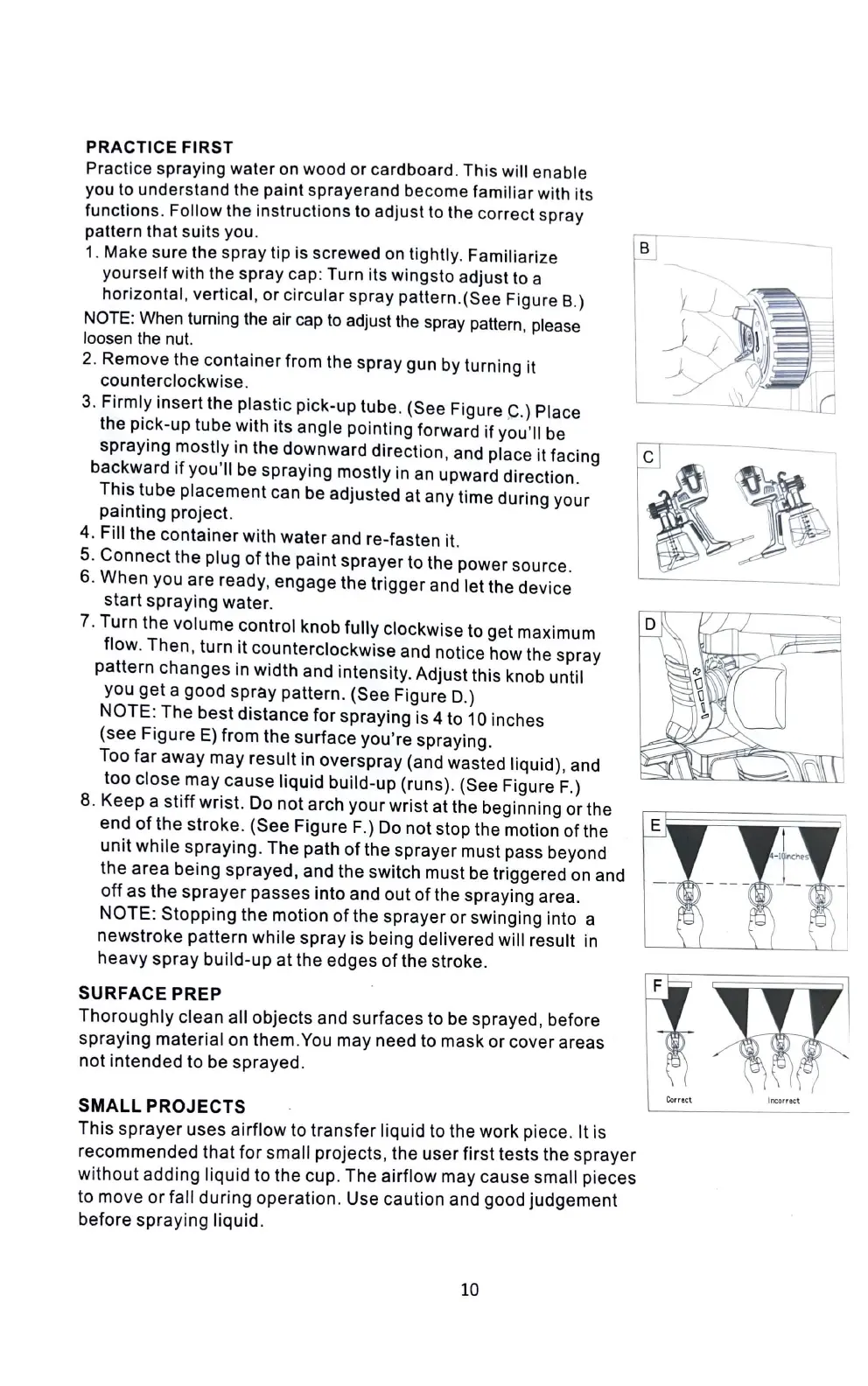
sure the spray tip is screwed on tightly. Familiarize
yourself with the spray cap: Turn its wings to adjust to a
horizontal, vertical, or circular spray pattern.(See Figure B.)
NOTE
:
When
turning
the
air
cap
to adjust
the
spray pattern, please
B
loosen
the
nut.
2.
Remove the container from the spray gun by turning it
counterclockwise.
3. Firmly insert the plastic pick-up tube. (See
Figure~
-) Place
the pick-up tube with its angle pointing forward
if
you'll be
spraying mostly in the downward direction, and place it facing
backward
if
you'll be spraying mostly in an upward direction.
This tube placement can be adjusted
at
any time during your
painting project.
4. Fill the container with water and re-fasten it.
5.
Connect
the plug
of
the paint sprayer to the power source.
6. When you are ready, engage the trigger and let the device
start spraying water.
7. Turn the volume control knob fully clockwise to get maximum
flow
. Then, turn
it
counterclockwise and notice how the spray
pattern changes in width and intensity. Adjust this knob until
you
get
a good spray pattern. (See Figure D.)
NOTE: The
best
distance for spraying is 4 to 1
O
inches
(see Figure E) from the surface you're spraying.
Too
far
away may result in overspray (and wasted liquid), and
too close may cause liquid build-up (runs). (See Figure F.)
8. Keep a
stiff
wrist. Do
not
arch your wrist
at
the beginning
or
the
end
of
the stroke. (See Figure F.) Do not stop the motion
of
the
unit
while
spraying. The path
of
the sprayer must pass beyond
the area being sprayed, and the switch must be triggered on and
off
as
the
sprayer
passes into and out
of
the spraying area.
NOTE: Stopping the motion
of
the sprayer
or
swinging into a
newstroke pattern while spray is being delivered will result in
heavy
spray build-up
at
the edges
of
the stroke.
SURFACE PREP
Thoroughly clean all objects and surfaces to be sprayed, before
spraying material on them.You may need to mask
or
cover areas
not intended to be sprayed.
SMALL PROJECTS
This
sprayer
uses airflow to transfer liquid to the work piece. It is
recommended that
for
small projects, the
user
first tests the sprayer
without adding liquid to the cup. The airflow may cause small pieces
to move
or
fall
dur
ing operation. Use caution and good judgement
before spraying liquid.
10
C
y
_)
J J
_J
\
-
~
C<irrect
Inco
rrect


 To Next Page
 Loading...