32
GB
B
A
A
A
Fig. 7.3
Fig. 7.6
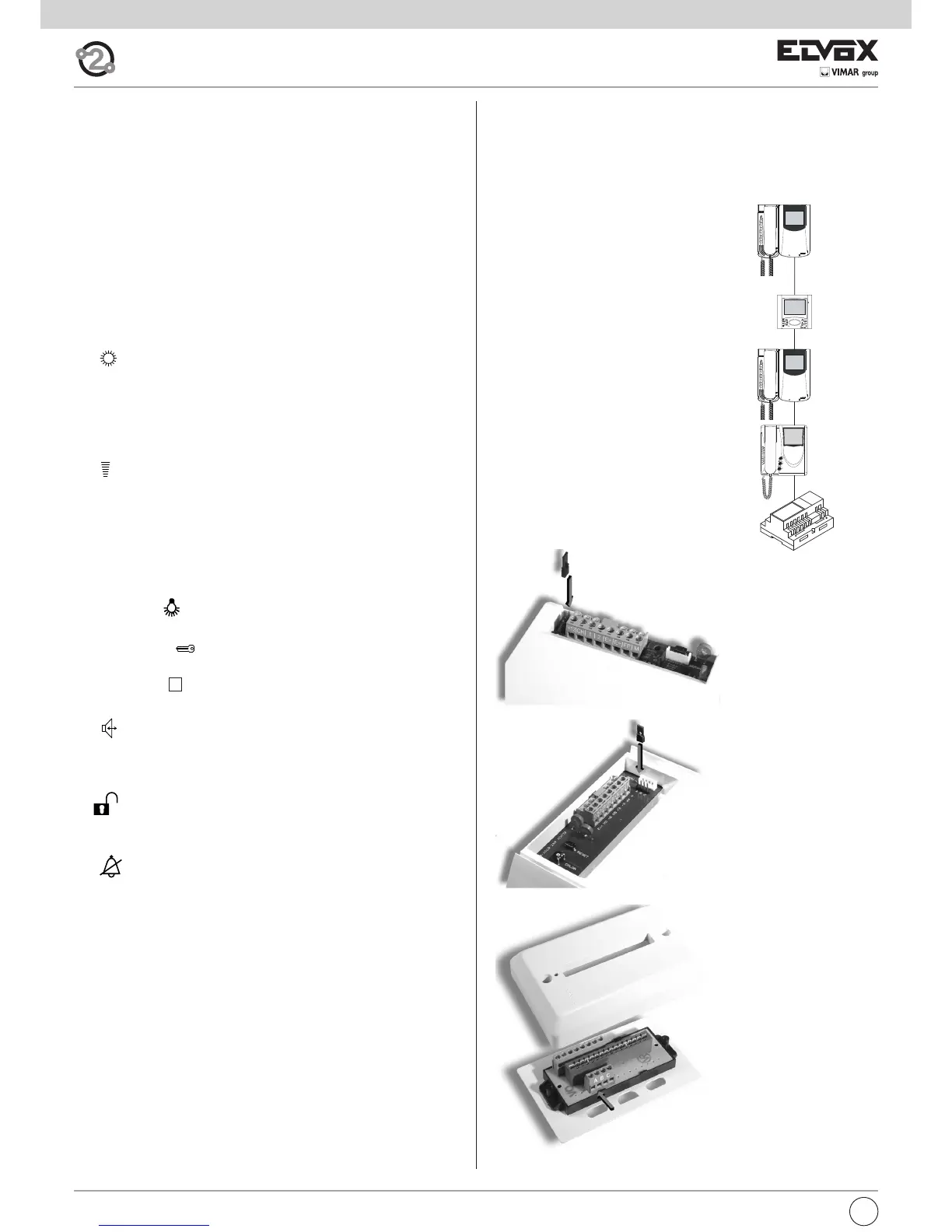
Connection and connector terminal board
+12, CH) Additional ringtone connection.
1, 2) BUS line.
E+, E- ) Additional supply voltage for video-interphone with power
supply type 6923.
FP, M) Connection for landing call push-button.
Fig. 7.5
Fig. 7.4
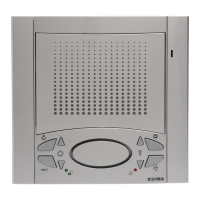
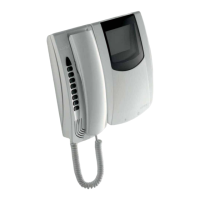
type 6621
type 6611
type 6721
type 6711
type 662C
type 661C
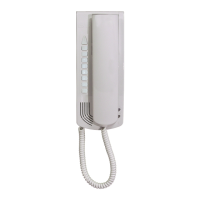
Video interphone technical specifications
- Video interphone in ABS.
- Removable terminal block.
- Flat 3,5" LCD screen.
- Electronic circuit on interchangeable cards.
- PAL standard video signal.
- Operating temperature from 0° to +40° C.
- Electronic ringtone.
- Input for landing calls with different ringtone from entrance panel calls.
- Output for additional ringtone type 860A.
- Supply voltage provided by bus.
-
Input for additional power supply (type 6923) if the system is configured to
enable simultaneous activation of more than two video interphones.
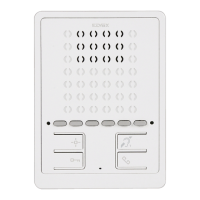
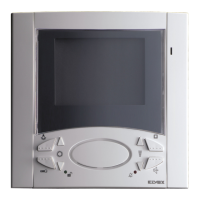
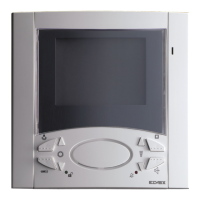
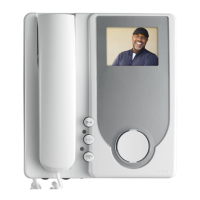
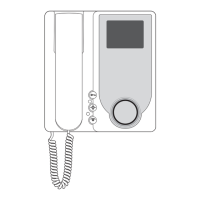
Controls and adjustments
A) Screen 3,5" LCD monitor.
B) Microphone.
C) Loudspeaker.
D) Pair of push-buttons.
1) When the video interphone is ON, the push-buttons can be used to
adjust the brightness.
2) When the video interphone is OFF, the push-buttons can be used to
select the tune for calls from a speech unit only. To program the tune:
hold 1 of the 2 push-buttons down for at least 2 seconds, and press the
push-buttons again repeatedly to select the desired tune.
E) Pair of push-buttons
1) In conversation with the “I” push-button pressed, press the “E”
push-buttons to increase or decrease the volume of the internal audio.
2) In rest position they adjust the chime volume: keep pressed for at
least 2 seconds one of the two “E” push-buttons, press repeatedly the
push-buttons to increase or decrease the chime volume. The “E” push-
buttons adjust the chime volume even during the immission of the in-
ternal or external call sound. Once the sound emission has been
ended, they adjust the contrast while the screen is switched on.
F) Push-button : for activating 1st auxiliary service if connected by
means of 692RH (e.g. stair lights).
G) Push-button : to open the lock and terminate any conversation
in progress.
H) Pushbutton : for self-sttype It allows installation selfactivation
from the inside without call from the entrance panel.
I) Two-channel conversation push-button: after the call and/or
switch-on of the monitor press the pushbutton once to activate the
audio. Pressing it once again the conversation terminates.
The red LED remains lit for the whole conversation dwell.
L)
Door open LED: the red led is lit when at least one door/gate is
open, it turns off when all doors are close (the function is optional according
to the type of installation).
M) 'Ringtone mute' LED: if the red LED lights up, this indicates that
the call is disabled (see point "E").
The red LED also remains lit for the entire duration of the conversation,
i.e. while the audio is active.
N) Push-buttons: for activation of auxiliary services or intercommunica-
ting calls (in function of the programming).
N.B. On the back of the video interphones type 6611 and 6711 is a RESET
push-button for use during programming. On video interphone 661C the
RESET push-button is on the bottom of the table-top conversion kit; all are
equipped with the A-B-C connectors for stabilising the video signal.
VIDEO SIGNAL STABILISATION
On the rear of monitor type 6611 and 6711
there are some connectors (A-B-C) for the
video signal stabilization.
For the table version monitors type 661C the
video signal stabilization is carried out by
means of a jumper on terminal block A-B-C
present on the stud. For types 6611, 6711 and
661C this jumper must be used in installations
with several appliances (interphones and mo-
nitors) connected in series (Fig. 7.3).
In series configuration displace the jumper (only
in the last set) into “B” position and keep the
jumpers of other interphones or monitors in the
initial position, i.e. “A” (Fig. 7.3).
For other wiring configurations see note: "Bus
termination for ELVOX TWO-WIRE installations"
provided (Page. 44).


 To Next Page
 Loading...