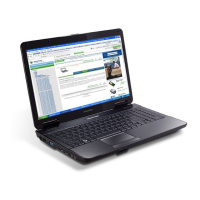
This document is a Service Guide for the eMachines E630/E430 Series notebooks, providing technical information for maintenance and repair.
Function Description:
The eMachines E630/E430 Series notebooks are portable computing devices designed for general use. They feature a range of processors, display options, memory configurations, and storage capabilities, making them suitable for various tasks. The service guide details the internal components, their disassembly and replacement procedures, and troubleshooting steps to address common issues.
Important Technical Specifications:
- Processors: AMD Sempron™ single-core processor*, AMD Athlon™ 64 X2 dual-core processor*, AMD Athlon™ 64 single-core processor*, AMD Turion™ dual-core processor*.
- Chipset: AMD Tigris RS880M + SB710.
- Operating System: Genuine Windows® 7™.
System Memory:
- Controller: 128-bit DDR2 SDRAM controller operating at up to 333 MHz.
- Slots: Up to 2 unbuffered SO-DIMM slots supporting DDR II 667/800.
- VGA Memory: Adjustable Maximum 128MB UMA VGA memory shared from North Bridge.
- Maximum Memory: 2GB per slot; 4GB total.
- Cache: On-board cache up to 1MB.
Display:
- Panel Options: 15.6" LCD CCFL/LED panel for NDWG0, 17" LED for NDWHO.
Graphics:
- GPU: ATI Radeon™ HD 4200 Graphics.
Storage Subsystem:
- Hard Disk Drive: 2.5" hard disk drive.
- Card Reader: Multi-in-1 card-reader (supports Secure Digital (SD), MultiMediaCard (MMC), Memory Stick (MS), Memory Stick PRO (MS PRO), xD-Picture Card (xD)).
Optical Drive:
- Type: DVD-Super Multi double-layer drive.
Audio:
- Codec: Realtek ALC272X-GR for High Definition Audio Codec with Dolby Digital Live.
- Speakers: Internal speakers x2 (2W).
- Jacks: Mic-in jack, Headphone/Line out jack.
Dimensions and Weight:
- Dimensions: 372.3mm x 246.5mm x 26.8mm/40.6mm with ID.
- Weight: 2.7kg (for 15.6" LCD/6-cell battery/super-multi ODD configuration).
Communication:
- Wireless: 802.11b/g/n WLAN/WiMax, Mini PCIE Wireless LAN module with mini card slot, Dual-Band built-in Antenna for Wireless LAN.
- LAN: Atheros AR8132L for 10/100 LAN, PCI-E 10/100M LAN, WOL (AC mode S5) support.
- Modem: External USB 2.0 modem, Support Wake on Ring (S3).
Privacy Control:
- Security: BIOS user, supervisor, HDD passwords, Kensington lock slot (7.5mm).
Power Subsystem:
- ACPI: ACPI 3.0.
- Battery: 48.8 W 4400 mAh PSE-certified battery.
- AC Adapter: 3-pin 65 W AC adapter.
- Energy Star: ENERGY STAR* compliant.
Special Keys and Controls:
- Keyboard: 99-/100-/103-key keyboard.
- Functionality: Supports Application keys for Windows XP/Linux version, Support for Home key and Application keys for Windows XP/Linux version, Multi-language support.
I/O Interface:
- Video: VGA port, 15 pins.
- Power: DC-IN port for adapter.
- Network: RJ-45 Ethernet port for LAN.
- USB: 2 USB ports.
- Audio: Headphone out / Line-out, Microphone-in.
- Card Reader: Multi-in-1 card reader (SD™, MMC, MS, MS PRO, xD).
Environment:
- Temperature (Operating): 5 °C to 35 °C.
- Temperature (Non-operating): -20 °C to 65 °C.
- Humidity (Operating, non-condensing): 20% to 80%.
- Humidity (Non-operating, non-condensing): 20% to 80%.
Usage Features:
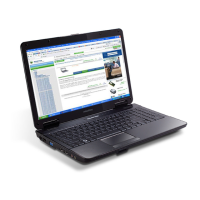
- Front View: Includes an integrated webcam (for selected models), display screen (LCD), touchpad toggle button, power button, wireless LAN communication button/indicator, speakers, and keyboard.
- Closed Front View: Features power and battery indicators visible even when the computer cover is closed, and a multi-in-1 card reader.
- Rear View: Contains ventilation slots for cooling.
- Left View: Provides DC-in jack, Ethernet (RJ-45) port, external display (VGA) port, USB 2.0 ports, microphone-in jack, and headphones/speaker/line-out jack.
- Right View: Houses the optical drive, optical disk access indicator, optical drive eject button, emergency eject hole, and Kensington lock slot.
- Bottom View: Features the battery bay, battery release latch, battery lock, hard disk bay, memory compartment, and ventilation slots/cooling fan.
- Indicators: Power, battery, HDD, Num Lock, and Caps Lock indicators provide status information.
- Keyboard: Standard keyboard with lock keys (Num Lock, Caps Lock), embedded numeric keypad, Windows Keys, Hot Keys, and a Special Key for specific functions.
- TouchPad: A touch-sensitive pointing device with left and right click buttons.
- BIOS Setup Utility: Allows configuration of system information, main settings, security (passwords), boot options, and exit.
- BIOS Flash Utilities: Supports DOS Flash Utility and WinFlash Utility for updating the BIOS.
- HDD/BIOS Password Utilities: Tools for managing passwords.
Maintenance Features:
The service guide provides comprehensive instructions for disassembling, replacing, and reassembling various components, as well as troubleshooting common issues.
Disassembly and Replacement:
The guide outlines a detailed process for disassembling and reassembling the notebook, categorized into External Module Disassembly and Main Unit Disassembly.
External Module Disassembly Process:
- Removing the Battery Pack.
- Removing the SD Dummy Card.
- Removing the Lower Covers.
- Removing the Optical Drive Module.
- Removing the DIMM Modules.
- Removing the WLAN Module.
- Removing the Hard Disk Drive Module.
Main Unit Disassembly Process:
- Removing the Switch Cover.
- Removing the Keyboard.
- Removing the LCD Module.
- Removing the Upper Cover.
- Removing the Power Board.
- Removing the Left Speaker Module.
- Removing the Right Speaker Module.
- Removing the TouchPad Bracket.
- Removing the Mainboard.
- Removing the RTC Battery.
- Removing the Thermal Module.
- Removing the CPU Fan.
- Removing the CPU.
LCD Module Disassembly Process:
- Removing the LCD Bezel.
- Removing the Camera Module.
- Removing the LCD Panel.
- Removing the LCD Brackets and FPC Cable.
- Removing the Antennas.
Reassembly Procedures:
Detailed steps are provided for reassembling all modules in reverse order of disassembly, ensuring proper component placement and connection.
Troubleshooting:
The guide includes a dedicated section for troubleshooting common problems, such as:
- Power On Issue.
- No Display Issue.
- Random Loss of BIOS Settings.
- LCD Failure.
- Built-In Keyboard Failure.
- TouchPad Failure.
- Internal Speaker Failure.
- HDD Not Operating Correctly.
- ODD Failure.
- Wireless Function Failure.
- Thermal Unit Failure.
- External Mouse Failure.
- Other Failures (Intermittent Problems, Undetermined Problems).
- Post Codes (Sec, Memory, BDS & Specific action, Driver entry point, SmmDriver entry point).
Jumper and Connector Locations:
Provides diagrams and descriptions for jumper and connector locations on the Top View, Bottom View, and Power Board, essential for diagnostics and configuration.
BIOS Recovery:
- Clearing Password Check.
- Clear CMOS Jumper.
- BIOS Recovery by Crisis Disk.
FRU (Field Replaceable Unit) List:
Includes exploded diagrams for the E630/E430 series (Main Assembly, Base Assembly, Rear Assembly) and a comprehensive list of Field Replaceable Units with their part numbers.
Model Definition and Configuration:
Information on different model configurations.
Test Compatible Components:
Details on components tested for compatibility, including Microsoft® Windows® 7 Environment Test.
Directs users to downloads.emachines.com/userguides/ for service guide files and updates.
Important Notes for Maintenance:
- FRU Part Ordering: Users are advised to check the most up-to-date information on the regional web or channel when ordering FRU parts, as part numbers may change and not be reflected in the printed guide. eMachines-authorized service providers should use the list provided by their regional eMachines office.
- Localized Features: The service guide covers the basic configuration. Localized features (e.g., add-on cards, modems, extra memory) may not be covered and require contacting regional offices for technical details.
- Conventions: The manual uses specific conventions:
- SCREEN MESSAGES: Denotes actual messages that appear on screen.
- NOTE: Provides additional information.
- WARNING: Alerts to potential damage from specific actions or inactions.
- CAUTION: Gives precautionary measures to avoid hardware or software problems.
- IMPORTANT: Reminds users of specific actions for procedures.

 Need help?


 To Next Page
 General