AIRPLANE
OPERATIONS
MANUAL
FLIGHT PLANNING
EMB-145 A1 LB FAA
REVISION 39
1-05-45
Page
5
Code
06
AOM-145/1114
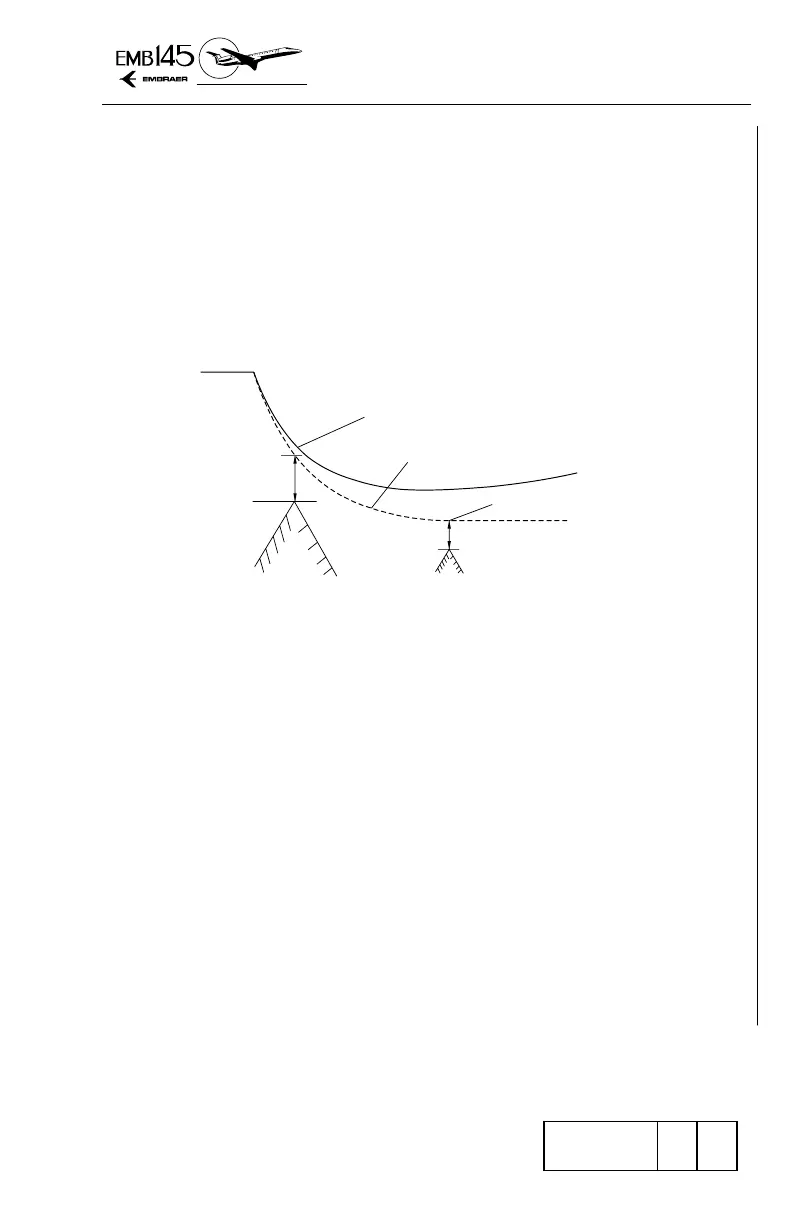
Regulations (FAR 121.191 / EU OPS 1.500) require that the airplane
be able to clear all terrain by a given margin when an engine fails. Two
means of compliance for en-route obstacle clearance are allowed:
– The net level-off altitude must clear all en-route obstacles by at least
1000 ft; or
– The net flight path must clear all en-route obstacles between the
point where the engine is assumed to fail and an airport where a
landing can be made by at least 2000 ft.
GROSS DRIFTDOWN PATH
NET LEVEL−OFF
NET DRIFTDOWN PATH
2000 ft
1000 ft
OBSTACLE
OBSTACLE
EM145AOM050048A.DGN
Prior to departure a detailed analysis of the route should be made
using contour maps of the high terrain and plotting the highest points
within the corridor’s width along the route (or, alternatively, using
Minimum En-Route Altitude, MEA, or Minimum Off Route Altitude,
MORA). The next step is to determine if it is possible to maintain level
flight with one engine inoperative 1000 ft above the highest point of the
crossing. If this is not possible, or if the associated weight penalties
are unacceptable, a driftdown procedure should be worked out, based
on engine failure at the most critical point and clearing critical
obstacles during the driftdown by at least 2000 ft. The minimum cruise
altitude and the point of no return (PNR) are determined by the
intersection of the two driftdown paths.
If an engine failure occurs after the PNR, the airplane will drift down on
course. If the failure occurs before PNR, the airplane will have to turn
back. In either flight direction the net flight path must clear the
obstacles by 2000 ft.



 To Next Page