WEIGHT AND
BALANCE
AIRPLANE
OPERATIONS
MANUAL
1-06-40
Page
4
Code
03
REVISION 29
EMB-145LR
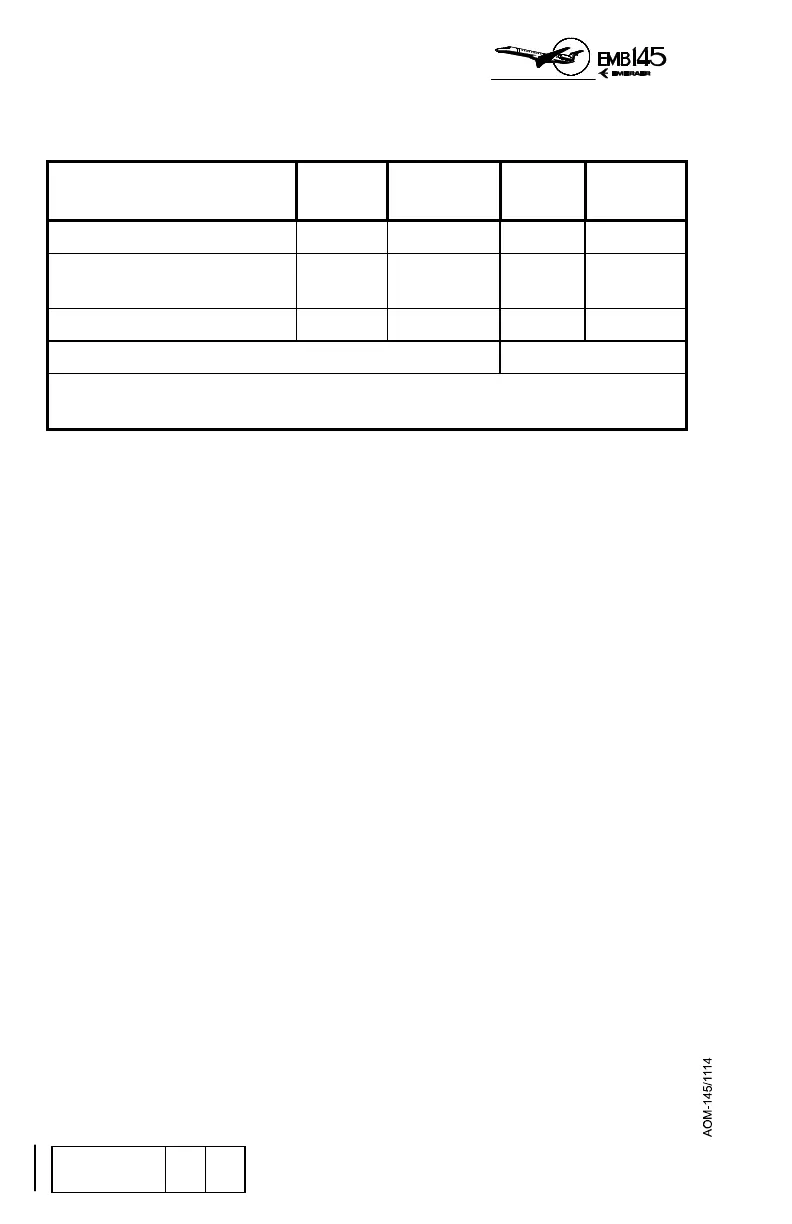
Aft Allowance Weight
(lb)
from Arm
(in)
to Arm
(in)
Moment
(lb.in)
Mid cabin pax to lavatory 170 * 522.83 811.02 +48992
Fwd attendant to aft
cabin
170 188.98 748.02 +95037
Trolley to aft cabin 88 218.50 767.72 +48331
Total = +192360
* Passenger is assumed to have no hand baggage when moving to
lavatory.
So the aft flight allowance will be +143368 lb.in taking the most
restrictive situation.
SEATING ALLOWANCES
Seating allowance is a result of uneven passenger distribution along
the cabin. If the mass of all passengers is assumed to be equally
distributed along the cabin, a margin (called seating allowance) must
be considered to compensate for the variation in passenger seating
locations. Manual load sheets usually use the Cabin Area Trim
method, where passengers are considered evenly distributed along the
passenger cabin, thus requiring seating allowance consideration.
The typical passenger loading sequence is based on the window and
aisle seating concept, according to which, for forward seating
allowances, window seats are filled from forward to aft and, after all
windows are occupied, the aisle seats are filled from the most forward
to the most aft. For aft seating allowances, the same concept is used
but with an aft-to-front filling sequence.
In order to determine the total seating allowance of the aircraft the
operator may divide the passenger cabin into zones. Each zone has its
own centroid where the total weight of the related passengers may be
concentrated. The centroid is determined by the weight average arms
of each passenger position considered inside each zone.



 To Next Page