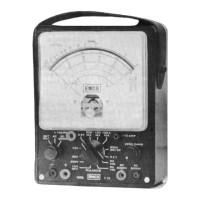
power when connecting or disconnecting the test leads. The meter and the leads must not be handled while the power is
on.
e. DC voltages are read on the black 0-10, 0-50, 0-250 scales marked D.C. When using the 10, 50, and 250 volt
ranges, the meter may be read directly. To obtain the indicated voltage in volts on the 2.5 volt range, divide the reading
on the 250 scale by 100. For readings on the 0.25 volt range, divide the reading on the 250 scale by 1000. On the 1000
volt range,
multiply the reading on the 10 scale by 100; on the 5000 volt range, multiply the reading
on the 50 scale by
100 to obtain the indicated voltage in volts.
AC Voltage Measurement
The instructions for AC voltage measurement are the same as those for DC voltage measurement, with the following
differences in procedure and reading.
a. Set the DC-AC-OUTPUT switch to the AC position.
b. To use the 5000 volt range, insert the test leads in the pin jacks marked "-" COMMON and A.C. 5000V.
CAUTION: Extreme care must be exercised when making measurement on the 5000 volt range, as high voltage is
dangerous. Never fail to turn off the power when connecting or disconnecting the test leads. The meter and the leads
must not he handled while the power is on.
c. Read the red 0-10, 0-50, 0-250 scale marked A. C. on all voltage ranges except the 2.5 volt range, which is read
on the red 0-2.5 scale marked 2.5V.A.C.
d. The reading of the meter scales corresponding to each range position is the same as for DC with the exception
of the special 2.5V.A.C. scale, which is numbered in tenths of a volt.
DC Current Measurement
CAUTION: Never place the instrument across a voltage source when it is set for current measurement. Failure to
observe this precaution may result in serious damage to the meter.
a. Set the DC-AC-OUTPUT switch to the DC position.
b. Set the RANGE switch to the current range that you can reasonably expect will include the current you are
measuring. If you are in doubt about the current present, always set the switch at the highest current range before
inserting the instrument in the circuit. Failure to observe this precaution may result in serious damage to the meter. If
the unknown current is too low for accurate measurement on the highest range, rotate the RANGE switch towards the
lowest current position until the range is found at which the current can be read accurately.
c. When a current is being measured on any range except the 10 amp. range, insert the test leads into the pin jacks
marked + (POSITIVE) and - COMMON and place the instrument in series with the component through
3


 To Next Page
 Loading...