Need help?
Do you have a question about the Emicon RAH MC HT Ka and is the answer not in the manual?
General notes on reproduction, usage, and company policies.
Details the manual's purpose and scope for selection, installation, use and maintenance.
Guidelines on keeping the manual accessible and updated.
Explains how to interpret symbols and use the manual safely.
Outlines potential hazards associated with the unit's components and operation.
Explains the meaning of warning, banned, and action required symbols.
Details specific safety pictograms and their meanings.
Defines the intended uses and restrictions for the machine.
Describes how to identify the unit via its rating plate.
Identifies refrigerant and oil, and discusses ecological information and exposure limits.
Provides guidance on safe handling of refrigerants and potential risks.
Emphasizes ventilation and avoiding exposure to high refrigerant vapor levels.
Outlines steps to take in case of a refrigerant leak.
Details health effects of refrigerant inhalation, skin/eye contact, and ingestion.
Provides immediate actions for exposure to refrigerants and subsequent medical advice.
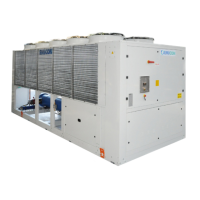
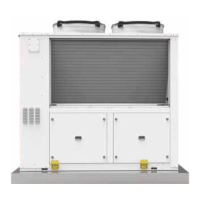
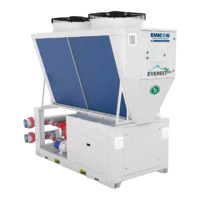
Details the unit's design for industrial/commercial cooling and high ambient temperatures.
Describes standard version and optional partial heat recovery (RP).
Explains various optional accessories available for the unit.
Presents detailed performance specifications, refrigerant charge, and electrical data.
Illustrates cooling capacity and power input correction factors based on operating conditions.
Defines the acceptable operating ranges for water flow, temperature, and ambient air.
Provides factors for adjusting performance based on glycol, water temperature difference, and fouling.
Lists sound power and pressure levels for different unit models.
Emphasizes trained personnel, safety precautions, and symbol usage during installation.
Focuses on workplace cleanliness, lighting, and ventilation requirements.
Lists essential PPE for operating and maintaining the unit.
Details checks before accepting the unit and procedures for reporting damage.
Provides instructions for storing the unit to prevent damage and deterioration.
Describes how to safely unpack the unit, warning about packaging hazards.
Offers recommendations for safe lifting and moving of the unit, noting sharp fins.
Specifies required clearances for installation and proper airflow.
Explains the function and connection of the RS485 interface for supervision.
Details requirements for water pipework installation, including insulation and connections.
Specifies water quality parameters to prevent corrosion and deposits.
Defines the minimum water volume required for proper unit operation.
Provides step-by-step instructions for filling the unit's water circuit.
Explains the procedure for draining the hydraulic circuit, especially for winter.
Describes the construction and corrosion resistance of the microchannel coils.
Identifies environments that can accelerate coil corrosion and recommends protective treatments.
Details the optional AiAX coating treatment for enhanced corrosion resistance.
Covers crucial safety aspects for electrical connections and power supply.
Lists electrical specifications for power supply, control boards, and cable sections.
Lists critical checks before powering on the unit to prevent damage.
Details default set-points and differential values for various safety and operational parameters.
Explains checks to perform during operation, like compressor rotation and sight glass color.
Describes the Hot Start function for managing high inlet water temperatures.
Explains the function and connection of safety valves, including discharge precautions.
Details methods for switching the unit on via keyboard or remote input.
Describes the unit's display visualization during cooling operation.
Explains how remote digital input controls unit ON/OFF status.
Instructs on how to switch the unit off using the keyboard.
Guides on how to view and modify operational set points.
Lists user-adjustable parameters like cooling set-point and password.
Explains how to view sensor-measured parameters using the PROBES key.
Describes how to view and manage alarms, including reset and password procedures.
Details how to view compressor and fan status using the CIRC key.
Shows compressor status, unloading, evaporating-condensing probe, and fan status.
Outlines the service menu options for accessing parameters and system information.
Explains how to access and modify service parameters with password levels.
Details adjustable parameters for set points, dynamic set points, and energy saving.
Describes the function to optimize efficiency by adjusting set points based on ambient temperature.
Covers parameters related to sanitary water temperature and anti-legionella cycles.
Explains the function for uploading/downloading parameters via HotKey.
Details settings for contrast, backlight, language, and system information.
Explains how to silence the unit's buzzer.
Highlights regulatory obligations, maintenance benefits, and safety precautions.
Specifies that access should be limited to authorized personnel and outlines site security.
Outlines periodic inspections and maintenance tasks according to regulations.
Lists specific checks for electrical, control devices, and refrigerant circuits by trained personnel.
Provides a schedule for checking electrical components, microprocessor, and connections.
Details maintenance tasks for coils, fans, water flow, and hydraulic circuit.
Outlines visual inspection, noise checks, voltage, connections, and oil level for compressors.
Explains how to clean microchannel coils to maintain performance and prevent corrosion.
Describes cleaning procedures for AiAX coated coils.
Provides instructions for draining the hydraulic circuit for long-term storage.
Covers refrigerant recovery, leak detection, and guidelines for component replacement.
Details safe disconnection procedures and environmental protection.
Explains how to dismantle, sort, recover, and dispose of unit components.
Covers regulations for electrical and electronic equipment disposal in the EU.
Provides a table of alarm codes, causes, and solutions for troubleshooting.
Shows dimensions and weights for the RAH 481 model.
Shows dimensions and weights for the RAH 571 model.
Shows dimensions and weights for the RAH 661 model.
Shows dimensions and weights for the RAH 761 model.
Shows dimensions and weights for the RAH 782 model.
Shows dimensions and weights for the RAH 832 model.
Shows dimensions and weights for RAH 841 and 941 models.
Shows dimensions and weights for the RAH 962 model.
Shows dimensions and weights for the RAH 1102 model.
Shows dimensions and weights for the RAH 1302 model.
Shows dimensions and weights for the RAH 1502 model.

 To Next Page
 General