
 Need help?
Do you have a question about the eMitter DC1600A and is the answer not in the manual?
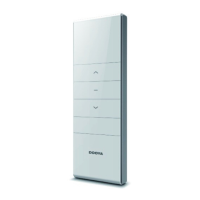
Details the physical buttons and appearance of the DC1600A emitter, including Up, Stop, Down, Lamp control, and Setting buttons.
Lists key technical parameters such as input voltage, transmitting frequency, power, operating temperature, and transmission distance.
Explains the transmitter's single-channel functionality, lamp control, and provides safety warnings regarding battery replacement and handling.
The DC1600A Emitter is a remote control device designed for operating tubular motors and controlling lighting. It features a user-friendly interface with distinct buttons for various functions, making it intuitive to use for both motor and lamp control.
The primary function of the DC1600A Emitter is to act as a wireless transmitter for controlling compatible tubular motors and lighting systems. It operates on a single channel, allowing for precise control over a specific motor or lamp. The device is equipped with four main control buttons: "Up," "Stop," "Down," and "Lamp control," along with a "Setting button" for configuration.
For motor control, the "Up" button typically initiates clockwise movement of the motor, while the "Down" button triggers counter-clockwise movement. The "Stop" button is used to halt any ongoing motor operation. This allows users to precisely position blinds, shades, or other motorized applications.
The "Lamp control" button is specifically designed for managing lighting. When paired with a compatible receiver that supports lamp control, this button allows users to cycle through different lighting states, such as turning the light bulb on and off. This provides a convenient way to manage ambient lighting from a single remote.
The "Setting button" is crucial for the initial setup and pairing of the emitter with the tubular motor. It facilitates the matching process, ensuring that the emitter can communicate effectively with the motor. This button is also used in conjunction with other buttons during the programming phase to define the motor's operational parameters.
The DC1600A Emitter is designed for ease of use and straightforward operation.
To match the emitter with a tubular motor, a specific sequence involving the "Setting button" is followed. The process typically involves pressing the "Setting button" twice in quick succession. During this setup phase, the motor provides audible feedback (a long sound) to indicate it's in programming mode. Subsequent presses of the "Setting button" (once) will cause the motor to "beep once," confirming the pairing. The time between these operations must be shorter than 4 seconds; otherwise, the device will exit the setting mode.
Once paired, the motor's operational direction can be set. Pressing the "Up" button will cause the motor to run or beep, indicating that the "Up" button will control the motor clockwise. Similarly, pressing the "Down" button will set it to control the motor counter-clockwise. This setup process ensures that the motor responds correctly to the "Up" and "Down" commands from the emitter. This matching process also deletes any previously programmed data from the motor, ensuring a clean slate for the new emitter.
For lamp control, the "Lamp control" button is used to cycle through the on and off states of the light bulb. Pressing the "Lamp control" button once will turn the lamp on, and pressing it again will turn the lamp off. This functionality is only available when the emitter is paired with a receiver that supports lamp control. The circular switching action makes it simple to manage lighting with a single button.
The emitter is powered by a 3V CR2450 lithium cell, which is easily accessible in the back of the device. The use of a standard battery type ensures convenient replacement when needed.
The DC1600A Emitter is designed for durability and minimal maintenance, but certain precautions and considerations are important for its longevity and optimal performance.
The device uses a CR2450 lithium cell. When the emission distance becomes noticeably short or the device becomes less sensitive, it is an indication that the battery needs to be replaced. It is crucial to replace the battery with the correct type to avoid the risk of explosion. Used batteries should be disposed of according to local instructions, promoting responsible recycling.
The emitter should not be exposed to moisture or subjected to strong impacts. Such exposure can negatively affect its lifespan and functionality. Keeping the device dry and protected from physical damage will ensure its continued reliable operation.
If the emission distance is significantly reduced or the device's sensitivity decreases, the first step in troubleshooting should be to replace the battery with a new, identical type. This often resolves performance issues related to power.
In summary, the DC1600A Emitter is a versatile remote control for tubular motors and lighting, featuring intuitive controls, a straightforward setup process, and simple maintenance requirements to ensure long-term functionality.
 General
| Current Rating | 16A |
|---|---|
| Number of Poles | 1 |
| Tripping Curve | C |
| Rated Current | 16 A |
| Breaking Capacity | 6 kA |
| Trip Characteristic | C curve |
| Standards | IEC 60898-1 |
| Type | Miniature Circuit Breaker |
| Mounting Type | DIN Rail |
| Poles | 1 |

 To Next Page