4
During this time, press the ring button. The chime will ring and the button
is now paired with the chime.
This automatically ends self-learning mode.
4. To pair multiple buttons, repeat the process for each button from step 1.
Note: The chime has an internal memory where it stores the codes of the currently
paired buttons for the event of a power failure. There is thus no need to pair buttons
again after a power cut.
Wiping the Memory of Paired Buttons
Press and hold the pairing button on the chime.
Plug the chime into a socket.
The LED of the chime will light up after ca. 5 seconds. Release the button.
The LED will turn o.
The memory of all paired buttons will be erased.
Ringtone Selection
1. Repeatedly press the ringtone change button or located on the chime.
2. Each press of the button will play a dierent ringtone. The last ringtone
played is the one that will be used.
Setting the Bell Volume
You can set 4 volume levels.
Repeatedly press the button on the chime.
Each press changes the volume.
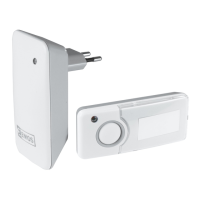
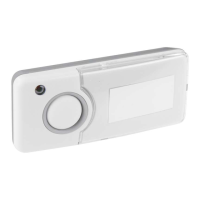
Installation of the Doorbell (Transmitter) Button
1. Begin by pairing the button with the chime.
2. Before installation, check that the pair works reliably in the chosen spot.
3. Remove the rear cover by inserting a screwdriver into the hole on the back
of the button.
4. Use the double-sided adhesive tape (included) or two screws, see Button
Description. Although the button is weather resistant, choose a location
where it is protected, e.g. in a wall recess.
5. Re-assemble the button.
6. Press the button to ring the chime. Pressing is accompanied by LED illumi-
nation indicating the button has sent a radio signal. The chime plays the
selected ringtone.
Note: The doorbell button (transmitter) can be placed on wood or brick walls with-
out issue. However, never place the button directly onto metal objects or materials
containing metal, such as plastic windows or doors that have a metal frame. In such
cases, the transmitter will not work properly.
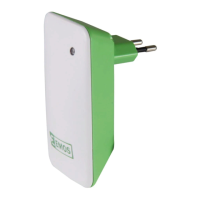
Installing the Chime (Receiver)
1. The chime is designed for indoor use only.
2. When running, it must be plugged in a 230 V AC/50 Hz socket and with free
space around it so that it is always accessible.


 To Next Page