Need help?
Do you have a question about the Empire DW500NP and is the answer not in the manual?
Details warning, caution, and danger signs indicating potential hazards and necessary precautions.
Advises taking precautions against falling and being turned upside down during product transportation.
Lists critical safety rules for machine operation, including electrical safety and prohibiting unauthorized access.
Details safe practices for cleaning, emphasizing power disconnection, proper tool usage, and avoiding sprays.
Specifies water temperature limits, pressure, hardness, and essential electrical grounding requirements.
Emphasizes qualified electrician connection, grounding, and leak current relay protection.
Steps to start the machine, including water supply, door closure, and pressing start buttons.
Steps to diagnose and resolve issues when the device fails to power on or function.
Solutions for issues related to water not filling or rinsing, checking supply, switches, and nozzles.
Addresses problems with the machine not heating water, checking thermostats and electrical connections.
Solutions for the washing tank not emptying, involving drainage hose and filter checks.
Tips to improve efficiency, including filter cleaning, nozzle checks, and detergent levels.
Steps to resolve excessive foaming in the washing tank, checking temperature and detergent usage.
This document serves as an instruction manual for the EMPIRE DW500 and DW500NP dishwashers, providing comprehensive guidance on their safe use, operation, and maintenance.
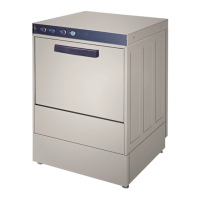
The EMPIRE DW500 and DW500NP dishwashers are designed for efficient and hygienic washing of dishes. They are constructed with a stainless steel frame, chassis, panel, and boiler, ensuring durability and adherence to hygienic standards. The machines feature adjustable legs for easy leveling and an automatically filled washing tank with continuous level control. Washing and rinsing water temperatures are independently controlled by two thermostats, ensuring optimal cleaning performance. The standard program duration is 2 minutes. The pumps are designed to be resistant to detergent and hot water, and the motors are heat-resistant, protected by a cooling fan against high temperatures. The boiler is insulated with glass wool to minimize heat loss and conserve energy. The system incorporates thermal and electrical protectors for safety, and the electrical panel is easily accessible for maintenance and inspections. The washing cycle is fully automatic, operating at 55 ºC, with rinsing performed at 80 to 85 ºC using hot and fresh water. All electrical equipment and cables comply with European Standards and safety regulations.
Before operating the dishwasher, users must ensure proper installation. This includes connecting the supply hose to the solenoid valve and a tap, and clamping the drainage hose to the machine's outlet, leading to a sewer system. The drainage hose must not be twisted or bent excessively. The water supply should be at 50ºC with a pressure between 202 and 404 kPa. If the pressure is too high, a reducer valve is needed; if too low, a pressurizing pump is required. The water hardness should be between 10 and 15º Fr; otherwise, a water softening device must be used. A siphon should be present in the drainage line to prevent odors. The machine requires a 380-400 AC V / 50 Hz power supply with proper grounding and an energy supply in the system.
For daily operation, users should open the packing and remove all protective tapes, then place the device on a flat, solid ground, adjusting the legs as needed. The elbowed part of the supply hose connects to the solenoid valve, and the other end to the tap. The drainage hose connects to the machine's drainage outlet and then to the sewer system. It's crucial not to install the product near flammable or explosive materials and to keep a fire extinguisher nearby.
Before loading, solid wastes should be cleaned from dishes, and they should be pre-washed with a sprayer. Do not overload baskets beyond the stated capacity or use detergent for pre-washing. Heavily soiled dishes should be soaked in water to dissolve dirt. Plastic materials should not be washed. Only foam-controlled liquid detergent should be used, and a detergent dosing apparatus should be connected. A polisher dosing apparatus should also be connected.
To start the machine, ensure the water supply hose and drainage connections are secure, the overflow pipe is in place, and the hot water supply valve is open. Load the basket, shut the door, and press the ON/OFF switch (A). The machine will fill with water and begin heating. The Water Temperature Indicator Lamp will illuminate when the water reaches the ready temperature. Once the lamp is on, press the Cycle Start Push Button (B) for three seconds to begin the washing cycle. The "It's washing" lamp will remain on during the cycle and turn off upon completion.
After a working day, for the DW500NP model, the water can be drained manually by turning off the machine (A), opening the door, removing the drain pipe, and pressing the Drain Pump Switch (D). The machine will drain water as long as the switch is pressed.
Regular maintenance is essential for the safe and long-lasting operation of the dishwasher.
Daily Maintenance: When the washing tank water becomes dirty, it should be replaced with fresh water. To do this, turn the "0-1" switch to "0" to close the device, then switch off the electricity. Open the cover and sponge out any solid wastes.
Cleaning the Device: If the washing tank water is dirty, it needs to be replaced. Set the STAND BY and START switches to "stop" and close the device, then switch off the electricity. After opening the cover, be careful not to impact the cover holder. Remove the overflow pipe. Clean the washing and rinsing nozzles, as well as the surface filters and pump suction filters, using a brush under flowing water. Reassemble all parts in their original positions. Close the cover. Turn on the relevant switch on the control panel to supply electricity. Bring the "STAND BY" and "START" switches to the starting position. For a complete cleaning, run the device for 5 minutes, then set the "START" switch to "pause" and open the cover.
Weekly Maintenance: Similar to daily maintenance, if the washing tank water is dirty, replace it with fresh water. Set the STAND BY and START switches to "stop" and close the device, then switch off the electricity. Open the cover, being careful with the cover holder. Remove the overflow pipe. Clean the washing and rinsing nozzles, surface filters, and pump suction filters with a brush under flowing water. Reassemble all parts. Close the cover. Turn on the electricity via the control panel, set STAND BY and START switches to starting position. Run the device for 5 minutes for a thorough clean, then set "START" to "pause" and open the cover.
Troubleshooting: The manual also provides guidance for interventions after failures. If the device is not working, check the electrical supply to the device, stand-by and start switches, level switch, and solenoid valve. If the tank is not filling, check the level switch, for contaminants in the tube, adequate water level, and the solenoid valve. If the tank fills slowly, check the tap, water pressure (use a pressurizing pump if below 202 kPa), and clean the solenoid valve filter. If water is not heating, check the overflow pipe connection, thermostat settings (80 ºC for rinsing, 50 ºC for washing), and electrical connections. If the tank is not emptying, inspect the drainage hose for solid wastes. If the machine is not working efficiently, ensure the pump suction filter and washing nozzles are clean, and that adequate detergent is supplied. If there is no drying (for models with drying system), check the polisher amount and rinsing water thermostat setting (80 ºC). For condensation in glasses, avoid storing them on a flat surface and check polisher dosage. For striped glasses, use only foamless detergent. If there is excess foam, check water temperature (must not be lower than 50ºC), detergent/polisher dosing apparatus, and clean the machine if foamed detergent was used. For stains on glass, decrease polisher dosage (0.1 cc / liter water). If washing arms are not rotating correctly, remove and clean them, and ensure water pressure is above 202 kPa (mount a pressurizing pump if lower).
 General
| Wash Cycle Time | 90 seconds |
|---|---|
| Racks per Hour | 40 |
| Power Supply | Electric |
| Voltage | 208-240V |
| Delay start | No |
| Half load | No |
| Child lock | No |
| Number of Wash Cycles | 1 |
| Number of programs | 1 |


 To Next Page