
 Need help?
Do you have a question about the Enatel RW312U and is the answer not in the manual?
All installation and maintenance must be carried out by suitably qualified personnel.
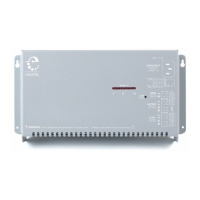
Introduces the RW range of rectifiers and lists their key features.
Details the function of status LEDs and the front panel current display.
Describes the automatic charging cycle between Boost and Float modes.
Explains Low Voltage Disconnect (LVD) and Temperature Compensation.
Covers current limiting, over-voltage, over-temperature shutdown, and reverse polarity.
Explains parallel rectifier operation, external shutdown, and control interfaces.
Details the optional alarm card for relay outputs on various fault conditions.
Provides critical safety warnings regarding hazardous voltages and components.
Instructs on the correct mounting orientation and placement for cooling.
Provides guidelines for connecting mains, load, battery, and control cables.
Details connecting the temperature probe and wiring for parallel rectifiers.
Details alarm contacts, relay functions, and wiring for parallel units.
Explains the configuration options for Rectifier Fail and Mains Fail alarms.
Step-by-step guide for initial setup and verification of the rectifier.
Provides critical safety warnings for servicing the rectifier.
Offers basic and load checks for diagnosing rectifier operational issues.
Details fuse types and ratings, advising against self-repair.
Highlights safety requirements and necessary test equipment for setting adjustments.
Lists the default operational parameters for various rectifier models.
Guides for adjusting float, boost voltages, and boost-to-float current.
Instructions for adjusting current limit and over-voltage shutdown.
Procedure for adjusting LVD 'on' and 'off' voltage limits.
Procedure for setting temperature compensation slope and alarm thresholds.
Details the terms, conditions, and duration of the manufacturer's warranty.
Outlines warranty exclusions, battery policy, and how to initiate a claim.
States warranty limitations, legal disclaimers, and company remarks.
 General
| Input Voltage | 90-264 VAC |
|---|---|
| Output Voltage | 12 VDC |
| Output Current | 25 A |
| Power Rating | 300 W |
| Efficiency | Up to 90% |
| Operating Temperature | -20 to +70 °C |
| Protections | Overvoltage, Overcurrent, Short circuit, Overtemperature |

 To Next Page

