Charger Handbook
Version: Chg1.4
Energizer Battery Manufacturing Inc. | 800-383-7323 (USA-CAN) | www.energizer.com
©2008 Energizer – Contents herein does not constitute a warranty of service, features or performance Page 2 of 4
NiMH Battery Chargers
Handbook and Application Manual
- Reduced cycle life if not properly managed by user
Timer Controlled:
This type of charger will stop the main charge at a predetermined time. Some chargers follow the main
charge with a trickle charge (very low charge rate) to top the batteries off or maintain their full charge.
Characteristics:
- Inexpensive
- A slow charge is generally good for battery cycle life
- Timer reduces need for user monitoring of charge time
- Long charge times (typically greater than 5 hours)
- Low charge rates used in this type to limit the effects of overcharging
- If the timer is reset due to loss of AC power, overcharging can occur
- No protection from charging primary (non-rechargeable) batteries
- May over-charge or under-charge batteries based on battery capacity vs. charger design
- There is no circuitry to monitor the batteries state of charge
“Smart” Charger:
This type of charger uses a microprocessor to monitor the battery voltage characteristics to determine
when it is fully charged. Typically an algorithm based on a change of voltage is used with optional
backup systems using temperature or timers. Often a low rate trickle charge is used to top the battery
off or to maintain a full charge on the battery.
Characteristics:
- When compared to timer controlled chargers, smart chargers can typically charge batteries
faster without impacting performance
- Relatively expensive due to advanced circuitry
- Generally higher battery temperatures associated with fast charging (less than 1 hour)
- Fast charging can negatively impact battery cycle life
“Smart” Charger Control Techniques
Delta Voltage (change in voltage):
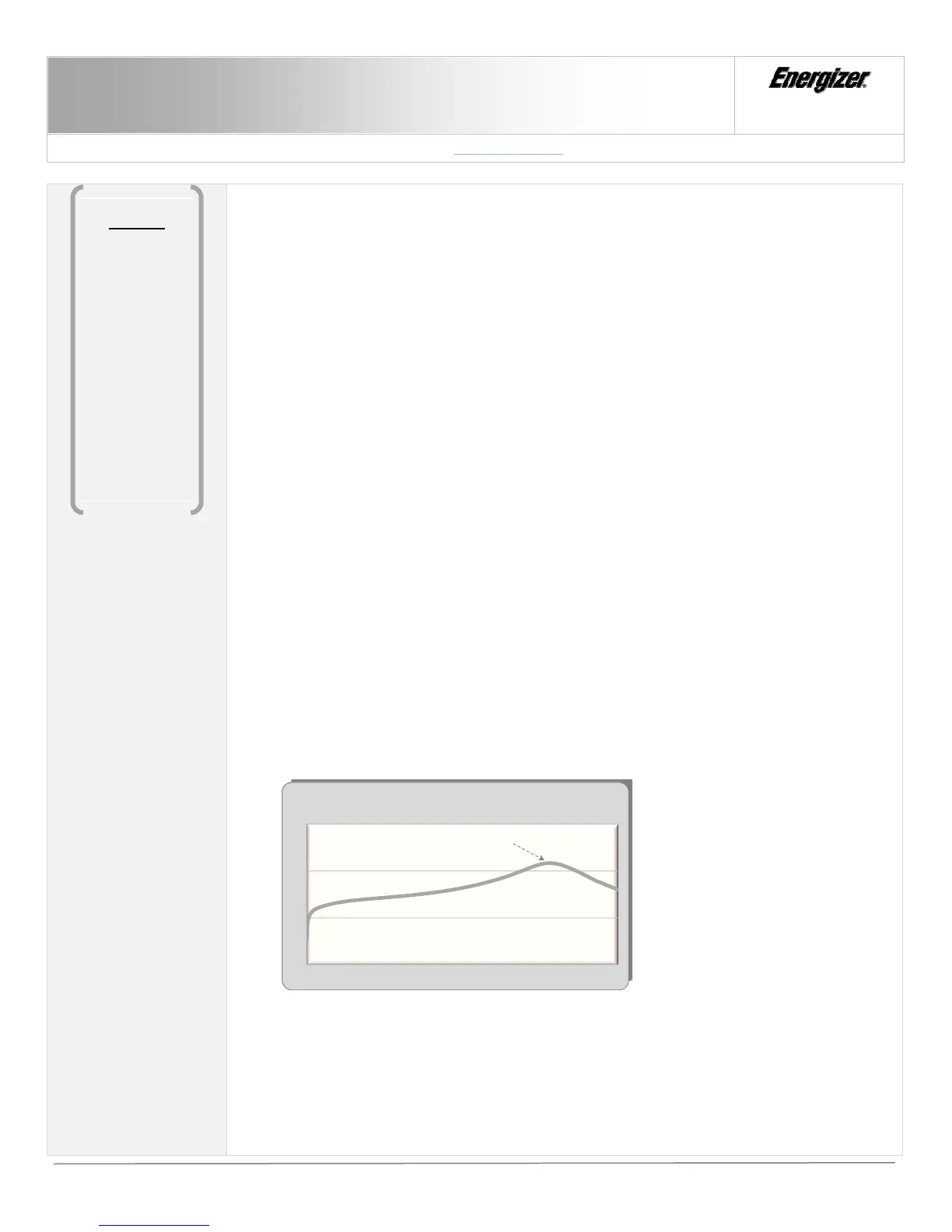
The charger microprocessor continually monitors battery voltage. When battery voltage reaches a peak
and subsequent decrease (e.g. 15 mV), charge is terminated (fig. 1). This typically occurs at 85% to
95% of full battery charge.
Voltage
Time
Voltage During Charging
NiMH Battery
Delta VDetection
Voltage
Time
Voltage During Charging
NiMH Battery
Delta VDetection
(fig. 1) Delta Voltage Detection
Charging Temperature:
Sensors monitor battery temperature during charge. When the batteries reach the maximum
temperature limit, the charge is terminated (fig. 2). This method is typically used as a backup technique
to avoid battery overcharging and overheating.
Contents
Introduction
General
Information
Charge Control
“Smart” Charger
Control Techniques
Cost to Charge
(electricity)
Summary
Glossary



 To Next Page