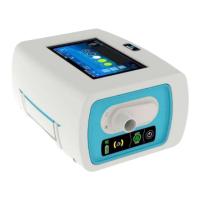
The EOVE-70 Secretion Management Device (SMD) is designed to provide treatment for adult and pediatric patients who are unable to manage their own secretions. It offers an Insufflation – Exsufflation mode, as prescribed by an attending doctor. The device consists of a ventilation module and a housing unit, which includes a display screen for setting parameters and viewing information.
Function Description:
The EOVE-70 SMD operates based on a closed control loop of proximal pressure. It supports both automatic and manual distribution modes. A pressure set point is sent to the turbine, which acts as the main actuator, directly influencing its speed and, consequently, pressure evolution. A higher pressure set point increases turbine speed. Proximal pressure is measured by a dedicated sensor. The determination of distribution parameters, particularly the flow ramp rate, directly impacts the turbine's acceleration at the start of each respiratory cycle.
Two solenoid valves control four internal valves to manage the respiratory phases. One solenoid valve controls two valves during the inhalation phase, while the other controls the remaining two during the exhalation phase. An inspiratory flow sensor measures flow to calculate peak flow and tidal volume for each respiratory cycle.
During the inspiratory phase, the device delivers positive pressure to the patient, proportional to the user-configured set point and turbine speed. Air is inhaled through valve 1, flows to the turbine, then through valve 3 and the inspiratory flow sensor. In this phase, the low-pressure circuit is at atmospheric pressure, and the high-pressure circuit (provided by the turbine) equals the proximal pressure delivered to the patient, resulting in a positive pressure difference. The pump provides additional pressure to the solenoid valves. Solenoid valve A activates to close valves 2 and 4, while solenoid valve B turns off, opening valves 1 and 3 for air to flow to the patient.
During the expiratory phase, the EOVE-70 SMD generates suction to assist the patient during coughing. Air flows through the inspiratory flow sensor, valve 4, then the turbine, and is exhaled through valve 2. In this phase, the low pressure equals the proximal pressure, and the high pressure equals atmospheric pressure, leading to a negative pressure difference. The pump continues to supply additional pressure to the solenoid valves. Solenoid valve B activates to close valves 1 and 3, and solenoid valve A turns off, opening valves 4 and 2 for exhalation.
When the EOVE-70 SMD is on but not actively ventilating, the turbine remains operational at a low speed to cool down if the temperature is below 45°C, or at a higher speed if above this threshold, producing a low ambient noise.
Important Technical Specifications:
The technical data for the EOVE-70 SMD can be found in the user guide.
The device includes:
- Pneumatic subassembly: Turbine, pneumatic block, patient circuit port, pump, inhalation/exhalation valves block, inspiratory flow sensor.
- Electrical subassembly: Motherboard, turbine board, keyboard, SpO2 connector, remote control connector.
- Battery: Internal Lithium-Ion batteries (EOVE1 or EOVE3 models, SP-INTBATT-001 and SP-INTBATT-002 respectively).
- Filters: Air inlet/outlet filters.
- Solenoid valves: Two solenoid valves (Camozzi or Clippard brand).
Usage Features:
The EO-Display housing unit allows control of the EOVE-70 SMD module when inserted. The screen displays current settings, treatment pressure, power supply mode, and enables parameter adjustment.
- Main Menu: Provides access to coaching function, preferences, alarms, calibration, and data export.
- Preferences: Allows adjustment of screen rotation (180°), display mode (settings as list), current date and time, brightness, and transition beep.
- Maintenance Menu: Accessible via a PIN code (6666). It has "General," "Counters," and "Information" tabs.
- General Tab: Controls accessories, language selection, connectivity, and manages interface app and operating system versions.
- Counters Tab: Displays operation time for components like battery, turbine, solenoid valves, pump, and patient usage.
- Information Tab: Shows serial numbers, current software versions, and operating system information.
- Calibration: A two-step process for the patient circuit, ensuring performance aligns with specifications. It involves unsealing and sealing the circuit extremity.
- Communication: The EO-Display communicates with the SMD module when inserted, requiring matching API versions for proper function.
- Data Export: Clinical data (up to one year) can be downloaded to a USB drive (FAT32, 32GB max, Class 10, 1 partition) from the "Export Data" menu.
- EO-Toolkit: A servicing software for downloading event logs, updating software, and managing counters and serial numbers. It can also provide troubleshooting assistance by diagnosing alarms and suggesting actions.
Maintenance Features:
Maintenance is compulsory and must be performed by qualified, trained technicians according to EOVE's schedule. Non-compliance can lead to performance loss, overheating, or device damage.
- Cleaning and Disinfection: Regular surface disinfection with a damp cloth and mild cleaning solution is required. Internal air-conducting parts can be disinfected using a Keredusy device (SP-KRDUSY70 kit) for up to 5 disinfections, after which specific components (pneumatic block, tubes, sealing rings, inspiratory flow sensor, Keredusy kit) must be replaced.
- Periodical Controls (Annual):
- Apply cleaning and disinfection recommendations.
- Inspect connections and circuit adapters for moisture or contaminants.
- Replace air filters (annually or sooner if dirty/dusty). Air filters are not washable or reusable.
- Check alarms and events for unusual activity.
- Check battery status and replace if damaged or if ageing reaches 70%.
- Operate the device on battery and AC power, ensuring full battery charge.
- Check and update software versions.
- Maintenance Schedule:
- 6 months: Storage period check, cleaning and disinfection (no technical service required for cleaning/disinfection).
- 1 year: Air filter replacement (no technical service required).
- 2 years: Internal filter and 4 valves replacement. Optional: Tubes and sealing rings replacement (depending on condition/disinfections). Dusting of EO-Display fan and heatspreader.
- 4 years: Internal flow sensor replacement.
- 1000 hours: Pump replacement.
- 20,000 hours: Turbine replacement.
- 100 million cycles: Solenoid valves replacement (both recommended if one needs changing).
- Component Replacement Procedures: Detailed instructions are provided for replacing the air filter, battery, pneumatic subassembly (turbine, pneumatic block, patient circuit port, pump, inhalation/exhalation valves block, motherboard, inspiratory flow sensor, solenoid valves, keyboard), and EO-Display housing unit components (CPU board, handle, screen, cooling fan, keyboard). New serial numbers must be updated in device memory after component replacement.
- Performance Controls (via EO-Toolkit or Manual): Full performance tests are required after preventive maintenance or repair, at least annually. This includes checking LEDs, keyboard, electrical interfaces, communication, and turbine performance.
- Software Update: CPU and interface software must be in the same API version. Updates are performed via EO-Toolkit, ensuring both PIC and CPU software are updated.
- Battery Charge Control: Verify charging status and completion.
- Troubleshooting: Alarms indicate technical problems, requiring immediate contact with an EOVE-certified technician. Troubleshooting trees are provided for issues like supply failure, battery failure, turbine failure, speed fault, sensor/CPU/memory failure, inspiratory flow failure, keyboard failure, and communication loss.
- Disposal: The EO-70SMD must be dismantled according to EOVE procedures for proper recycling of components (Lithium-Ion batteries, electronic boards, plastic/shells, foams/tubes/sealing rings). Special attention is given to dangerous substances like Lithium-Ion batteries, which require specific storage and disposal protocols.

 Need help?
 General

 To Next Page