⚫
Maintain adequate distance between vehicles.
⚫
Reduce speed in wet areas.
⚫
Use extreme caution when approaching sharp or blind turns.
⚫
Use extreme caution when driving over loose terrain.
⚫
Use extreme caution in areas where pedestrians are present.
MAINTENANCE
Always:
⚫
Maintain the vehicle in accordance with the manufacturer’s periodic service schedule.
⚫
Ensure that repairs are performed by those that are trained and qualified to do so.
⚫
Follow the manufacturer’s maintenance procedures for the vehicle. Be sure to disable the vehicle before
performing any maintenance. Disabling includes removing the key from the key switch and removal of a
battery wire.
⚫
Insulated any tools used within the battery area in order to prevent sparks or battery explosion caused by
shorting the battery terminals or associated wiring. Remove the batteries or cover exposed terminals with
an insulating material.
⚫
Check the polarity of each battery terminal and be sure to rewire the batteries correctly.
⚫
Use specified replacement parts. Never use replacement parts of lesser quality.
⚫
Use recommended tools.
⚫
Determine those tools and procedures not specifically recommended by the manufacturer will not
compromise the safety of personnel nor jeopardize the safe operation of the vehicle.
⚫
Support the vehicle using wheel chocks and jack stands. Never get under a vehicle that is supported by a
jack. Lift the vehicle in accordance with the manufacturer’s instructions.
⚫
Maintain the vehicle in an area away from exposed flame or persons who are smoking.
⚫
Be aware that a vehicle that is not performing as designed is a potential hazard and must not be operated.
⚫
Test driving the vehicle after any repairs or maintenance. All tests must be conducted in a safe area that is
free of both vehicular and pedestrian traffic.
⚫
Replace damaged or missing warning, caution, or information labels.
⚫
Keep complete records of the maintenance history of the vehicle.
Use extreme caution and, if unsure as to the potential for injury, refer the repair or maintenance to a qualified
mechanic.
FOR THE USER
1. GENERAL SAFETY PRACTICES
1.1 Introduction
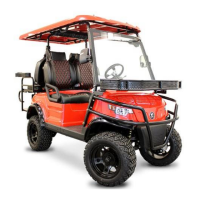
Like other machines, EPIC CART can cause injury if improperly used or maintained. Part II contains
broad safety practices applicable to EPIC CART operations. Before operation, the user shall establish such
additional specific safety practices as may reasonably be required for safe operation.
1.2 Nameplates, Markings, Capacity, and Modifications
1.2.1 The user shall maintain in a legible condition all nameplates, warnings and instructions which are
supplied by the manufacturer.


 To Next Page
 Loading...