The HTS801 is a sophisticated humidity and temperature sensor designed for demanding applications, particularly in environments characterized by high humidity and chemical pollution. It offers a comprehensive suite of features for accurate measurement, robust operation, and user-friendly configuration and maintenance.
Function Description:
The HTS801 measures relative humidity (RH) and temperature (T) and can calculate various humidity-related physical quantities such as dew point (Td), frost point (Tf), wet bulb temperature (Tw), water vapor partial pressure, mixing ratio, absolute humidity, and specific enthalpy. It is available with six remote probe types (T5, T7, T9, T10, T17, T28) to suit different application ranges for RH, T, and pressure, as well as varying environmental conditions.
A key feature is its autonomous heating system for the high-end E+E RH and T sensing element, which ensures reliable and long-term stable measurements even in extremely humid or chemically polluted environments. The monolithic structure of the RH/T sensing element facilitates a fast return to normal conditions after condensation or chemical contamination. This is further enhanced by a proprietary E+E coating.
The device incorporates different intelligent operating modes to adapt to specific measurement tasks. These include:
- Condensation Guard (CG): For temporary condensation, available for probe types T5, T9, and T10. It eliminates condensation on the sensing element by intensive heating for 10 seconds when a specified RH setpoint is reached. The outputs are frozen during the heating and cool-down process.
- High Humidity Guard (H2G): For continuous high humidity and condensing conditions, available for probe types T7, T17, and T28. This dual heating system (probe body and sensing element) prevents condensation, ensuring accurate RH measurement and fast recovery. For T17 and T28, an additional T sensor aids in determining relative humidity near condensation.
- Automatic ReCovery (ARC): All HTS801 types support ARC, which uses brief and intensive heating to evaporate foreign molecules from the sensing element, counteracting chemical pollution. ARC can be triggered manually (via PCS10, display, or push-buttons), cyclically (periodically at a set interval, with an option for automatic start at power-on), or externally via an optional ARC module (AM1) or Modbus commands. During ARC, output values are frozen.
Measured data is provided through two freely scalable analog outputs, an RS485 (Modbus RTU) interface, or an Ethernet-PoE (Modbus TCP) interface. Alarm (relay) outputs are also available.
Important Technical Specifications:
- Relative Humidity (RH) Measuring Range: 0...100 %RH
- RH Accuracy:
- -15...+40 °C (5...104 °F) RH ≤90%: ±(0.95 + 0.0013 * mv) %RH
- -15...+40 °C (5...104 °F) RH >90%: ±1.8 %RH
- -25...+70 °C (-13...+158 °F): ±(1.05 + 0.0084 * mv) %RH
- -40...+180 °C (-40...+356 °F): ±(1.15 + 0.013 * mv) %RH
- -70... -40°C (-94...-40 °F): ±3.85%RH
- Temperature (T) Measuring Range:
- Types T5/T9/T10: -70...+180 °C (-94...+356 °F)
- Type T17: -80...+180 °C (-112...+356 °F)
- Type T28: -80...+60 °C (-112...+140 °F)
- T Accuracy: ±0.2 °C (±0.34 °F) at 23 °C (73 °F) for T5/T9/T10, T17/T28 T measurement down to -80 °C (-112 °F), RH measurement down to -70 °C (-94 °F).
- Analog Outputs: Two freely selectable and scalable outputs (0-1/5/10 V or 0-20 mA/4-20 mA, 3-wire). Both outputs must have the same electrical quantity.
- Digital Interface: RS485 (Modbus RTU) or Ethernet-PoE (Modbus TCP).
- Power Supply: 8-35 V DC / 12-30 V AC. Optional integrated power supply 100-240 V AC (50/60 Hz) (AM3) or PoE with option J4.
- Enclosure: Polycarbonate (UL94 V-0 approved) or Stainless steel 1.4404 / AISI 316 L, both IP65/NEMA 4X.
- Pressure Range (pressure-tight probe): 0.01...20 bar (0.15...300 psi) for T7/T10/T17; 0.01...300 bar (0.15...4350 psi) for T9.
- Operating Temperature (electronics board): -40...60 °C (-40...140 °F) without display; -20...50 °C (-4...122 °F) with display.
Usage Features:
- Configuration Interface: The HTS801 is ready to use with factory settings. Users can modify settings via the free PCS10 Product Configuration Software (connected via USB-C to USB-A cable, HA010327) or, if equipped, a 3.5" TFT color display with push-buttons. Modbus RTU protocol allows limited configuration of communication settings.
- TFT Colour Display (Optional): Provides full configuration and visualization capabilities. It includes a data logger with a storage capacity of 20,000 values per measurand/calculated quantity, a real-time clock with battery backup, and graphical representation of logged data. Display alarms can be configured.
- rapidX Smart Probe (Option PC7): Enables plug-and-play probe exchange during operation without configuration, adjustment, or calibration. The probe automatically uploads its specific parameters to the HTS801 electronics, simplifying maintenance and reducing downtime.
- Alarm Module (Option AM2): Offers two freely configurable relay outputs for alarm or control purposes, with various operation modes including switch hysteresis, switch window, and error indication.
- Modbus RTU (Option J3) and Modbus TCP (Option J4): Allows integration into bus systems for data acquisition and control. The Modbus RTU interface supports up to 32 sensors. The Ethernet module features Power over Ethernet (PoE) and an RJ45 connector with IP65 protection. A web server is available for quick communication checks.
- Simulation Mode: For testing the measurement system, RH and T output values can be fixed for a specified duration.
Maintenance Features:
- Self-Diagnosis and Error Messages: The device provides error messages on the display and via status LEDs, categorized as non-critical (user-solvable) or critical (requiring E+E service).
- Cleaning and Filter Cap Replacement: The sensing head can be cleaned, and the filter cap replaced. E+E original filter caps are recommended to maintain response time.
- Automatic ReCovery (ARC): As described above, ARC is a key maintenance feature to recondition the sensing element against chemical pollution, minimizing drift effects.
- RH and T Calibration and Adjustment: Calibration and adjustment can be performed at E+E Elektronik's laboratory or by the user. User adjustment options include offset or 2-point adjustment via the display/push-buttons or PCS10 software. Specific instructions are provided for different probe types, including deactivating heating functions during adjustment to ensure stability. For T17/T28 probes, it's crucial to maintain the same temperature for RH and T probes during adjustment.
- Fuse Replacement (Option AM3): The 1.25 A fuse on the 100-240 V AC side of the integrated power supply (AM3) must only be replaced by E+E after-sales service.
- ESD Protection: The sensing elements and electronics board are ESD sensitive and must be handled with appropriate protective measures.
- Environmental Aspects: The device is designed and manufactured in compliance with environmental protection requirements, and local regulations for disposal must be observed.

 Need help?
 General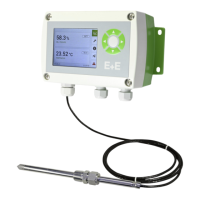

 To Next Page