Need help?
Do you have a question about the Epson CaptureOne TM-S1000 and is the answer not in the manual?
Details minimum hardware and software requirements for scanner operation.
Covers scanner type, resolution, graduation, and data formats for scanning.
Details MICR magnetic character types and recognition rates.
Configuration for internal use, recommended not to change.
Configuration for internal use, fixed to ON.
Describes the function of POWER, ERROR, and DOCUMENT LEDs.
Explains how to turn the scanner on and off using the power switch.
Step-by-step guide for installing a new franking cartridge.
Details the four actions performed on a document in a single pass.
Instructions for cleaning the scanner glass to ensure optimal performance.
Procedure for cleaning the MICR unit to maintain magnetic character reading accuracy.
Steps to safely remove jammed paper from the scanner.
Explains DOCUMENT and ERROR LED status messages and their causes.
Lists errors that the scanner can recover from and the required actions.
Details critical errors requiring power cycling or service intervention.
Identifies the location and function of various internal scanner sensors.
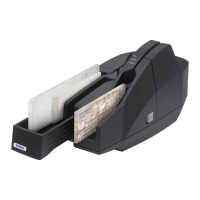
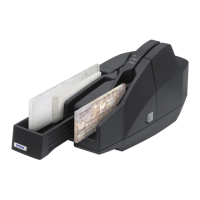
The Epson CaptureOne Single Feed is a specialized scanner designed for efficient processing of checks and similar documents. It is available in both one-pocket and two-pocket models, catering to different document handling needs. The device is engineered to perform multiple actions on a document in a single pass, including scanning images of both the front and back, reading magnetic characters (MICR), and franking.
The primary function of the CaptureOne Single Feed is to automate the processing of checks. It utilizes a Contact Image Sensor (CIS) for scanning, ensuring high-quality image capture. The scanner is capable of scanning both sides of a check simultaneously, reading the MICR line, and applying a franking pattern in a single pass, which significantly streamlines the workflow for financial institutions and businesses that handle a large volume of checks.
The device supports electronic endorsement, allowing recorded image data to be pasted onto the back image of a check. This feature enhances the integrity and traceability of processed documents. The franking section is equipped with a dedicated cartridge (EFC-01) that prints a pattern on the document, typically for endorsement or cancellation purposes.
Document Insertion and Ejection: Checks are inserted into the sheet feeder (SF) and fed automatically. For optimal feeding, the pocket guide and SF guide should be fully extended. The scanner is designed to handle single-ply, normal paper documents within specific size and weight ranges. After processing, documents are ejected into either the main pocket or, for the two-pocket model, into a sub-pocket. It's crucial not to overfill the pockets to prevent paper jams. The main pocket can hold up to 100 sheets, while the sub-pocket (in the two-pocket model) can hold up to 50 sheets.
User Interface and Indicators: The CaptureOne Single Feed features LED indicators for Power, Error, and Document status, providing clear visual feedback on the scanner's operational state.
A power switch is provided to turn the device on or off, and a cover is included to prevent accidental power-offs.
Software and Connectivity: The scanner connects to a computer via a USB 2.0 high-speed interface, ensuring rapid data transmission. It is compatible with various Windows operating systems, including 2000 Professional, XP Home/Professional, and Vista (32-bit and 64-bit editions). The device supports development languages such as Win32 (Visual C++, Visual Basic) and .NET (Visual C++, Visual C#, Visual Basic.NET), allowing for integration into custom applications. The TM-S1000 Utility and Driver CD provide the necessary software for operation and maintenance.
Error Handling: The scanner provides detailed error and information codes, indicated by the LED patterns, to help users identify and resolve issues. Status messages, recoverable errors, and unrecoverable errors are clearly defined with their causes and recommended solutions. For instance, a "Waiting for paper insertion" status is indicated by a green DOCUMENT LED flashing at 160 ms intervals, prompting the user to insert a sheet. Paper jam errors, mechanism position errors, and document read errors are examples of recoverable issues with specific troubleshooting steps. Unrecoverable errors, such as CPU execution errors or memory overwrite errors, typically require the user to turn off the power immediately.
Cleaning the Scanner Glass: Regular cleaning of the scanner glass is essential to maintain image quality. It is recommended to clean the glass if it becomes dirty from ink or paper dust, or at least every six months or after 100,000 passes. The process involves opening the scanner cover and lightly wiping the glass areas with a soft, dry cloth. For grease, oil, or ink smears, a cloth lightly dipped in alcohol can be used. It's crucial not to use synthetic detergents, benzine, water, or other liquids directly on the scanner glass to prevent spots or stains.
Cleaning the MICR Unit: The MICR unit should be cleaned every six months or after 100,000 passes to prevent errors in reading magnetic characters caused by dirt or dust. This can be done using the TM-S1000 Utility or application, often in conjunction with KICTeam Waffletechnology® cleaning cards or equivalent commercial cleaning sheets. Sticky cleaning sheets should be avoided as they can cause jams or machine failure. Used cleaning sheets must be disposed of properly and not reused.
Franking Cartridge Replacement: The franking cartridge has a limited life, typically 18,000 prints, and an expiration date of 18 months from production. When replacing the cartridge, the franker cover is opened by pulling a lever forward. The used cartridge is removed by holding a knob at the top, and a new genuine Epson cartridge is carefully inserted until it clicks into place. The franker cover is then closed until it clicks. It is important to keep franking cartridges out of reach of children, handle them carefully to avoid ink stains, and not remove them from their packing until ready for use.
Clearing Paper Jams: In the event of a paper jam, the scanner cover or franker cover should be opened to access and remove the jammed paper.
Self-Test Function: The scanner includes a self-test function, performed using the Epson TM-S1000 Utility, which checks various scanner functions such as the model name, serial number, control firmware version, and the presence of the franking cartridge. This helps in diagnosing potential issues.
Transporting the Scanner: For transportation, the scanner should be turned off, the power supply connector removed, and the pocket and SF guides stored inside the scanner. The device should then be packed upright.
The Epson CaptureOne Single Feed is designed for reliability, with a scanner life span of 1 million sheets, an MTBF (Mean Time Between Failures) of 180,000 hours, and an MCBF (Mean Cycles Between Failures) of 2,470,000 cycles, ensuring long-term performance in demanding environments.
 General
| Category | Scanner |
|---|---|
| Resolution | 200 dpi |
| Interface | USB 2.0 |
| Scanner Type | Check scanner |
| Duplex Scanning | Yes |
| Scanning Method | Contact Image Sensor (CIS) |
| Model | TM-S1000 |
| Supported Operating Systems | Windows XP, Vista, 7, 8, 10 |
| Feeder Capacity | 100 sheets |
| Color Depth | 24-bit color |
| Power Consumption | Approx. 1.5 W (standby) |
| Operating Temperature | 5°C to 35°C |
| Operating Humidity | 20% to 80% |
| Paper Width | 50.8 mm - 216 mm |
| Weight | 4.0 kg |

 To Next Page