
 Need help?
Do you have a question about the ERICO TDS150-1SR Series and is the answer not in the manual?
Ensure power is removed from the area and circuits prior to connection.
Install RCD if required by national codes to avoid nuisance tripping.
Connect wiring to the two primary terminals indicated for operation.
Connect alarm terminals if remote monitoring is required.
Apply power and check TDS operation and status indication.
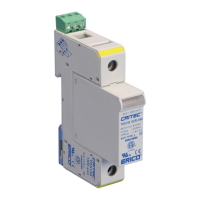
The Transient Discriminating Surge Diverter (TDS) series is engineered to provide robust protection for various power distribution systems. These units are designed to safeguard single-phase, split-phase, and three-phase power distribution systems against transient voltage events. Depending on the specific model, TDS units can be configured for single-phase protection (TDS150 or TDS1100), multi-mode protection in split-phase systems (TDS50), or comprehensive protection in three-phase systems (TDS350). Their versatility allows for connection in various configurations, including Line-to-Neutral (L-N), Line-to-Ground (L-G), or Neutral-to-Ground (N-G), adapting to the specific requirements of the power distribution system.
Multiple TDS units can be deployed to achieve multi-mode protection or to protect complex three-phase distribution systems effectively. The TDS series is compatible with a range of nominal RMS voltages, including 120Vac, 220Vac, 240Vac, and 480Vac, offering flexibility across different electrical environments. Additionally, these units can be utilized to protect DC power systems, further extending their application scope.
Installation of the TDS series requires adherence to national electrical codes and safety protocols. It is crucial to ensure that power is completely removed from the area and circuits before commencing any installation or maintenance work. Qualified personnel are required to perform these tasks to prevent electrical shock or burn hazards. The device is designed for easy mounting onto 35mm (top hat) DIN rails, a standard EN50022 component. The securing clips are positioned towards the bottom of the rail, with the label text facing upwards for correct orientation.
For optimal performance, the TDS modules must be installed within an enclosure or switchboard panel. This enclosure serves multiple purposes: it prevents the TDS unit(s) from exceeding their maximum specified operating temperature, provides adequate electrical and safety protection for all exposed terminals, meets environmental requirements, and prevents the ingress of moisture and water. The design also ensures that the indicator status of the TDS can be easily inspected.
Wiring connections are critical for the proper functioning of the TDS. The interconnecting wiring should be kept as short as possible, ideally not exceeding 300mm (12 inches), and sharp bends should be avoided (a radius greater than 100mm is recommended). Where feasible, conductors should be twisted together. The terminals are designed to accommodate multi-strand wiring up to 25mm² (#4AWG) or single-strand wiring up to 35mm² (#2AWG), with an insulation strip-back of 8mm (5/16 inches).
When Residual Current Detectors (RCDs) are part of the system, it is preferable to install the TDS modules upstream of the RCD. This placement helps prevent nuisance tripping that can occur during transient activity. Overcurrent protection is also essential and must be installed in the upstream circuit of every TDS unit if the mains supply exceeds 100A. This protects the TDS, the load, and the wiring in the event of a fault.
The TDS series offers remote status monitoring via voltage-free contacts. This feature allows for continuous oversight of the device's operational status. Failure of the TDS is indicated by the opening of Normally Closed (N/C) contacts and the closing of Normally Open (N/O) contacts. It is important to ensure that the voltage and current ratings of these contacts are not exceeded. The status of these contacts is independent of whether power is supplied to the TDS module, reflecting solely the failure status of the module itself.
The TDS modules incorporate an internal thermal disconnect element. This element automatically disconnects the varistor from the network in the event of a thermal overload. Should this internal disconnect operate, a red flag will appear in the transparent window of the Status Indicator(s) on the front of the TDS, providing a clear visual cue for maintenance.
Regular inspection of TDS units is recommended, especially after periods of lightning or transient voltage activity. The Status Indicator should be checked, and if tripped, the module should be replaced. When a TDS module needs to be removed from service, it is imperative to ensure that power has been removed and, if possible, "locked out." Only qualified personnel should undertake the replacement of TDS modules. Replacement plug-in modules are available, simplifying the maintenance process. It is crucial to ensure that any new module installed is of the same type and voltage as the one being replaced to maintain system integrity and performance.
The device is designed for reliability and ease of maintenance, ensuring continuous protection for critical power distribution systems. Adherence to installation guidelines, regular inspections, and proper replacement procedures will maximize the lifespan and effectiveness of the TDS series.
 General
| Series | TDS150-1SR |
|---|---|
| Category | Power distribution unit |
| Frequency | 50/60 Hz |
| Enclosure | Metal |
| Status Indication | LED |
| Remote Monitoring | No |
| Mounting Type | Rack |
| Phase | Single |
| Operating Temperature | -40°C to 85°C |
| Humidity Range | 5-95% non-condensing |
| Safety Standards | UL 1449, IEEE C62.41 |
| Maximum Continuous Operating Voltage (MCOV) | 150 V |
| Protection Modes | L-N |

 To Next Page