5
APPLICATION
1. INTRODUCTION
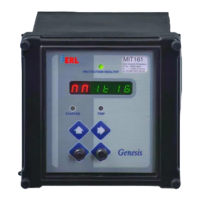
The type MIT161 numerical sensitive current protection relay combines the power and
flexibility of microprocessor technology. The relay is especially tuned to suit applications
where low settings, low burden and rejection of harmonic currents become a necessity.
The relay is suitable for high resistance earth fault protection and capacitor bank
unbalance current protection.
2. CHARACTERISTICS
MIT161 relay has two stage protection i.e. earth fault element and lowset element.
Earthfault element is provided with DTL characteristic and the lowset element is provided
with DTL & IDMTL (Standard Inverse 3 sec, Standard Inverse 1.3 sec, Very Inverse
Extremely Inverse and Long Time Inverse) characteristics.
3. RESET TIME DELAY
The lowset element IDMTL characteristic is also provided with reset time delay
characteristic for detecting “Flashing faults”.
The increasing use of plastic cables, both, conventionally buried types and aerial bundled
conductor types have given rise to the number of "pecking" or "flashing intermittent faults
on distribution systems. At the fault position, the plastic melts and temporarily reseals the
faulty cable for a short time, after which the insulation fails again. The same phenomenon
has occurred in joint boxes where an internal flashover temporarily reseals.
The behaviour of different types of over current relays under flashing fault condition is
compared in Fig.1. The repeating process often caused electromechanical disc relays to
"ratchet” up and eventually trip the faulty circuit provided that the reset time of the relay
was longer than the time between successive flashes. Early electronic IDMTL relays with
instantaneous reset features were not at all effective in dealing with this condition and
only tripped after the flashing fault had developed into a solid permanent fault.
To overcome this the MIT161 relay has a reset time setting which can be user
programmed to be either instantaneous or delayed from 1 to 60 seconds in step of 1 sec.
On the other hand, on overhead line networks, particularly where reclosers are
incorporated in the protected system, instantaneous resetting is desirable to ensure that, on
multiple shot reclosing schemes, correct grading between the source relays and the relays
associated with the reclosers is maintained.


 To Next Page