EasyManua.ls Logo

ESD-PROTECT SR 800 - User Manual

ESD-PROTECT SR 800
3 pages
Print Icon
To Next Page IconTo Next Page
Loading...
Manual
ESD-PROTECT GmbH
Industriestraße 27 | 56276 Großmaischeid
www.esd-protect.de info@esd-protect.de
Tel. 02689 92870-0 Fax 02689 92870-24 Seite 1
Stand: 24.04.23
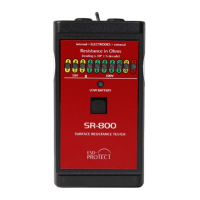
EP0201009Surface Resistance Meter SR 800
Description
The surface tester is an ohmmeter with battery operation and built-in
strip electrodes. It is designed for quick measurement of surface
resistances to check ESD protection applications easily and reliably.
This meter is equipped with an automatic test voltage selector that
automatically switches the test voltage from 10V to 100V from a
resistance of 1 x 10⁶ Ω. Two banana plugs and the switch for the
electrodes (internal/external) allow the connection of two external
electrodes (2.27kg) for point-to-point resistance measurements (Rp-p).
Scope of delivery
- Surface tester
- 9V battery
- Calibration certificate
Features & components
A Banana sockets: For connecting the external electrodes.
B Change-over switch: For use of the internal strip electrodes or the external
electrodes.
Toggle switch left to "INTERNAL" for internal electrodes.
Toggle switch right to "EXTERNAL" for external electrodes
C LEDs for displaying the measured value: Resistance is measured in ohms and
displayed as 10X ± 1/2 decade, where X is the range displayed on the tester.
D Battery monitor: As soon as this LED lights up, the battery should be replaced.
Please do not use the tester when this LED is lit.
E Test switch: Use this contact surface to perform a surface resistance
measurement. Press and hold the button until one of the resistance measurement
LEDs (C) lights up.
F Battery compartment: Remove the cover to access the 9V battery compartment.
G Parallel electrodes: Make sure to set the toggle switch (B) to “INTERNAL" if you
want to carry out a measurement with the parallel electrodes on the back of the
unit. Please do not damage the conductive sheathing of the electrodes.

Question and Answer IconNeed help?

Do you have a question about the ESD-PROTECT SR 800 and is the answer not in the manual?

Overview

The ESD-PROTECT SR-800 Surface Resistance Meter is a battery-operated ohmmeter with built-in strip electrodes, designed for quick and reliable measurement of surface resistances in ESD protection applications. It features an automatic test voltage selector, switching between 10V and 100V for resistances starting from 1 x 10^6 Ω. The device also includes two banana sockets and a change-over switch, allowing for the connection of external 2.27 kg electrodes for point-to-point resistance measurements (Rp-p).

Technical Specifications:

  • Accuracy: ± ½ decade
  • Weight: 0.2 kg
  • Dimensions: 13 cm x 7 cm x 3 cm
  • Power Supply: 9 V Alkaline battery

Scope of Delivery:

The SR-800 comes with the surface tester itself, a 9V battery, and a calibration certificate.

Usage Features:

Components:

  • A - Banana sockets: Used for connecting external electrodes.
  • B - Change-over switch: Toggles between using the internal strip electrodes and external electrodes.
    • Toggle left to "INTERNAL" for internal electrodes.
    • Toggle right to "EXTERNAL" for external electrodes.
  • C - LEDs for displaying the measured value: Resistance is measured in ohms and displayed as 10X ± 1/2 decade, where X indicates the displayed range.
  • D - Battery monitor: This LED illuminates when the battery needs replacement. The tester should not be used when this LED is lit.
  • E - Test switch: A contact surface used to initiate a surface resistance measurement. Press and hold this button until one of the resistance measurement LEDs (C) lights up.
  • F - Battery compartment: Located under a removable cover for accessing the 9V battery.
  • G - Parallel electrodes: These are the internal electrodes located on the back of the unit. Ensure the toggle switch (B) is set to "INTERNAL" when using them. Care should be taken not to damage their conductive sheathing.

Measurement with Integrated Parallel Electrodes (Surface Measurement Point-to-Point, Rp-p):

  1. Preparation: Do not clean the surface before testing. Remove all objects, including ESD-sensitive devices, that could interfere with the test.
  2. Placement: Place the surface tester on the most used part of the surface, ensuring it is at least 5 cm from any edge and 8 cm from any grounding point.
  3. Electrode Selection: Set the electrode switch (B) to "INTERNAL" for the internal electrodes.
  4. Measurement: Press and hold the test contact (E) until the measurement is displayed on the LEDs (C).
  5. Troubleshooting: If the measurement falls outside permissible limits, clean the surface and retest. This helps determine if dirt is causing an insulating layer.

Using External Electrodes (General Rule):

  1. Electrodes: Use both 2.27 kg electrodes for point-to-point resistance measurements (Rp-p).
  2. Insulation: Ensure the object being measured is electrically insulated, as the surface tester always measures the path of least resistance.
  3. Lead Separation: Keep the test leads as separated as possible.
  4. Unit Placement: Place the unit no closer than 5 cm from the edge of the surface and no closer than 8 cm from any earthing point.
  5. Electrode Spacing:
    • For point-to-point measurements (Rp-p), place the 2.27 kg electrodes approximately 25 cm apart.
    • For ground measurements, place them approximately 90 cm apart.
  6. Preferred Measurement Points: Focus on frequently used parts of the surface, most worn areas, the center of the surface, and the point furthest from the grounding point.
  7. Sectioned Surfaces: If the surface has sections (e.g., floor tile joints, clothing seams), place the 2.27 kg electrodes on different sections to ensure comprehensive measurement.

Maintenance and Care:

  • Cable Sockets Area: Regularly wipe the area around the cable sockets at the top of the meter with a clean cloth dampened with alcohol. This removes skin oils, dust, or other contaminants that could affect the accuracy of high resistance measurements. The frequency of cleaning depends on usage, but monthly cleaning is recommended.
  • Electrodes: Clean the electrodes with a minimum 70% isopropanol alcohol-water solution. Ensure the electrodes are completely dry before use.
  • Compliance Measurements: For compliance measurements, do not clean the surfaces being measured. However, if measurements are outside the standards, clean the material surface and retest to rule out dirt as a factor.
  • User Serviceability: The surface resistance tester requires minimal maintenance and contains no user-serviceable parts. For calibration needs, contact ESD-PROTECT GmbH.

ESD-PROTECT SR 800 Specifications

General IconGeneral
BrandESD-PROTECT
ModelSR 800
CategoryMeasuring Instruments
LanguageEnglish