Need help?
Do you have a question about the ESP LTD KH-602 and is the answer not in the manual?
Clean guitar after each use to maintain finish and prolong string life.
Use caution with accessories that may damage guitar finish.
Maintain fingerboards with lemon oil to prevent drying and maintain luster.
Store guitar in case, tuned, and away from extreme temperatures.
Adjust tuning machine head tension for optimal tuning stability.
Properly adjust the truss rod for correct neck relief and playability.
Learn to check neck bow using strings for proper guitar setup.
Adjusts the master output level of the guitar.
Adjusts the high frequencies present in the guitar's signal.
Connects the guitar's signal to an amplifier via a cable.
Convert string vibrations into an electronic signal for amplification.
Selects between different pickups or combinations for varied tones.
Electronics that do not require a battery for operation.
Electronics using a battery to manipulate signal for enhanced tone control.
Engages coil-tapping feature by pushing/pulling a control knob.
Blends output between pickups, common on basses.
Controls bass, mid, and treble frequencies on active EQ bass systems.
Adjustable bridge with separate screws for intonation and height.
Tune-o-matic bridge with set-screws to lock bridge/tailpiece for improved tuning.
Bridge for acoustic/semi-acoustic models, often glued, with limited adjustment.
Vibrato system for creating manual pitch effects on Xtone guitars.
Traditional tremolo for slight vibrato effects, mounted on the body.
Advanced tremolo system locking strings at nut and bridge for superior tuning stability.
Step-by-step guide for changing strings on Floyd Rose systems.
Using fine tuners on the tremolo for precise pitch adjustments.
How to adjust string height using pivot studs on Floyd Rose bridges.
Process for setting string intonation on Floyd Rose tremolo systems.
Adjusting tremolo spring tension to set the bridge's float level.
Simple bass bridge with height and intonation adjustment screws.
Bass bridges allowing maximum tone transfer, with string-thru option.
Bass version of the tune-o-matic bridge with adjustable saddles.
Details items not covered by the limited lifetime warranty.
Procedure for requesting warranty service and obtaining authorization.
This document serves as an owner's manual and warranty information for ESP guitars and basses, providing comprehensive guidance on the care, maintenance, and optimal use of these instruments. ESP, founded in 1975, is recognized for its high-quality standards and meticulous craftsmanship, with every instrument undergoing thorough inspection before shipping. All ESP instruments are covered by a limited lifetime warranty, ensuring years of enjoyment for the owner. The manual encourages owners to read through its contents to understand the instrument's features, care requirements, and maintenance procedures.
The manual begins with a detailed "Guitar Anatomy" section, visually identifying key components such as tuning keys, tuning posts, the truss rod cover, string retainer, nut (locking), fingerboard, frets, position markers, neck and bridge pickups, pickup selector, pickup height screw, pickup mounting ring, controls, bridge (tremolo), pivot studs, tremolo arm, strap button, headstock, neck, neck bolts/heel, neck plate, body, tremolo spring cavity, control cavity, and battery compartment. This visual guide helps owners familiarize themselves with their instrument's structure.
"General Maintenance" emphasizes the importance of periodic care to ensure proper functioning and appearance. While ESP instruments are quality-controlled, an initial setup by a qualified repair shop is recommended to match individual playing styles and preferences. Regular cleaning is crucial for maintaining the finish and prolonging string life. After each use, owners should wipe down the fingerboard, strings, and plated parts to remove perspiration, which can cause corrosion and rusting. Metal bridge parts, in particular, should be thoroughly cleaned and lubricated during string changes. For gloss finishes, a polish specifically formulated for musical instruments should be used with a soft polishing cloth, avoiding solvents or abrasive cleaners. Satin finishes require only a dry cloth for light wiping.
Care should also be taken with accessories like plastic, vinyl, or synthetic leather guitar straps, stands, and wall hangers that use surgical rubber tubing, as these materials can react with and damage the instrument's finish. Strap buttons should be secure, and if larger or longer screws are desired for more physical force, professional installation is advised, as strap button failure or damage from changing buttons is not covered under warranty.
Fingerboards, especially rosewood and ebony, can dry out over time, indicated by sharp fret edges or a lighter appearance. Applying lemon oil periodically can restore luster and prevent drying. Strings should be removed, a small amount of oil applied with a lint-free cloth, rubbed into the fingerboard, and excess oil wiped off immediately.
Proper storage is vital. When not in use, the guitar should be kept in its case (a hardshell case or gig bag is recommended for protection and dust prevention). The guitar should be stored at room temperature, avoiding extreme hot, cold, damp, or dry conditions. Loosening strings slightly (one or two turns per tuning key) is advised for long-term storage or air travel to relieve tension. Damage from extreme temperatures is not covered under the warranty.
"Tuning Your Guitar" explains the process of adjusting pitch using tuning keys. For guitars with locking tremolo systems, the locking nut must be loosened before using tuning machines, as fine tuners on the bridge offer only limited adjustment. Counter-clockwise rotation raises pitch, while clockwise rotation lowers it. Tuning should proceed from lowest to highest strings, with re-checking necessary, especially for new strings or floating tremolos, as tuning one string can affect others. Stretching new strings by bending notes and physically pulling them away from the fingerboard (gently) helps them settle.
"Strings & Tuning Machines" recommends frequent string changes (every 1-2 weeks for daily players) to maintain clear, precise sound and avoid dullness or buzzing. New strings should be checked for smoothness and defects before installation. Replacing one string at a time is advised to maintain neck tension. For double-locking tremolos, a specific re-stringing section is provided.
The manual includes a table of factory string gauges and tunings, noting that gauge preference is personal and heavier gauges may require professional nut re-slotting and truss rod adjustment.
"Tuning Machine Adjustment" describes how to tighten or loosen adjustable tuning machine heads using a small Phillips or flathead screwdriver (clockwise to tighten, counter-clockwise to loosen), cautioning against over-tightening.
"Neck & Truss Rod" details the function of the adjustable truss rod in the neck, which counteracts string tension. Adjustments may be needed due to changes in string gauge, tuning, or environmental factors. Truss rod adjustment is the first step in setup and should precede string action adjustments. Most ESP guitars feature two-way adjusting truss rods.
To adjust the truss rod, the cover at the headstock or body joint must be removed, and a 4mm allen wrench or 8mm pipe wrench used. Counter-clockwise loosens, clockwise tightens. If the truss rod nut is in the neck pocket, the neck may need to be removed. Truss rod adjustments should only be performed by a qualified technician to prevent damage, which is not covered by warranty.
"Checking Neck Bow" explains how to assess neck relief by holding down the low and high E strings at the first fret and around the 16th fret, then tapping the string in the middle (frets 7-9). A slight bow (0.3-0.5 mm or 0.010"-0.020") is desirable. Too much bow causes buzzing in the neck center, while too little (backbow) causes buzzing near the nut and low action across the fretboard. Adjust the truss rod accordingly: loosen for backbow, tighten for underbow, in 1/4-turn increments, then retune and recheck.
"String Action" refers to the distance between strings and frets, measured at the 12th fret. Factory settings are provided, but changes in temperature, humidity, string gauge, or tuning can affect height. High action makes playing difficult, while low action causes buzzing. Height adjustment screws on the bridge are used, and an accurate 6-inch steel rule is needed for measurement. Truss rod adjustment and tuning should precede string height adjustments. Lowering action below factory settings is not recommended and may cause buzzing. Recommended minimum string action heights for guitars and basses are provided.
"Intonation" explains how to ensure the guitar plays in tune with itself across the fretboard by adjusting string saddle length. Intonation is set by comparing the 12th fret fretted note to the 12th fret harmonic. If the fretted note is sharp, move the saddle back; if flat, move it forward. The string may need to be loosened first. This process is repeated until the fretted note matches the harmonic. Consistent fretting pressure during adjustments is important for accuracy.
"Pickup Adjustment" covers magnetic pickups. Raising or lowering a pickup increases or decreases output. Pickups should be adjusted for balanced volume, but not too close to strings, as this can affect string vibration, causing oscillating notes, buzzing, or distortion. A small screwdriver adjusts height via two screws (bass and treble sides). Some pickups have adjustable pole pieces for individual string output. Maximum bridge pickup heights are provided as factory settings, measured from pickup top to string bottom with strings held at the last fret, noting that exact levels are not strict specifications.
"Controls & Electronics" describes basic electronic controls. Control knobs can be tightened or removed with a 2.0mm allen wrench or flathead screwdriver. If a knob is loose, the knob should be removed, and the control tightened to the body from the back of the guitar.
The "Volume Control" adjusts master output, increasing clockwise and decreasing counter-clockwise. Multiple volume controls may exist for different pickups, and turning off one can silence the instrument if both pickups are on.
The "Tone Control" adjusts high frequencies, with full clockwise for all frequencies and counter-clockwise for decreasing high frequencies.
The "Output Jack" sends the signal to the amplifier. For active electronics, the cable should be removed after playing to prevent battery drain. If the jack is loose, it should be secured from the inside before tightening the jackplate to avoid breaking wires.
"Pickups" convert string vibrations into electronic signals. Two types are common: Single Coils (one coil, weaker output, noisy due to hum/RF interference) and Humbuckers (two coils, hum-cancelling, higher output).
The "Pickup Selector Switch" (3-way slotted, 3-way toggle, or 5-way slotted) switches between pickups or combinations. "Series" refers to two coils in full output (traditional humbucking wiring), while "Parallel" reduces output and simulates a single coil while remaining hum-cancelling. Some guitars use a push-pull volume control instead of a switch for pickup selection.
"Passive Electronics" do not use a battery and only decrease volume or high frequencies. "Active Electronics" use a 9-volt alkaline battery to manipulate the signal, resulting in "Active" or "Low Impedance" output. An amplifier's "LOW" or "ACTIVE" input should be used. Battery replacement is needed for distortion, weak signal, or no output. High-quality alkaline batteries are recommended. Battery life varies from 625-3000 hours. Active pickups do not require a bridge ground connection.
"Push-pull/Push-push Coil Tap" is usually on a volume or tone control. Pulling the knob turns off one coil, halving output and making it a true single coil, which may introduce noise.
The "Balance Control" (common on basses) has a center detent. In the center, both pickups are at full volume. Clockwise selects the neck pickup, counter-clockwise selects the bridge pickup, allowing blending.
"Active Bass EQ Controls" describes 2 or 3-band EQ systems (bass, mid, treble boost/cut) with a center-detent "0" position. Clockwise increases frequency output, counter-clockwise decreases it. Active EQ systems require a 9V battery.
"Guitar Bridges" are located on the body behind pickups, where string ball-ends attach and pass over saddles. Saddles are individually adjustable for intonation. Some bridges allow individual string height adjustment, while others have treble and bass side adjustments with a pre-set radius. Some bridges lock strings or the bridge/tailpiece to posts.
"Tune-o-matic" bridges have separate screws for intonation and height adjustment via mounting screws. Ball-ends attach to a stop-bar tailpiece or feed through the body ("string-thru").
"TonePros® Tune-o-matic" bridges add set-screws to lock the bridge and tailpiece to studs, improving tone and sustain, and maintaining tuning/intonation stability. Strings can be cut off during re-stringing without parts falling off.
"Acoustic Bridge" (rosewood) is glued to the top. Re-stringing involves inserting ball-ends through the back or top of the bridge and holding with bridge pins. String height and intonation are preset by a single bone or plastic saddle, requiring removal and sanding for adjustment by a professional.
"Bigsby® Vibrato" (on Xtone guitars) is a tailpiece section mounted behind a standard Tune-o-matic bridge. Strings attach to pins on the back roller, pass under the front roller, and over the bridge. Pressing the handle flattens all six strings by about a half-tone; raising it sharpens them by a half-tone.
"Vintage Tremolo" (traditional tremolo) mounts to the body without a recess. Used for slight vibrato effects, not heavy dive-bombing. Mounted with 2 or 6 screws at the front. Strings insert through the back of the guitar into the tremolo block and over saddles. Each saddle height is adjustable for action. The tremolo arm threads into the hole on the treble side.
"Floyd Rose® Double-Locking Tremolo" (popularized in the 80s) locks strings at both the saddle and nut, minimizing slippage and friction, resulting in excellent tuning stability and pitch manipulation via the tremolo arm. ESP guitars typically have a recess route for this bridge, allowing both pulling up and pushing down in pitch. This "floating bridge" balances against back-body springs, so changes in tuning or string gauge drastically affect performance and require adjustments. The tremolo arm threads into a fitting on the treble side.
"Changing Strings (Floyd Rose® Double-Locking Tremolo)" recommends changing one string at a time to avoid the tremolo pulling back into the recess route and making re-tuning difficult. Changing string gauges will also affect bridge height. The process involves loosening pressure pad lock-down screws on the locking nut (3mm allen wrench), loosening strings, removing old strings, then cutting the ball-end of new strings, inserting them into the string-lock block, tightening the lock-down screw, feeding through the locking nut, under the pressure pad, under the string retainer, through the tuning key post, winding a couple of turns, and tuning to pitch. Special winding is not needed. After replacing all strings, tune, stretch, and retune until stable, then tighten the three pressure pad screws, ensuring correct orientation.
"Fine Tuning" with Floyd Rose systems uses fine tuners behind the string saddles once strings are locked at the nut. If fine tuners run out of adjustment, loosen pressure pad lock-down screws, adjust fine tuners to the middle, retune with machines, then relock.
"Adjusting String Height" on Floyd Rose bridges uses two pivot studs (screws) at the front (bass and treble sides). Clockwise lowers, counter-clockwise raises. The bridge base-plate should be parallel to the body top; if angled, spring tension in the back cavity needs adjustment first.
"Adjusting Intonation" on Floyd Rose bridges involves loosening the pressure pad screw on the locking nut, then the string to be adjusted. Next, loosen the saddle lock-down screw, move the saddle, tighten the saddle lock-down screw, tune, and check intonation. Repeat until set, then lock down the string at the nut.
"Adjusting The 'Float' Level (Spring Tension)" involves the tremolo springs in the back cavity. Springs counteract string tension and adjust bridge angle. The bridge base plate should be parallel to the body when tuned. If the bridge is angled upward or backward, adjust springs (tighten for angled away, loosen for angled into recess) in 1/4-turn increments, retune, and repeat until parallel. Different spring placements are possible based on string gauge and tuning.
"Bass Bridges" include: "Deluxe (DB4 / DB5 / DB6)" - Simple, with two height adjustment screws (1.5mm allen wrench) and intonation screws at the back. Strings feed traditionally through the hole in the back of the bridge.
"BB604 / BB605" - Designed for maximum tone transfer, with a "string thru body" option for certain models. Strings can feed through body holes or traditionally from the back of the bridge. String-thru increases tension, desirable for lower tunings or beefier tone. Two saddle height adjustment screws (1.5mm allen wrench) and intonation screws at the back.
"Tune-o-matic Bass" - Comprised of bridge and tailpiece. Tailpiece holds string ends, strings pass over saddles. Saddles are individually adjustable for intonation. Two screws adjust bass and treble sides for overall string height. 8-string basses only have adjustment for each set of strings.
The "ESP Guitars Limited Lifetime Warranty & Instrument Info" section details the warranty, which covers defects in materials and workmanship under normal operating conditions for the life of the original retail purchaser, provided the instrument was purchased NEW from an Authorized ESP Dealer. Factory Seconds have a 90-day warranty. Electronic parts and hardware are warranted for one year. Online registration or returning the warranty card within ten days of purchase is required to validate the warranty. The sales receipt is proof of purchase.
The warranty covers labor and materials for necessary repairs. If the instrument is destroyed, lost, or damaged beyond repair while at ESP for warranty repair, it will be replaced with a similar style of equal or lesser value. Owner is responsible for insurance covering the instrument.
Limitations and Exclusions: The warranty does not cover instruments with altered or missing serial numbers, modified after shipment, false information on registration, electronics/hardware after one year, unauthorized purchases/repairs, initial setup/regular maintenance, normal wear and tear (e.g., worn frets, scratches, paint wear), unauthorized repair costs, strap button damage from abuse, finish defects due to temperature/humidity changes or chemicals, extreme humidity/temperature exposure, subjective issues (tonal characteristics, wood grade), playability below recommended "action" settings, case wear, shipping damages, freight charges to ESP, or other defects from normal use, wear, aging, misuse, neglect, improper operation, abuse, accident, theft, or acts of Nature. Charges apply if no problem is found or for priority service/shipping. ESP assumes no liability for property damage or loss of income/satisfaction from product failure. The warranty is the sole warranty, and implied warranties are limited to its duration. ESP is not liable for special, indirect, consequential, incidental, or other similar damages.
"How to Obtain Warranty Service" instructs owners to notify the ESP Dealer where the instrument was purchased. If unavailable, contact the nearest Authorized ESP Dealer or Distributor. The dealer must ship the instrument freight and insurance pre-paid to ESP or an Authorized ESP Service Center. The owner is responsible for freight and insurance costs. An RMA# must be clearly marked on packages. Only Authorized ESP Service Centers can perform warranty service. All returned instruments must include a written description of the malfunction. ESP or the Service Center will advise on completion date, and the repaired instrument will be returned freight and insurance prepaid. No other person is authorized to assume liability for ESP. ESP does not offer repair service for non-warranty issues, which should be taken to a qualified professional. Contact information for ESP Guitars Warranty Service Center is provided.
The manual concludes with a "Warranty Registration" card for owners to detach and send to ESP or register online, collecting personal and instrument information, as well as optional details like favorite artists/bands and magazines.
 General
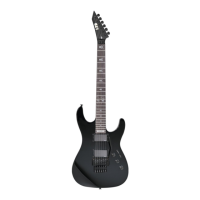
| Body Material | Mahogany |
|---|---|
| Neck Material | Maple |
| Fingerboard Material | Rosewood |
| Scale Length | 25.5" |
| Pickups | EMG 81 (Bridge) / EMG 60 (Neck) |
| Bridge | Floyd Rose |
| Number of Frets | 24 |
| Color | Black |
| Frets | Jumbo |
| Tuners | Grover |
| Hardware Color | Black |
| Finish | Gloss |
| Neck | Thin U |
| Body Type | Solid |

 To Next Page