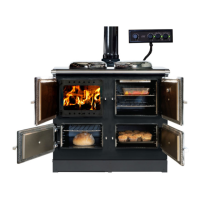
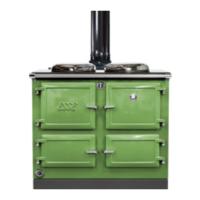
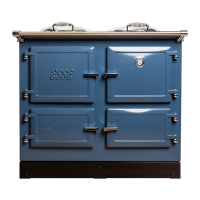
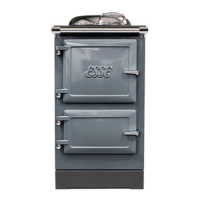
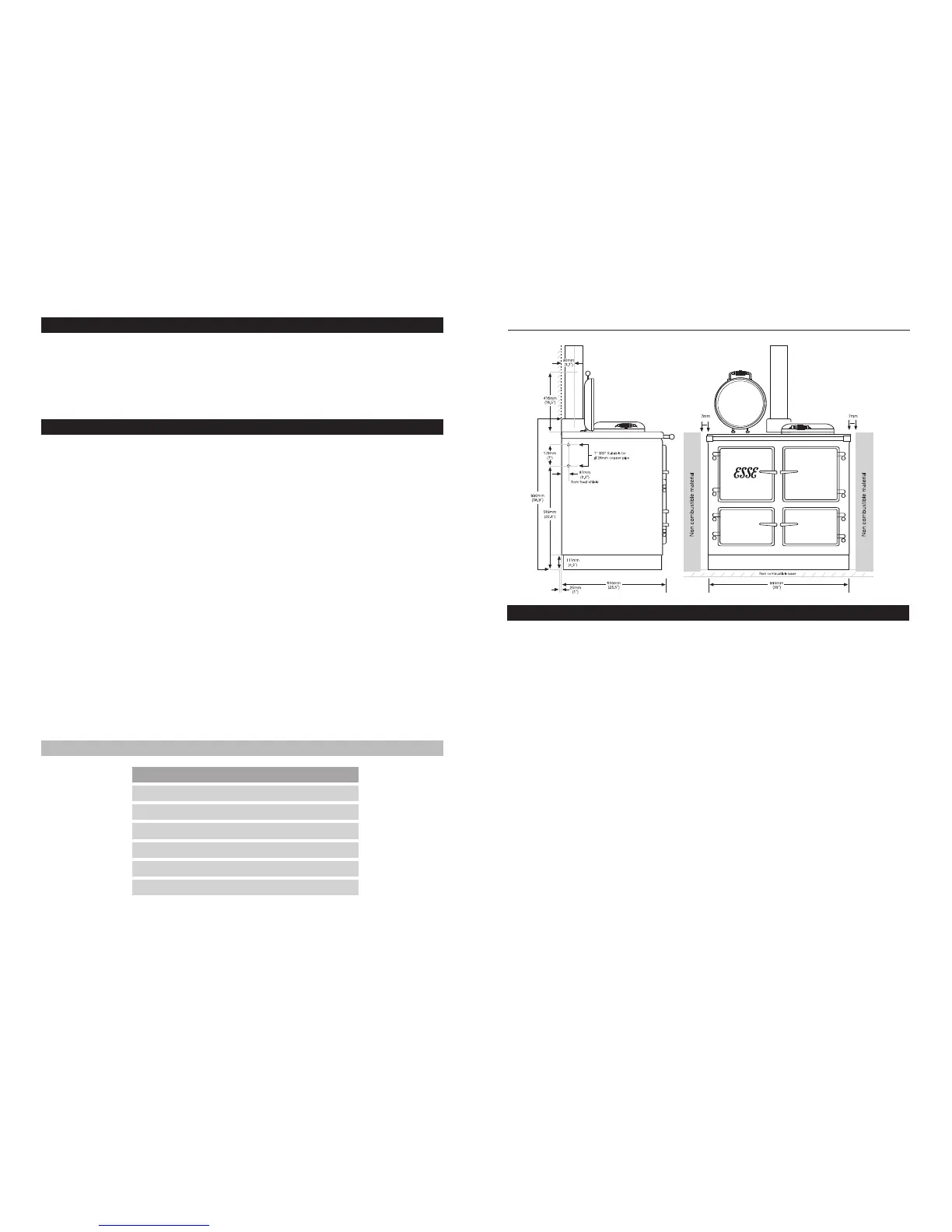
Fig.1 – Cooker Dimensions Note: All Dimensions are in milimetres
The successful operation of the cooking appliance relies on the adequate performance of the
chimney to which it is connected. The following chimney guidelines must be followed:
TECHNICAL INFORMATION
Nominal heat output 5.0kW
Combustion air requirements 29m
3
/h
Weight of appliance 450kg
Minimum chimney draught 12Pa
Mean flue gas temperature 170°C
Flue gas mass flow 10g/s
In the UK, the installer has a responsibility under the Health and Safety at Work Act 1974 to
provide for the safety of persons carrying out the installation. Attention is drawn to the fact
that fire cement is caustic and hands must be washed thoroughly after use. The appliance is
heavy (max 450kg) and care must be taken during handling. Although the appliance does
not contain asbestos products, it is possible that asbestos may be disturbed in existing
installations and every precaution must be taken.
These instructions give a guide for the installation of the appliance but in no way absolve the
installer from responsibilities to conform to British Standards, in particular BS8303 and
BS6461, relating to the installation of solid fuel appliances. All local regulations including
those referring to national and European standards need to be complied with, when installing
this appliance.
Outside of the UK, the installer must comply with all local, national & European standards
that apply.
Any adjacent combustible material should be far enough away from the appliance so as not to
raise 60ºC above the room temperature when the appliance is in operation. If necessary, any
adjoining walls should be protected from the effects of heat. Clearances from combustible
materials are 20mm from the sides and 40mm from the rear.
It is also recommended that a smoke alarm and appropriate fire safety equipment such as
a fire extinguisher and fire blanket are installed in the kitchen as a safety precaution.
An adequate air supply for combustion and ventilation is required. A purpose provided air
vent is necessary. Air openings provided for this purpose must not be restricted.
General Safety Information Page 2
Chimney and Flue Information Page 3
Flue Draught Page 4
Installing the Appliance Page 5
Commissioning the Appliance Page 5
Chimney and Flue Page 6
Replacement Parts Page 7
Hot Water System Page 7
• It should have an internal cross section of
no less than 320cm2 (200mm dia.) (If a
flue liner is used, it should be 150mm (6’’)
diameter and be made of suitable
material for burning wood). A Flue with
a diameter of 150mm (6’’), is required
to connect to the cooker.
• Voids in the chimney should be avoided,
as these will prevent a steady flue
draught. The appliance flue pipe should
pass beyond the narrowing of the
chimney.
• Terminate at least 1m above roof level so
that the chimney does not terminate in
a pressure zone.
• If the appliance is installed as a
freestanding appliance, it should not
support any part of the chimney.
• Be free from cracks, severe bends, voids,
and obstructions.
• Be connected to this one appliance only.
• New chimneys must be in accordance
with local regulations.
• The chimney must be capped to prevent
ingress of rain.
• A flue/chimney access point is required
so that the state of the chimney can be
checked and any fallen soot removed.
• External flues must be insulated to
prevent heat loss.
• Do not fit an extractor fan in the same
room as the appliance.
• Be a minimum 4.6m high from top
of the cooker to the chimney pot.
CHIMNEY AND FLUE INFORMATION
CHIMNEY AND FLUE INFORMATION
TABLE OF CONTENTS
GENERAL SAFETY INFORMATION
Warning: This appliance is not suitable for installation in a shared flue system
2 3


 To Next Page
 Loading...