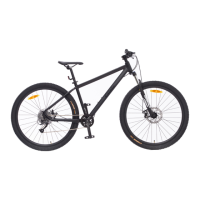
The device in question is an Estate Electric Folding Bicycle, model number EST-EFLDBIKE, with product code 705770, manufactured in September 2021. This manual provides comprehensive information for its use, assembly, maintenance, and troubleshooting.
Function Description:
The Estate Electric Folding Bicycle is designed for personal transportation, offering the convenience of an electric bicycle with the added benefit of a folding frame for easy storage and portability. It provides pedal assistance, making it easier to ride, especially uphill or over long distances. The electric motor engages when the rider pedals, providing an extra boost. The folding mechanism allows the bicycle to be compactly stored in small spaces, such as car trunks, apartments, or public transport.
Important Technical Specifications:
- EPAC cut-off speed: 25 km/h
- Mass of EPAC in the most usual configuration (weight): 23 kg
- Electric motor max. continuous rated power: 250 W
- Max. permissible total weight: 123 kg (bicycle + rider + luggage)
- Dimensions (assembled): 155 x 51 x 109 cm
- Rechargeable li-ion battery model number: FP-YY247.8
- Rated voltage: 24 V
- Rated capacity: 7.5 Ah, 180 Wh
- Battery dimensions and net weight: 43 x 6.4 x 7.7 cm, 2.1 kg
- Battery charger model number: XVE-2940200
- Charger output: 29.4 V, 2 A
- Charging time (from 0% to 100%): 5 hrs (approx.)
- Tyre pressure: 270–440 kPa (40–65 psi), which is equivalent to 19–30 N·m (6.895 kPa).
- Maximum rider weight: 100 kg (including rear carrier 15 kg loading; excluding the bicycle weight).
Usage Features:
- Folding Mechanism: The bicycle features a quick-release folding mechanism for the frame, handlebar, and pedals, allowing for compact storage.
- Opening the Bike: Unfold the bike, connect the front frame to the rear half-part, lift up the frame quick release, and open the front frame. Lock the quick release.
- Assembling the Handlebar: The handlebar stem pillar is inserted into the fork tube, and the handlebar is secured with clamp bolts. The stem pillar has a minimum insertion line that must be observed.
- Installing the Pedals: The pedals are threaded into the crank arm. The right pedal ("R") is threaded clockwise, and the left pedal ("L") is threaded anticlockwise. Torque requirements are 35–40 N·m.
- Installing the Saddle: The seat post is inserted into the bicycle frame, ensuring the minimum insertion mark on the seat post is completely inserted. The quick release seat post binder bolt is secured, and the tension adjustment nut is adjusted to prevent the cam lever from rotating excessively.
- Folding the Electric Bicycle: Unlock the quick release on the frame, then release it. Lift up the quick release until it unlocks, then fold the front frame. Unlock the locking lever on the handlebar stem, and push the bolt to the side to release the locking mechanism. Fold the lever in the pedal, then fold the pedal. Fold the frame and stem.
- Battery and Operation:
- Battery Charging: The battery is a smart lithium battery. It is recommended to charge the battery after every use. The charging process involves connecting the AC plug into an electrical wall outlet, opening the battery cover, and inserting the DC connector into the battery. The charging light illuminates red during charging and turns green when 80% charged. A full charge (from 0% to 100%) takes approximately 5 hours.
- Operation: To start, insert the key into the battery and turn it to the ON position to supply electricity. The LED light next to the throttle will illuminate to show battery percentage. To stop, turn the battery key to the OFF position.
- Electric-assisted mode (pedal assistance): Pedal assistance is triggered when the rider pedals. The power assistance will turn itself off when the e-bike reaches the maximum speed of 25 km/h.
- 6km/h mode: The throttle can be turned to provide 6 km/h assistance when pushing the bicycle.
- Removing/inserting the battery: To remove the battery, turn the battery key to the UNLOCK position and pull out the battery by the handle. To insert the battery, turn the battery key to the OFF position.
- Safety Features:
- Reflective vest: Cyclists must wear a reflective vest at night outside urban areas.
- Usage restrictions: The appliance is not intended for use by persons (including children) with reduced physical, sensory or mental capabilities, or lack of experience and knowledge, unless they have been given supervision or instruction concerning the use of the appliance by a person responsible for their safety. Children should be supervised to ensure that they do not play with the appliance.
- Traffic laws: State and local traffic laws must be obeyed. The bicycle is equipped with a warning device (horn or bell) and a light.
- On and off-road operation: The bicycle is not intended for use on unpaved ground or for off-road use.
- Protective equipment: Always wear proper protective equipment, such as an Australian standards-approved helmet, elbow pads, knee pads, long sleeve shirt, gloves, and long pants.
- Footwear: Always wear fully enclosed shoes; never ride barefoot or in sandals.
- Wet weather warning: Slow down your speed when riding in rainy and snowy conditions and in slippery areas. Increase braking distance to ensure safety.
- Night-time operation: Do not ride at night without a headlight, taillight, a white front reflector, a red rear reflector, and yellow wheel reflectors.
- Handlebar grips and tube end plugs: Should be replaced if damaged, as bare tube ends have been known to cause injury.
- Battery safety: Do not disassemble or modify the battery. Do not connect the (+) and (-) connections of the battery with a metal object. Do not expose the battery to liquids. Do not short-circuit the positive (+) and negative (-) battery terminals.
- Charging safety: Switch off the bike before charging. Ensure the battery is attached to the bike, and the bike is switched off.
- Storage: Store the battery in an event of non-use, infrequent use or storage, please recharge the battery at least every month to ensure that it will work properly, and keep it in a dry and cool environment. Prolonged storage of an empty battery may damage the battery.
- Power run out: Do not let the battery run out of power completely, otherwise it will damage the battery. The best charge-discharge is 20%–80%.
- Overnight charging: Never leave the battery charging overnight or with no one to monitor. A damaged battery may overheat and cause a fire. Always unplug the charger from the battery and wall outlet when fully charged.
Maintenance Features:
- Cleaning and Care:
- General cleaning: After every ride, wash the bike with soapy water (liquid dish soap is recommended) for its ability to remove grease without damaging the bike. Do not wash any electrical parts. Avoid using high-pressure washers. Always dry the bike with a soft cloth to avoid rust and corrosion.
- Lubrication: Lubrication is an important part of maintenance. The front axle, middle axle, flywheel, front fork shock absorber pivot, and other components should be scrubbed with an appropriate lubricating oil every six months.
- Chain tension: Check the chain tension after every ride. The correct chain tension is 8036 N. The bike has a freewheel, so the chain can be checked by spinning the pedals backwards. The chain needs to be as tight as possible without creating friction that will waste energy and wear the chain and cogs prematurely.
- Rear wheel alignment: To adjust the rear wheel's position, loosen one side and push the rim between the chain stays to move the loose end of the axle a short distance back or forward. Retighten the nut. Loosen the other side and ease the rim in the other direction so the rear wheel is once again straight in the frame.
- Tyre pressure: Test again and repeat the process, moving the rear wheel a short distance forward or back until the tension is in the target zone. You need to test by spinning the pedals because neither cogwheel will be a perfect circle so the chain tension will vary as the cranks spin. Once the chain tension is acceptable, tighten both nuts fully.
- Cables: During the whole process, pay attention to the motor cable, do not damage or loosen the cable.
- Storage: When not in use, store the electric folding bicycle in a cool, dry place, protected from dust, high humidity, and frequent temperature changes, and out of reach of children. For prolonged storage, use the original carton for the bike and storing the battery separately. Ensure the battery is at least partially charged as prolonged storage of an empty battery may damage the battery.
- Service and Repair:
- Worn parts: As with all mechanical components, the bicycle is subjected to wear and high stresses. Different materials and components may react to wear or stress fatigue in different ways. If the design life of a component has been exceeded, it may suddenly fail, possibly causing injuries to the rider. Any form of crack, scratch, or change of colouring in highly stressed areas indicates that the life of the component has been reached, and it should be replaced.
- Wheel rims and brake pads: Danger of wheel failure due to rim and brake pad wear! Replace the wheel when any part of the rim wear groove is not visible. Replace the brake pad when any part of the brake pad wear groove is not visible.
- Brake pads replacement: Use an M6 Allen key to release the bolt of the brake pad. Replace the brake pad. Then tighten the bolt with an M6 Allen key, making sure to adjust the brake pad to fit perfectly with the rim.
- Spare parts: After sales support centres stock spare batteries and chargers for the electric folding bicycle. To purchase a spare part or book a service, contact the after sales support centre.
- Warranty: The product is guaranteed to be free from defects in workmanship and parts for a period of 12 months from the date of purchase. Defects that occur within this warranty period, under normal use and care, will be repaired, replaced, or refunded at Tempo's discretion. The benefits conferred by this warranty are in addition to all rights and remedies in respect of the product that the consumer has under the Competition and Consumer Act 2010 and similar state and territory laws. Goods come with guarantees that cannot be excluded under the Australian Consumer Law. You are entitled to a replacement or refund for a major failure and to compensation for any other reasonably foreseeable loss or damage. You are also entitled to have the goods repaired or replaced if the goods fail to be of acceptable quality and the failure does not amount to a major failure.
Troubleshooting Guide:
The manual includes a comprehensive FAQs and Troubleshooting Guide to address common problems:
- When turned on, the indicator light won't turn on: The battery is completely discharged. Charge the battery.
- The motor won't work, the display won't turn on: The electric cable which connects the battery is loose. Contact after sales support for a service.
- There is no electric power to the bike: The fuse has burnt out. Contact after sales support for a service.
- Insufficient battery capacity: Charge the battery fully.
- The travelling distance has been reduced: The battery is getting old and needs replacement. Replace the battery. Spare batteries are available for purchase from after sales support.
- Braking frequently, riding uphill or running against the wind continuously: Use more pedalling.
- The connecting cable is becoming loose: Insert the charging connector firmly into the socket.
- The indicator light does not illuminate when charging: The fuse has burnt out. Contact after sales support for a service.
- The charger is damaged: Replace the charger. Spare chargers are available for purchase from after sales support.
- Other issues: Problems with electrical components. Contact after sales support for a service.

 Need help?

 To Next Page
 General