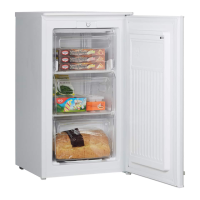
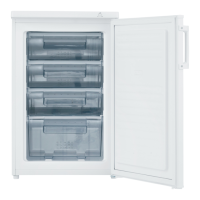
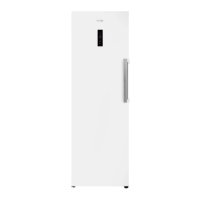
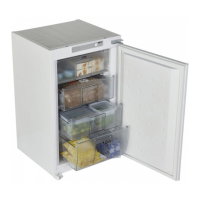
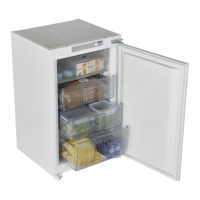
This document provides instructions for use of an ETNA freezer, model VV0182. The appliance is intended solely for household use, specifically for freezing fresh food and for long-term storage of frozen food (up to one year, depending on the type of food).
Appliance Description
The freezer consists of several key components:
- Freezing compartment (1): The primary area for freezing fresh food.
- Storage compartment (2): For storing already frozen food.
- Control unit (3): Houses the thermostat knob and signal lights.
- Condensate tray (4): Collects water during defrosting.
The drawers within the appliance are protected against accidental pulling out. To remove a drawer, pull it out as far as it will go, then lift it at the front and pull it out completely.
Important Notes and Warnings
- Safety: This appliance can be used by children aged 8 years and above, and persons with reduced physical, sensory, or mental capabilities, or lack of experience and knowledge, if they have been given supervision or instruction concerning safe use and understand the hazards involved. Children should not play with the appliance, and cleaning and user maintenance should not be performed by children without supervision.
- Installation: Before connecting, read the instructions carefully. Integrated appliances come with separate installation instructions for experts. Remove all packaging materials. Allow the appliance to rest in a vertical position for approximately 2 hours before connecting to power to prevent operation faults in the cooling system due to transport.
- Electrical Connection: The appliance must be connected to a grounded power mains in compliance with standards and regulations. The plug must be readily accessible after installation. The appliance will withstand short-term voltage deviations of up to +/- 6%.
- Environment: Do not use outdoors or expose to rain. Do not store explosive substances like aerosol cans with flammable propellants.
- Maintenance: Before cleaning, unplug the appliance. If the power cord is damaged, it must be replaced by a service technician. If out of use for a prolonged period, switch off, unplug, empty, defrost, clean, and leave the door ajar.
- Ventilation: Keep ventilation openings clear of obstruction.
- Defrosting: Do not use mechanical devices or other means to accelerate defrosting, other than those recommended by the manufacturer.
- Refrigerant Circuit: Do not damage the refrigerant circuit.
- Internal Appliances: Do not use electrical appliances inside food storage compartments unless they are of the type recommended by the manufacturer.
- Stability: Ensure the appliance is installed as instructed to avoid hazards from poor instability.
- Rating Plate: The rating plate is located inside the appliance. If the language is incorrect, replace it with the one supplied.
- Disposal: The product and its packaging should not be treated as normal household waste. Take it to an authorized collection center for waste electrical and electronic equipment. Packaging materials are environmentally friendly and recyclable.
Advice for Saving Power
To optimize energy consumption:
- Install the appliance as specified in the manual.
- Avoid opening the door more often than necessary.
- Ensure unobstructed air circulation underneath the appliance.
- Keep the condenser unit on the rear wall clean.
- Replace damaged door gaskets promptly.
- Store food in tightly sealed containers or appropriate packaging.
- Cool food to room temperature before placing it in the appliance.
- Defrost frozen food in the refrigerator compartment.
- Remove some drawers from the freezer to maximize interior space.
- Defrost conventional freezers when a 3-5 mm layer of frost or ice has built up.
- Ensure uniform shelf layout and proper food placement for free air circulation.
- In appliances with a fan, do not block fan slots.
- Switch off the fan or ionizer if not needed to reduce power consumption.
Installation and Connection
Selecting the Room:
Install the appliance in a dry, well-ventilated room. The ambient temperature must fall within the specified range for the appliance's climate class, indicated on the rating plate:
- SN (subnormal): +10°C to +32°C
- N (normal): +16°C to +32°C
- ST (subtropical): +16°C to +38°C
- T (tropical): +16°C to +43°C
Ensure the room is large enough, with at least 1 m³ of space per 8 grams of refrigerant (amount stated on the rating plate).
Appliance Placement:
- The appliance has four height-adjustable feet, allowing height adjustment between 82 cm and 90 cm. Adjust the height before installing it into the kitchen cabinetry so the upper edge is just under the worktop.
- Avoid direct sunlight and proximity to heat sources. If unavoidable, install an insulation panel.
Connecting the Appliance:
- Connect to the power mains using a connection cable and a grounded wall outlet.
- Nominal voltage and frequency are on the rating plate.
- The appliance must be grounded according to effective standards and regulations. It can withstand short-term voltage deviations of +/- 6%.
Operating the Appliance
The control unit features:
- A: Knob for temperature settings, switching on/off, and activating the super freeze function.
- B: Signal light indicating super freeze function is activated.
- C: Signal light indicating the appliance is powered.
- D: Flashing signal light for high temperature alarm.
Switching the Appliance On/Off:
- To switch on: Rotate knob A clockwise towards the thicker end of the marking.
- To switch off: Rotate knob A back to the position where the arrow aligns with the symbol (the appliance remains powered, and signal light C stays on).
Adjusting the Temperature:
- Rotating knob A towards the thicker end of the marking results in a lower (cooler) temperature.
- Rotating knob A towards the thinner end results in a higher (warmer) temperature.
- Adjust the setting based on ambient temperature changes.
- The recommended setting is halfway between the thinner and thicker ends of the sign.
Freezer Boost Function:
- Use this function when first switching on, before cleaning, or when inserting a large amount of food.
- To activate: Rotate knob A to position * (signal light B will illuminate).
- After freezing, rotate knob A back to the desired setting. Signal light B may turn off, indicating a sufficiently low temperature has been reached.
- If not manually deactivated, the function will automatically deactivate after approximately two days, and the freezer temperature will return to the most recent setting (knob position remains at *).
High Temperature Alarm:
- If the internal temperature is too high, signal light D will flash.
- The light will switch off automatically once the temperature drops to a safe level.
- When the appliance is first switched on, there is a 24-hour delay in alarm operation to prevent unnecessary alarms while the appliance reaches its adequate temperature.
Freezing and Storing Frozen Food
Freezing Process:
- The maximum amount of fresh food that can be frozen at once is specified on the rating plate. Exceeding this amount will result in inferior freezing quality and may deteriorate already frozen food.
- For large amounts: 24 hours before freezing, rotate the thermostat knob to position *. After 24 hours, place fresh food into the freezing compartment, ensuring it does not touch already frozen food.
- For small amounts (up to 1 kg): Adjusting the thermostat knob is not necessary.
- After 24 hours, the food can be moved to other parts of the freezer. The freezing process can be repeated by rotating knob A back to the middle position, then after 5 seconds, to position * (signal light B will light up).
- Once freezing is complete, rotate knob A back to the desired setting, even if signal light B is off.
Important Warnings on Freezing Fresh Food:
- Only freeze food suitable for freezing, ensuring it is high quality and fresh.
- Use appropriate, airtight packaging that is impermeable to humidity to prevent drying out and vitamin loss.
- Label food with type, amount, and freezing date.
- Freeze food as quickly as possible; use small packages and refrigerate food before freezing.
Storage of Industrially Frozen Food:
- Follow the manufacturer's instructions regarding storage temperature and expiry date.
- Choose food with undamaged packaging, stored at -18°C or lower.
- Avoid food covered in frost, as this indicates partial defrosting and inferior quality.
- Protect food from thawing during transport. Increased temperature shortens storage time and deteriorates quality.
Frozen Food Storage Time (Recommended):
- Fruit, beef: 10 to 12 months
- Vegetables, veal, poultry: 8 to 10 months
- Venison: 6 to 8 months
- Pork: 4 to 6 months
- Minced meat: 4 months
- Bread, pastry, ready-to-eat meals, lean: 3 months
- Entrails: 2 months
- Smoked sausage, fatty fish: 1 month
Defrosting Frozen Food:
- Freezing does not kill microorganisms; bacteria reactivate upon defrosting.
- Use partially or completely defrosted food as soon as possible.
- Partial thawing decreases the nutritive value, especially for fruit, vegetables, and ready-to-eat food.
Defrosting the Appliance
Defrosting a Conventional Freezer:
- Defrost when a 3-5 mm layer of frost or ice has built up.
- 24 hours before defrosting, activate the super freeze function to pre-cool food.
- After this period, remove food from the freezer and protect it from defrosting.
- Switch off the appliance and unplug the power cord.
- Do not use: defrosting sprays (may melt plastic parts or harm health), knives, or sharp objects (may damage cooling system pipes).
- To speed up defrosting, place a pot of hot water on the glass shelf.
- Clean and dry the interior (see Cleaning the Appliance).
- Empty the condensate tray at the bottom of the appliance.
- Remove the cabinet kickplate.
- Reach into switchboard openings and release the latch.
- Pull the plate towards you and remove it.
- Remove and empty the condensate tray.
- After defrosting, switch the appliance back on and set the thermostat knob to the desired setting before returning food.
Cleaning the Appliance
- Before cleaning, unplug the appliance.
- Use a soft cloth. Avoid abrasive substances, acids, or solvents, as they can damage surfaces.
- Clean the exterior with water or a mild solution of suds. Lacquer-coated and aluminum surfaces can be cleaned with lukewarm water and mild detergent. Low-alcohol cleaners (e.g., window cleaners) are acceptable, but avoid alcohol-containing cleaners for plastic materials.
- Clean the interior with lukewarm water and some vinegar.
- Regularly remove frost or ice build-up (3-5 mm thick) to prevent increased power consumption. Do not use sharp objects, solvents, or sprays.
- To vacuum dust from the condenser unit:
- Remove the cabinet kickplate.
- Reach into switchboard openings and release the latch.
- Pull the plate towards you and remove it.
- Pull out the condensate tray.
- Use a vacuum cleaner to clean dust from the condenser unit.
- Replace the condensate tray and switchboard in reverse order.
- After cleaning, switch the appliance back on and insert the food.
Troubleshooting
| Problem | Cause or Remedy



 To Next Page
 General