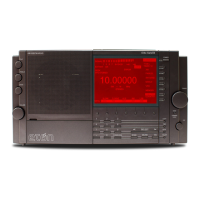
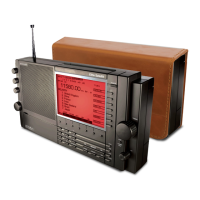
FRONT PANEL BOARD
Please refer to the E1 Front Panel Board Block Diagram (Figure 2) as you follow this discussion. References will also
be made to components shown on the “SCH. Front Panel” schematic sheets 1 and 2.
Power Supply
Power from V_BAT on the main board is applied
directly to regulator VR1 to provide full time 3.3 volts to
the processor (U1) and all other digital ICs that are
connected directly to the processor. Power from V_BAT
is also applied to switch Q5. Q5 is controlled by the
processor and switches power on and off to regulator
U8. U8 is set to +3.6 volts and provides switched power
to the LCD, LCD backlight, LCD controller (U5), LCD
RAM (U6), and the DC-DC converter.
Processor Section/LCD Control
U2 functions as a latch that decodes 8 individual
data lines from the eight bit processor data bus. It is
enabled and selected by the processor. U3 works as a
bidirectional switch that allows gated two way
communication between the Satellite Interface board,
and the processor data bus. It is enabled, and has its
direction controlled by the processor. U10 works as a
switch to apply the eight bit processor data bus to the
tactile switch matrix . It is enabled by the processor only
as needed when button activity is detected. This greatly
reduces the RFI that the switch matrix would otherwise
emit. U11 serves as a switch to connect the eight bit
processor data bus to the LCD controller only when the
controller is powered. It is enabled by the same signal
that turns on Q5. U4 is an EEPROM whose purpose is
to store information such as memory settings in a non-
volatile manner. U12 functions as a DPDT switch to
connect receive and transmit series data between the
processor and either the Satellite interface board, or the
front panel connector, to exchange memory settings
between two E1 receivers, and for possible processor
programming. U5 is the LCD controller serving to
interface between the LCD itself, and the processor. U6
is the LCD RAM and is used to temporarily store the
pixel states.
Voltage Detection
Q3 and Q8 serve to periodically sample the battery
voltage in order to display battery level. Q1 is used to
detect if power is present at the external power jack. U9
is the low voltage detector used to shut off the radio at a
voltage high enough to retain all volatile settings in the
event of a power interruption or simply when the battery
voltage falls too low (less than 3.7V). CR8 and Q20
function to turn the radio off in the event of excess
voltage (greater than 17V) being applied to the radio that
would otherwise over dissipate several components.
Other Switching / Misc.
Q13 and Q12 serve to switch 3.3 volts on and off to
the tuning encoder and PBT pot. SW38 is the power
button, and SW41 is the processor reset button. Q6
controls the intensity of the LCD backlight, which is
chopped at approximately a 3 kHz rate. Unless it is at full
brightness at which time the duty cycle is 100%. It is
driven directly by the processor.
DC-DC Converter
U7 functions to control two DC to DC converters,
one for negative LCD glass bias, and the other for the
synthesizers and tracking filter on the main board. Both
are powered by the switched 3.6 volt supply. U7 (pin 1
out) is the oscillator. U7 (pin 2 out) is the pulse width
modulator for the LCD bias supply. Q7 is the driver, and
Q9/Q4 form the feedback path after the contrast pot.
The contrast pot will vary the output voltage from -17 to -
21 volts.
U7 (pin 13 out) is the pulse width modulator for the
synthesizer/tracking filter supply. Q15 is the driver, and
CR5/Q14 constitutes the feedback path. The output of
this supply is fixed at +16V.
Audio Filter
A 100Hz low pass / bandpass filter is used to filter
100 Hz tone bursts form the HF audio whenever the
radio attempts to set its own clock by tuning to the
clearest WWV universal time broadcast in the HF band
(not LF). Q18 is part of a Sallen-Key low pass filter.
Q19 forms a twin T bandpass amplifier. Together they
form the overall low pass/bandpass response. Q17 and
Q16 form a switch to turn power on and off to the filter.
Tactile Switch Matrix
SW1 to SW40, except SW 39, form the E1 receiver
front panel switch matrix. Pressing any button connects
one of eight gated data lines from the eight bit processor
data bus (columns), to one of five return lines that go
back to the processor (rows).


 To Next Page
 Loading...