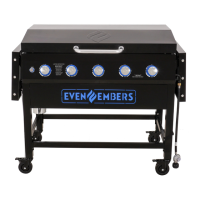
This document outlines the assembly, operation, and maintenance of the Even Embers 5 Burner Gas Griddle, Model GAS2540AS. It is designed for outdoor cooking and emphasizes safety precautions throughout its use.
The primary function of this device is to provide an outdoor cooking surface using propane gas. It features five burners, allowing for versatile cooking temperatures across the griddle top. The griddle is intended for personal, non-commercial use.
Usage Features:
The griddle is designed for straightforward operation, with a focus on safety. Before initial use and after any tank refill or movement, a leak test is mandatory to prevent fire or explosion hazards. This involves applying a soapy water mixture to all gas connections and checking for bubbles, which indicate a leak. The griddle should always be operated outdoors in a well-ventilated area, away from combustible materials, buildings, and overhangs. A minimum clearance of 36 inches (91 cm) from the back and all sides of the griddle to any combustible material is required.
Lighting the main burners involves opening the griddle lid, ensuring all control knobs are in the "OFF" position, and slowly turning on the fuel supply at the cylinder valve. To light a burner, the control knob is pushed and turned to "HIGH," and the igniter is held for 3-5 seconds. If ignition doesn't occur within 5 seconds, the knob should be turned to "OFF," and a 5-minute wait is required before repeating the procedure. For subsequent burners, the same steps are followed. If the igniter fails, match lighting instructions are provided, which involve using a paper match in a matchlighter.
The griddle is equipped with a Type 1 connection device that ensures gas flow only when a positive seal is obtained with the cylinder valve. It also includes a regulator flow limiting device that restricts gas flow to 10 cubic feet per hour if activated. If the griddle isn't heating sufficiently, a "Regulator Resetting Procedure" (Mini Reset or Full Reset) is outlined to address this.
Seasoning the griddle top is recommended before cooking to create a non-stick surface and protect against rust. This process involves heating the griddle, applying cooking oil, spreading it evenly, and allowing it to smoke, repeating the process multiple times until a dark surface begins to form. While a slight warp may develop during heating and cooling, it should not affect performance.
For cooking, it's crucial to maintain proper food hygiene, including thoroughly washing hands and utensils when handling raw meat, poultry, or seafood. Different platters should be used for raw and cooked foods, and marinades from raw food should not be reused on cooked items. A meat thermometer is recommended to ensure food reaches safe internal temperatures.
To turn off the griddle, the cylinder valve must be closed first, followed by turning all burner control knobs to the "OFF" position. This sequence prevents gas from being left in the system under pressure.
Maintenance Features:
Regular maintenance is essential for the griddle's longevity and safe operation. The document provides detailed instructions for cleaning the griddle and its components.
For the griddle cooking surface, a specific cleaning procedure is recommended after each use. This involves cooling the griddle top below 300°F, scraping food debris with a spatula or metal scraper, wiping with a paper towel, and then applying a small amount of water to sections of the griddle, scraping water and debris toward the grease cup. It's crucial not to use cold water on a hot griddle to prevent warping and never to use dish soap on the seasoned surface, as it will remove the seasoning. For tough spots, table salt and hot water can be used, followed by a thin layer of oil. After cleaning, a thin coating of cooking oil should be applied to maintain seasoning and protect against rust. If rust appears, it can be rubbed off with steel wool or low-grit sandpaper, and the surface should be re-seasoned. In humid or coastal climates, more frequent seasoning and heavier cooking oils may be necessary.
Burner cleaning and maintenance are also detailed. This includes keeping the appliance free of combustible materials and debris, and visually checking burner flames for proper operation. Spiders and insects can build nests in burner tubes, blocking gas flow and potentially causing a burner tube fire or fire beneath the griddle. To clean the burner assembly, the gas supply must be turned off, the cooking griddle removed, and cotter pins detached from each burner post. Burners are then lifted, and a narrow bottle brush or stiff wire is used to clear burner tubes and flame ports. A wire brush cleans the outer surface of the burner. Any damaged burners (cracks, abnormal holes) must be replaced. After cleaning, burners are reinstalled, ensuring proper alignment with valve nozzles, and cotter pins are replaced. A leak test and relighting of burners are necessary to verify proper operation.
For storage, the cylinder valve must be fully closed, and all surfaces cleaned. Burners should be lightly coated with cooking oil to prevent rusting. If storing the griddle indoors, the LP tank must be disconnected and left outdoors. A dust cap should be placed on the cylinder valve outlet. Before use after storage, especially after longer periods, the burner should be checked and cleaned for spider or insect nests. Covering the unit when stored outside is recommended to extend its life and condition.
The document also includes a "Trouble Shooting" section to help diagnose and resolve common issues such as burners not lighting, insufficient heat, irregular flame patterns, yellow or orange flames, flame blowouts, flare-ups, grease fires, flashbacks, and peeling inside the lid. Each problem is linked to a possible cause and a corresponding prevention or cure.


 To Next Page
 General