3
EN
DANGER
DANGER
If you smell gas:
• Shut o gas to the appliance.
• Extinguish any open ame.
• If odour continues, keep away from the appliance and immediately call your re department.
Failure to follow this instruction could result in re or explosion, which could cause property damage,
personal injury, or death.
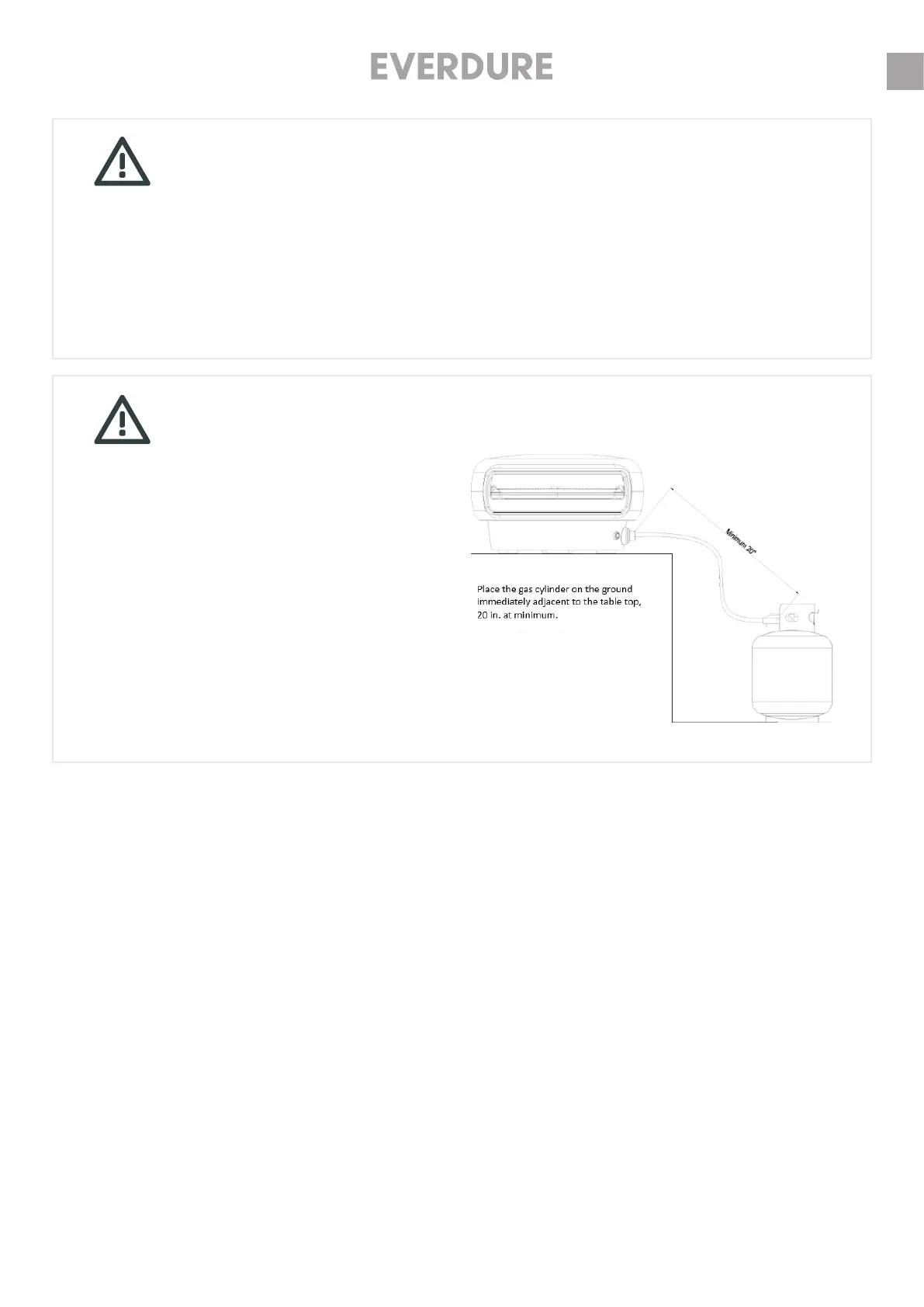
• Never operate this appliance unattended.
• This appliance shall not be located or used
under overhead, unprotected, combustible
construction.
• Never operate this appliance within 10ft
(3.0m) of any structure, combustible material,
or other gas cylinders.
• Never operate this appliance within 24.5ft
(7.5m) of any ammable liquid.
• If a re should occur, keep away from the
appliance and immediately call your re
department. Do not attempt to extinguish
an oil or grease re with water.
Always check the gas hose and regulator for leaks before use. If there is evidence of abrasion, wear, cuts, or leaks,
the hose must be replaced prior to the appliance being put into operation. The replacement hose assembly shall be
that specied by the manufacturer.
This appliance is not intended for commercial use.
Grill appliances must conform with local codes or, in the absence of local codes, with the
National Fuel Gas Code,
ANSI Z223.1/NFPA 54, Storage and Handling of Liqueed Petroleum Gases, ANSI/NFPA 58; or Natural Gas and
Propane Installation Code, CSA B149.1; Propane Storage and Handling, CSA B149.2; or the Standard for Recreational
Vehicles, ANSI A119.2/NFPA 1192; and Recreational Vehicle Code, CSA Z240 RV Series, as applicable.
When utilizing the power adaptor, the appliance shall be electrically grounded in accordance with local codes or, in
the absence of local codes, with the National Electrical Code, ANSI/NFPA 70, or the Canadian Electrical Code CSA
C22:1.
Keep the electrical supply cord and the fuel supply hose away from any heated surface(s).
Appliance must be a minimum of 1ft (0.30m) away from any combustible wall surface.


 To Next Page
 Loading...