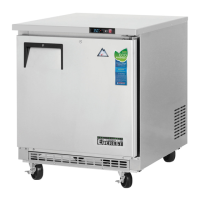
This document serves as the owner's manual for Everest Undercounters with Back Mounted Condensing Units, covering models ETBR1, ETBSR2, ETBR2, ETBWR2, ETBR3, ETBF1, ETBSF2, ETBF2, ETBWF2, ETBF3, ETBR1-D2, ETBSR2-D2, ETBR2-D4, ETBWR2-D4, and ETBR3-D2. It provides comprehensive guidelines for installation, safe operation, maintenance, troubleshooting, and warranty information.
Function Description:
The Everest Undercounter units are commercial refrigeration appliances designed for storing food products at controlled temperatures. They feature a back-mounted condensing unit and are available in various configurations, including solid door and drawer models. The units utilize R290 Hydrocarbon (propane) refrigerant, which is environmentally friendly but highly flammable, necessitating strict adherence to safety precautions. The primary function is to maintain specific internal temperatures for either refrigeration (33.0°F to 40.0°F / 1.0°C to 4.0°C) or freezing (-5.0°F to 0°F / -21.0°C to -18.0°C), depending on the model.
Important Technical Specifications:
- Refrigerant Type: R290 Hydrocarbon (Propane).
- Refrigerant Charge: Up to 150 grams (5.3 oz) per refrigeration circuit.
- Electrical Specifications: 115 volts, 60 hertz, single phase. Equipped with a NEMA 5-15P plug, requiring a 15 amp breaker.
- Temperature Control: Carel 'Easy' or 'ir33' Digital Temperature Control, depending on the model and production date.
- Default Temperature Settings:
- Refrigerators: 35.0°F (2.0°C)
- Freezers: -4.0°F (-20.0°C)
- Recommended Temperature Ranges:
- Refrigerators: 33.0°F to 40.0°F (1.0°C to 4.0°C)
- Freezers: -5.0°F to 0°F (-21.0°C to -18.0°C)
- Available Temperature Setting Ranges:
- Refrigerators: 33.0°F to 54.0°F (1.0°C to 12.0°C)
- Freezers: -10.0°F to 54.0°F (-23.0°C to 12.0°C)
- Defrost Cycle: Preset to defrost every 5-6 hours, with a duration of 45 minutes or less.
- Clearance Requirements: A minimum distance of 6 inches is required for back and right side clearance to ensure proper ventilation.
- Compressor: Hermetically sealed, warranted for five years. Example model ESC47L specifies 1/8 HP compressor, 3.27A total amps (comp run), 218PSIG high pressure test, and 38PSIG low pressure test.
Usage Features:
- Digital Temperature Control: Units are equipped with a Carel digital temperature control (either 'Easy' or 'ir33' series) for monitoring and setting the cabinet temperature. The display shows the current temperature and symbols for compressor activity, evaporator fan operation, and alarms.
- Temperature Setting: Users can adjust the desired temperature within the recommended ranges using the UP and DOWN buttons on the digital control. The setting is saved by holding the "Set" button.
- Manual Defrost: While automatic defrost cycles are in place, a manual defrost can be initiated by pressing and holding the Manual Defrost Button until the Defrost Symbol appears on the LED display. This stops the compressor and fan motors for a maximum of 45 minutes or until a safety termination temperature is reached.
- Self-Cleaning Condenser Fan: At the beginning of every compressor cycle, the condenser fan motor automatically rotates in reverse for 30 seconds to blow dust off the condenser coil, contributing to efficiency.
- Shelf Installation: Models come with shelves, shelf clips, and notched pilasters. Shelves are installed by attaching clips to pilaster notches and then placing shelves securely on the clips, ensuring even spacing and stability.
- Drawer Configurations: Drawered undercounters (e.g., ETBR1-D2, ETBSR2-D2, ETBR2-D4, ETBWR2-D4, ETBR3-D2) support various pan divider configurations for organizing contents. Pan dividers are not included as standard and must be purchased separately. Custom pan dividers may be required for standard full-sized pans.
- Door Switches: Interior lights and evaporator fan motors are controlled by door switches for solid door models and rocker switches for glass door models.
Maintenance Features:
- Condenser Coil Cleaning: Monthly cleaning of the condenser coil is crucial to prevent lint, dust, and grease buildup, which can reduce energy efficiency and lead to component failure. The manual provides detailed instructions:
- Disconnect the unit from the power outlet.
- Locate the condenser coil behind the vented grill at the back.
- Remove screws from the back grill and detach it.
- Use a long-bristled brush to remove lint, dust, and debris from between the metal fins, avoiding heavy pressure.
- For grease, use a commercial condenser coil cleaner, allowing it to saturate before brushing and wiping off residue.
- Repeat until fins are clean.
- Securely reattach the back grill.
- Reconnect the unit to the outlet.
- Gasket Inspection and Cleaning: Regular inspection and cleaning of door gaskets are necessary to ensure a complete seal, preventing temperature fluctuations and food spoilage.
- Interior Cleaning: The interior surface should be cleaned with mild soap and warm water. It's important to wipe the interior dry to prevent water damage and avoid abrasive cleaners or steel wool.
- Exterior Cleaning: The exterior stainless steel surface should be cleaned with a stainless steel cleaner to restore its condition and passivation, avoiding abrasive products.
- Prevention of Acid Damage: Acidic products and those containing vinegar must be stored in sealed containers to prevent damage to the unit's interior and evaporator coil.
- Ventilation: Maintaining proper ventilation (6 inches clearance on back and right sides) is essential to prevent overheating and ensure optimal performance. Avoid installing the unit in small, confined spaces or building enclosures around it.
- Electrical Safety: Regular checks of the power plug for debris and the electrical circuit for proper grounding are recommended. Damaged power cords must be replaced by authorized technicians.

 Need help?
 General

 To Next Page