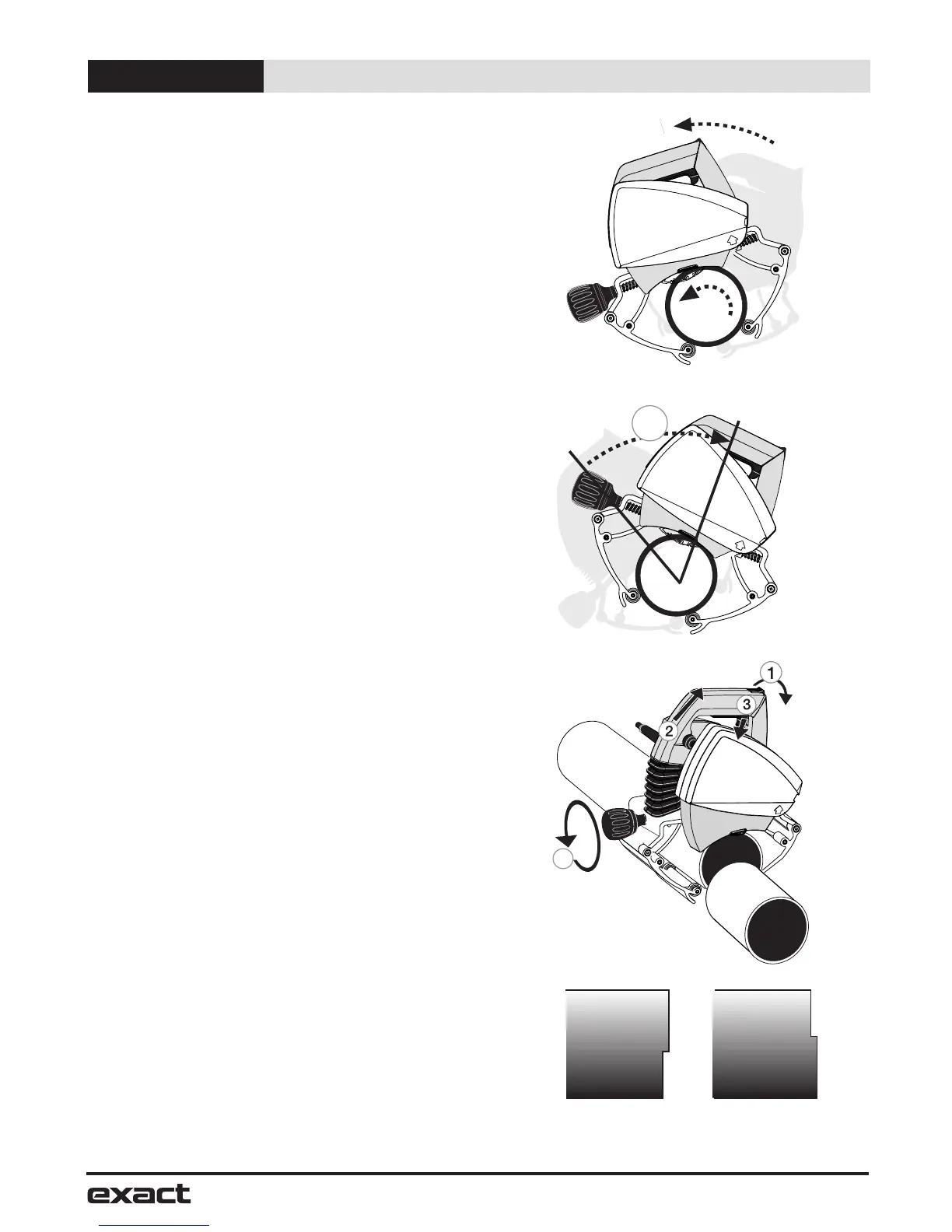
When the pipe is cut off, push the UNLOCK button
forward until the yellow mark is visible and the locking
is released (Fig L/1). Now raise the motor unit to
starting position (Fig L/2). Release the power switch
(Fig L/3). When the blade is stationary, remove the
pipe saw from the pipe by loosening the gripped
handle (Fig L/4). Ensure that the moving lower blade-
guard is lowered into safety position.
Should there be problems during piercing or sawing,
abnormal sounds or vibrations due to which you have
to interrupt sawing before the pipe is cut through,
release the blade by pushing the UNLOCK button
forward until the UNLOCK button is released, and lift
the motor unit up. Once the problem is cleared, start
sawing again.
Never start the motor, when the motor unit is locked
in sawing position or teeth of the blade contact the
pipe to be sawn.
Overload protection and spin-speed regulator
There is a spin-speed regulator in model 220E. A
suitable spin speed is selected, determined by the
material to be sawed. There is also an automatic
overload protection in the regulator.
In the case of overload: Release the power switch
(Fig L/3). Push the UNLOCK button forward until the
yellow mark is visible and the locking is released (Fig
L/1). The electronics circuit limits the current and stops
the motor. When the motor stops due the overload,
the red light on the pipe cutter is turned on. The pipe
cutter has to cool down while the electronics percepts
the internal temperature. The motor will not start (even
the red light turned off) until the switch is released
and pressed once more time or plug disconnect and
reconnect. The red light indicates to the user that the
machine was overloaded.
The indicator light in question turns on for a moment
every time the motor is started. This in normal and
does not require any actions.
Straightness of cut and adjusting wheel
The cut is affected by many factors, e.g. the size of
the pipe, the material, the wall thickness, the quality
of the pipe's surface, the roundness, welded seams,
blade condition, feed rate, operator's experience.
13
Operation
Fig J
Fig K
Fig L
Fig M
english
4
1/6
Gap to left Gap to right


 To Next Page