Need help?
Do you have a question about the Exped ORION EXTREME and is the answer not in the manual?
Remove all pegs and release the tent cords. Store pegs in the accessory bag.
First, release tension on the ridge pole and push it out of the sleeve without pulling.
Never light a stove in a tent as it is a fire hazard or can lead to carbon monoxide poisoning.
Lay out the combined canopy and rainfly with orange guy loops facing downwind.
Secure the head end with two pegs using the dark green guy loops.
Insert the two long poles into color-coded pole sleeves No. 1+2 until they curve.
Insert the ridge pole into the color-coded sleeve No. 3 until it curves.
Secure pole tips into grommets, tension rainfly with webbing, and secure corners with pegs.
Apply guy lines in a star-shaped configuration and secure with pegs, then tension.
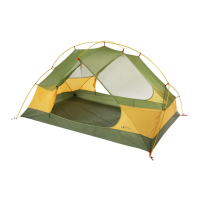
The Exped Orion Extreme and Orion UL are advanced tents designed for various outdoor adventures, offering a blend of innovation, quality, and refined details.
These tents provide shelter and protection from the elements, with a design that differentiates between windward and leeward sides for enhanced weather protection and increased ventilation. The doors are strategically placed on the leeward side. The canopy can also be set up independently as a ventilated shelter or bug tent, or as a canopy alone for a quick setup.
The tent utilizes a three-pole system: two long poles and one ridge pole. The pole sleeves are internal, flat, and color/number coded for easy setup, designed to reduce wind resistance and shed rain and snow efficiently. The guy lines are made of Dyneema, are reflective, and feature buckles for stepless adjustment. The rainfly fabric on the windward side extends to the ground to keep out wind, sand, and snow, while the leeward side has a small gap for enhanced ventilation.
Setup:
Setup Options:
Tips and Tricks:
Safety Note: Never light a stove inside the tent due to fire hazard and the risk of carbon monoxide poisoning.
Teardown:
Pre-adventure check: Before each trip, check the tent for completeness and damage. Inspect tent poles for cracks and burrs.
Condensation management: Appropriate ventilation prevents condensation. Regular re-tensioning of the tent is necessary as nylon fabrics absorb moisture, expanding, and then contracting when dry, affecting optimal stability.
Pole repair: Pole repair tubes are integrated into the supports of the air vents (Orion UL: in the accessory bag) for immediate access if needed.
Cord Stuffsacks: These prevent tangling of tent cords during packing. To use, insert three fingers into the Cord Stuffsack, wrap the tent cord around fingers, and then turn the stuffsack inside out.
Contents: The tent comes with a pre-mounted canopy and rainfly, an accessory bag (containing 3 tent poles, pegs, spare zipper slider, repair tube, spare pole segment, guylines, fabric patches), and a packsack.


 To Next Page
 General