
 Need help?
Do you have a question about the EZ Digital FG-7002C and is the answer not in the manual?
Summary of operating instructions and hazard warnings for user safety.
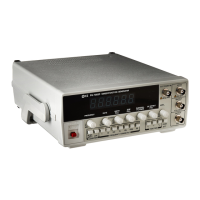
Overview of the instrument as a versatile signal source for electronics applications.
Detailed technical specifications, including output characteristics and frequency ranges.
Lists items included with the instrument, such as manual, cables, and fuses.
Procedure for checking the instrument for damage and verifying supplied accessories.
Instructions on how to safely connect the instrument to AC power, including voltage checks.
Guidelines for ensuring adequate cooling and ventilation for proper operation.
Information on placing the instrument, including tilt stand adjustment.
Recommendation for allowing the instrument to warm up for stability before use.
Identification and description of front panel controls, indicators, and connectors.
Guidance on operating the instrument and its capabilities.
Step-by-step procedure for using the instrument as a function generator.
Procedure for setting up and using the instrument as a pulse generator.
Details on the TTL/CMOS output, its compatibility, and usage.
Details on the TTL/SYNC output for TTL SYNC logic circuits.
Procedure for setting up and using the instrument as an FM signal generator.
How to use external voltage to control the generator's frequency.
How to select specific output frequencies using VCF input voltages.
Procedure for setting up and using the instrument as a sweep generator.
How to use external signals to control the sweep generator.
How to use the instrument as an external frequency counter.
Step-by-step guide for replacing fuses safely.
Recommendation for regular adjustment and calibration by qualified personnel.
Instructions on how to clean the instrument safely and effectively.
Introduction to the diverse applications of the sweep/function generator.
Method for troubleshooting by injecting signals and listening for output.
Method for troubleshooting by tracing signals through stages of equipment.
How to determine amplifier overload points using triangle waveforms.
Evaluating amplifier performance using square waves and an oscilloscope.
Using the instrument to test speaker and impedance network frequency responses.
Switching frequencies electronically using preset voltages to the VCF IN BNC.
Using triangle/ramp output to simulate DC source for testing logic and compactors.
 General
| AC Output | 120V |
|---|---|
| Fuel Type | Gasoline |
| Starting System | Recoil |
| Engine Type | 4-stroke OHV |
| Outlet Types | 120V AC outlets |
| Noise Level | 68 dBA |

 To Next Page