
 Need help?
Do you have a question about the F5 VIPRION 2400 and is the answer not in the manual?
Overview of the VIPRION 2400 system, its components, and features for network traffic management.
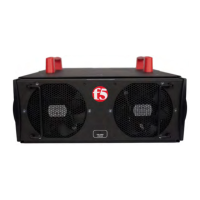
Description of the VIPRION 2400 chassis, the housing unit for system components.
Details on blades as primary traffic management components in the VIPRION platform.
Information on the external USB LCD module for system configuration and management.
Instructions for connecting and using the USB LCD module for system management.
Explanation of the LCD module menus for display options and system configuration.
Overview of indicator LEDs located on blades, power supplies, and the fan tray.
Explanation of LED behaviors that indicate system or component status.
Details on blade LEDs indicating primary/secondary status, alarm, and system state.
Description of blade LED states during normal system operation.
Explanation of blade LED indications for specific operating conditions.
Description of the fan tray's indicator LED status.
Explanation of LEDs for AC power supply status and power input.
Explanation of LEDs for DC power supply status and power input.
How the Alarm LED indicates system alert conditions.
Steps to define custom alerts for system indicators using configuration files.
Description of 10GbE SFP+ and 40GbE QSFP+ interfaces on VIPRION blades.
Details on using 40GbE QSFP+ ports as single 40GbE or four 10GbE ports.
Using the tmsh command-line utility to configure 40GbE QSFP+ interface bundling.
Using the graphical Configuration utility for 40GbE QSFP+ interface bundling.
How to configure platform interfaces, including status viewing, using tmsh or the Configuration utility.
Command to view the operational status of a single interface on the platform.
Command to view the operational status of all interfaces on the platform.
Configuration of interface speed and duplex mode settings for network connectivity.
How network interface LEDs indicate traffic activity, speed, and duplexity.
Description of LEDs for 40GbE QSFP+ ports in 40GbE and 4x10GbE modes.
Information on supported optical transceivers for the platform.
Pinout details for connectors and cables used with the platform.
Options available in the AOM Command Menu for system management when the host is powered down.
Steps to access the AOM Command Menu via the serial console for system management.
How to capture and view a blade's console output using the AOM Command Menu.
General guidance and safety precautions for installing the VIPRION 2400 platform chassis.
Recommendations for safely and effectively mounting the chassis in a rack environment.
List of hardware components included with the AC-powered VIPRION 2400 chassis.
List of hardware components included with VIPRION B2000 Series blades.
Required peripheral hardware for platform management, connectivity, and recovery.
Procedure for safely unpacking the VIPRION 2400 chassis from its shipping container.
Guidance on selecting a suitable location and installing the VIPRION 2400 chassis.
Information on using the pre-installed two-point rack mounting brackets for chassis installation.
Step-by-step instructions for installing the chassis into a two-post rack.
Description of the four-point rack mounting rail kit and its installation process.
Procedure for installing the cable management system on the chassis for organized cabling.
Importance and procedure for grounding the VIPRION 2400 chassis for safety.
Step-by-step instructions for connecting the chassis grounding stud to the ground terminal.
Information on powering the AC-powered VIPRION 2400 platform and its requirements.
Instructions for connecting power cables to the AC platform and powering it on.
Information on powering the DC-powered VIPRION 2400 platform and its requirements.
Detailed steps for connecting DC power to the VIPRION platform and powering it on.
Guidance on installing VIPRION B2000 Series blades into the chassis.
Procedure for removing a blank from a chassis slot to install a blade.
Procedure for safely removing a blade from the VIPRION chassis without powering down.
Procedure for installing a VIPRION blade into an empty chassis slot.
Instructions for connecting Ethernet and serial console cables to the platform.
Concepts and methods for managing VIPRION clusters.
Using the LCD module to configure the cluster IP address.
Using the LCD module to configure the cluster IP subnet mask.
Using the LCD module to configure the default gateway IP address for the cluster.
Using the LCD module to configure the management IP address of individual blades.
Using the config utility via serial console to set cluster IP, subnet mask, and gateway.
Using the tmsh command-line utility to configure cluster IP, subnet mask, and gateway.
Steps to license the BIG-IP software on the VIPRION platform using the Configuration utility.
How to verify that installed blades are recognized and available for processing network traffic.
Overview of replaceable components for routine platform maintenance.
Information on the hot-swappable AC power supplies and power redundancy features.
Procedure for removing an AC or DC power supply from the chassis.
Procedure for installing a new AC or DC power supply into the chassis.
Details on the hot-swappable DC power supplies and their operation.
Steps for wiring the DC connector for the DC power supply.
Detailed steps for connecting DC power to the VIPRION platform and powering it on.
Information about the removable fan tray that maintains airflow throughout the chassis.
Procedure for replacing the VIPRION 2400 fan tray without powering down the unit.
Information about the drive assembly in VIPRION B2000 Series blades.
Procedure for replacing the hard disk drive assembly in a VIPRION blade.
Safety precautions and guidelines for installing the platform in a rack environment.
Specific electrical and installation requirements for AC-powered VIPRION platforms.
Specific electrical and installation requirements for DC-powered VIPRION platforms.
Diagram illustrating the airflow direction (cold air in front, hot air out back) within the VIPRION 2400 platform.
General specifications for VIPRION 2400 system features like transceivers and routing protocols.
Hardware specifications including dimensions, weight, processor, and interfaces for VIPRION blades.
Hardware specifications for the VIPRION 2400 chassis, including dimensions, weight, and power input.
Environmental operating specifications for the VIPRION chassis, including temperature and humidity.
Understanding AC power options, cables, and requirements for the VIPRION platform.
Details on AC power supply redundancy configurations for system availability.
Power consumption and heat output for low-line AC input based on blade configuration.
Power consumption and heat output for high-line AC input based on blade configuration.
Understanding DC power options and requirements for the VIPRION platform.
Power consumption and heat output for DC platform based on blade configuration.
Compliance statements regarding safety requirements and relevant directives.
Compliance statements regarding Electromagnetic Compatibility (EMC) requirements for different regions.
Specifications related to acoustic levels, airflow movement, and operational altitude limits.
Declaration of conformity with EU directive on restriction of hazardous substances.
Table detailing conformance to China RoHS standards for hazardous substances in components.
Guidelines for properly repackaging the VIPRION 2400 chassis and blades for transport or return.
Procedure for safely repackaging the VIPRION 2400 chassis for shipment.
Procedure for safely repackaging a VIPRION B2000 Series blade for shipment.
Data security guidelines for returning equipment to F5 Networks for reprocessing or repair.
Overview of volatile, battery-backed, and non-volatile memory in F5 equipment.
Methods for securely removing sensitive data from storage drives before returning equipment.
Steps to remove customized IP address data from the AOM subsystem.
Procedure to remove sensitive data from the HSM or FIPS card before returning.
 General
| Product Type | Application Delivery Controller |
|---|---|
| Chassis Type | Modular |
| Number of Blades Supported | 4 |
| Slots | 4 |
| Maximum Throughput | 160 Gbps |
| Performance (L7) | 80 Gbps |
| Maximum Connections | 1, 000, 000 |
| Power Supply | Dual 1200W AC |
| Redundancy | Yes |
| USB Ports | 2 |
| Serial Console Port | 1 |
| Model | VIPRION 2400 |
| Form Factor | Rack-mounted |
| Throughput | 80 Gbps |
| Connections per Second | 30, 000 |
| Supported Modules | vCMP |
| Management | CLI |
| Management Ports | 2 |
| High Availability Ports | 2 |
| Dimensions (H x W x D) | 17.5 |

 To Next Page
