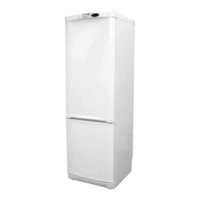
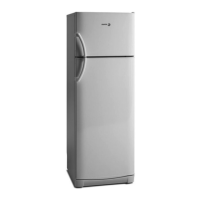
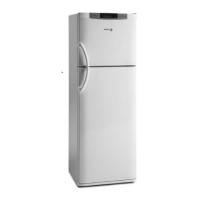
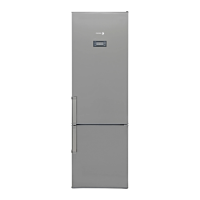
This document describes a Fagor refrigerator, providing essential information for its safe and efficient use, installation, operation, maintenance, and troubleshooting.
Function Description:
The Fagor refrigerator is a household appliance designed for the storage and preservation of food items. It features a refrigerator compartment and, depending on the model, a four-star freezer compartment capable of freezing food. Some models include advanced features such as a "Multifresh System" for ideal conservation of fresh food like meat, fish, and vegetables without freezing, and a "Double Fresh System" with a membrane filter to maintain high humidity for fruits and vegetables, preventing them from drying out. Optional features include an "Even Cold" system with a ventilator for uniform cold distribution and a "Hygienizer Filter" with a double filter to absorb odors and reduce microorganisms. Certain models are "NET Comp@tible," ready for connection to Fagor Digital Home or other home automation systems for remote control and telediagnosis, though this connectivity is currently available only for the Spanish market.
Important Technical Specifications:
The refrigerator operates correctly within specific ambient temperature ranges: 10°C-43°C for one-motor and No-Frost models, and 10°C-38/43°C for two-motor models (E, EV, and ED). It uses R600a coolant, which is environmentally friendly but inflammable, requiring careful handling if the cooling circuit is damaged. The electrical connection requires a 220-240V supply with earth. The light bulb, if present, is a screw-type E14, 220-240V with a maximum of 15W.
Dimensions vary by height (A): 1710mm, 1860mm, 2010mm, or 2010mm. All models have a width (B) of 600mm, a width with the door open (C) of 1150mm, and a depth (D) of 610mm. These units comply with EEC Directives 73/23, 93/68, 89/336, 92/75, and 96/57.
Usage Features:
The refrigerator features a control panel for temperature regulation, typically displaying temperatures in °C.
For Fagor one-motor models, the control panel includes:
- "Temperature Connection and Selection" for switching the refrigerator and freezer on/off and setting temperatures using (+/-) keys.
- "Display" for digital temperature display and selection.
- "SUPER FREEZING" function to automatically adjust freezer temperature to maximum cold for faster freezing, recommended 24 hours before introducing large amounts of food. It turns off automatically or can be manually switched off.
- "Alarm" for an intermittent sound if the door is left open for more than 120 seconds, which stops upon closing the door.
For Fagor two-regulation models (E and EV), the control panel includes:
- "Refrigerator Temperature Selection" and "Freezer Temperature Selection" controls.
- "Refrigerator connection" and "Freezer connection" with an ON light.
- "SUPER COOLING" function to regulate refrigerator temperature to maximum cold for six hours, turning off automatically or manually.
- "SUPER FREEZING" function, similar to one-motor models, for freezer temperature adjustment.
- "Alarm" for a light and audio signal if freezer temperature is abnormally low, with the audio alarm manually turned off using "SUPER FREEZING." Also, an intermittent alarm sounds if the door is open for more than 120 seconds.
- "Cold level" indicated by the number of lights on, with more lights signifying a colder freezer.
For Fagor two-regulation models (ED and No-Frost), the control panel includes:
- "Refrigerator Temperature Connection and Selection" and "Freezer Temperature Connection and Selection" for switching on/off and setting temperatures. Switching off the freezer also switches off the refrigerator.
- "Display" for digital temperature display and selection for both compartments.
- "SUPER COOLING" and "SUPER FREEZING" functions, similar to E and EV models.
- "Alarm" for abnormally low freezer temperature and for doors left open for more than 120 seconds.
Correct use guidelines include:
- Leaving enough space between food items for air circulation.
- Avoiding contact between food and the cold back wall.
- Not exceeding the rack stops.
- Not leaving the door open longer than necessary.
- Not placing hot food in the refrigerator.
- For the freezer: not exceeding freezing power limits, ensuring food is in good condition, observing best-by dates, wrapping food in aluminum foil or plastic film, avoiding contact between fresh and frozen food, never refreezing thawed food, freezing in daily servings, not storing carbonated or glass bottles with liquids, avoiding eating very cold ice-cream or food directly, and labeling wrapping with content and freezing date.
- For maximum freezing capacity, removing the central basket and placing food on the freezer shelf is recommended. For maximum volume, removing the ice tray is suggested. For best energy yield, keeping the ice-cube holder full is advised.
- Ice-making involves filling trays three-quarters with water, placing them in the freezer, and twisting slightly to remove cubes once frozen.
Maintenance Features:
- Cleaning: Before cleaning, switch off the refrigerator. Clean the interior with warm water and bicarbonate of soda to prevent odors. Avoid steam cleaning machines, solvents, or abrasive detergents. Do not place inside fittings in the dishwasher. Periodically clean the water trap and drain with warm water and bleach. Annually clean the rear grill with a vacuum cleaner to maintain performance and reduce consumption.
- Changing the Light: Turn off the light switch, press the inside lip to remove the reflector cover, and replace the bulb with a screw-type E14, 220-240V, max 15W.
- Defrosting (Refrigerator): The refrigerator has an automatic defrosting system. Water drops or ice on the back wall are normal and evaporate over the motor.
- Defrosting (Freezer): Frost or ice buildup on freezer walls should be removed at least twice yearly to prevent increased energy consumption. No-Frost refrigerators do not require manual defrosting. When defrosting, choose a time with minimal food, empty the freezer, place frozen food in thermal bags in a cool place, unplug the freezer, and wait for ice to melt. A plastic spatula can be used to speed up the process, but never use sharp metal objects to avoid damaging the refrigerating circuit.
- Power Outage: If possible, do not open the doors. Check if food has unfrozen once power is restored. Consume defrosted food immediately and do not refreeze.
- Long Periods of Non-Use: Empty, unplug, and clean the unit. Leave doors open to prevent odors. The "Vacation function" allows the freezer to remain on with low consumption while the refrigerator section is turned off and closed, preventing odors.
- Troubleshooting: The manual provides a detailed troubleshooting guide for common issues like the refrigerator not operating, vibrations, insufficient cooling, continuous motor operation, door not closing, water/ice buildup, odors, and light failure, along with corresponding causes and solutions.
- Technical Service: If problems persist, consult the technical assistance service, providing the refrigerator model, reference, purchase date, problem description, and contact details.


 To Next Page
 General