
 Need help?
Do you have a question about the Fairfield Circuitry Shallow Water and is the answer not in the manual?
Describes the effect as uncertain, subtle, and nostalgic, built around a chorus/vibrato circuit with random modulation.
Details the random voltage generation from a microcontroller, with RATE controlling the time interval range.
Explains how random voltages are filtered/integrated, with DAMP controlling slope and DEPTH controlling modulation amount.
Covers the filter and gate needed to remove noise, using the input's envelope to modulate a low-pass filter's frequency.
Lists physical attributes like jacks and enclosure size, and technical specs like impedance, power supply, and current draw.
Provides guidance on using the correct power supply and details the extended warranty terms and conditions.
Adjusts time intervals for random pitch fluctuations, with a wide range from rare to nervous.
Affects the modulation signal's slope, softening changes as DAMP increases.
Adjusts the intensity of modulation, with noticeable interaction with other controls.
Adjusts envelope level to the low pass filter and gate circuit for sound character.
Balances dry and wet signals, allowing for vibrato or chorus sounds.
Controls the overall output volume of the effect.
Internal jumpers adjust input signal level and impedance for different sources.
Fine-tunes the recovery filter's lowest frequency for sensitivity adjustments.
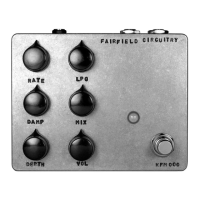
The Shallow Water K-Field Modulator is an effects pedal designed to introduce subtle, uncertain, and nostalgic sonic textures to an audio signal. At its core, it operates like a traditional analog chorus/vibrato circuit, employing a bucket brigade device to delay the input signal by a few dozen milliseconds. This delay time is then modulated, creating pitch variations known as vibrato. When the original signal is mixed with the delayed signal, the resulting moving comb filters produce a chorus effect.
However, the Shallow Water distinguishes itself through its unique architecture, particularly in how the delay time is modulated randomly and how its recovery filter interacts with the input signal. These characteristics place it in its own category of "k-field modulators."
The pedal's modulation begins with a pseudo-random generator, a microcontroller-based program that outputs stepped random voltages with random time intervals. The RATE control adjusts the overall range of these time intervals, influencing the speed of the random pitch fluctuations from rare to nervous. At high RATE and DAMP settings, these rapid variations may be filtered out, reducing perceived modulation.
These random stepped voltages are then processed through an integrator, which is controlled by the DAMP knob. DAMP influences the slope at which the random steps transition to new values. Increasing DAMP makes the random steps slow and sluggish, while lower settings result in sharp and abrupt changes. At its minimum, pitch modulations are quick and sudden. As DAMP increases, modulations become elongated and softened. With high DAMP settings, the changes can be so slow that they are perceived as chorus rather than pitch modulations, especially when some dry signal is mixed in.
The DEPTH knob determines the intensity of this modulation. The interaction between RATE, DAMP, and DEPTH is significant, and users are encouraged to experiment to find their desired subtle variations.
After the signal passes through the delay line, a recovery filter and gate circuit are employed to remove unwanted noise generated by the bucket brigade device. This is achieved by an envelope follower that tracks the input signal's envelope and uses it to modulate the frequency of a low-pass filter. The LPG control adjusts the level of this envelope. Lower LPG settings result in a darker sound, choking subtle notes and reducing sustain. Higher settings produce a brighter sound with more sustain, potentially revealing some noise from the bucket brigade device.
The MIX control balances the dry and wet signals. Turning it fully clockwise (wet) creates a vibrato effect, while adding some dry signal (counter-clockwise) achieves chorus-type sounds. The VOLUME knob controls the overall output level, with unity gain typically found around the noon position.
The Shallow Water is designed for use with a typical center-negative, regulated 9-9.6 VDC power supply. It is protected against reversed polarity and overvoltage. There is no internal battery connection.
For optimal signal matching, the pedal includes two internal jumpers at the input stage: BOOST and PAD. By default, BOOST is on and PAD is off, suitable for high-impedance, low-output signals like guitar single-coil pickups. If excessive distortion occurs, moving the BOOST jumper to the off position reduces overall gain by 6 dB. For line-level signal sources, setting the PAD to its on position provides an additional 6 dB of gain reduction and reduces the input impedance by a factor of 10.
The recovery filter's lowest frequency can be fine-tuned via an internal trimpot labeled LPG ADJUST. This allows users to customize how the filter reacts to incoming signals. Lowering this frequency emphasizes the low-pass filter's action, effectively raising the sensitivity threshold. To adjust, set MIX to full wet, LPG to minimum, and DEPTH to minimum. While listening to a signal, carefully turn the trimpot clockwise to raise the filter's frequency or counter-clockwise to lower it. Adjustments should be minimal due to the trimpot's sensitivity. After adjustment, LPG should be turned up momentarily to observe the envelope's response to the incoming signal.
Fairfield Circuitry offers a 2-year warranty from the purchase date, covering repairs or replacements for malfunctioning products. However, this warranty may be voided by modifications or misuse. The owner is responsible for all shipping expenses. The warranty applies only to the original owner and may require proof of purchase. In case of issues, users are advised to contact Fairfield Circuitry as soon as possible with a description of the symptoms, even if the warranty has expired, as they may still be able to assist.
 General
| Type | Modulator |
|---|---|
| Technology | Analog |
| Power Supply | 9V DC |
| Input Impedance | 1 MΩ |
| Output Impedance | 1 kΩ |
| Bypass | True Bypass |
| Controls | Depth, Rate, Mix |
| Jacks | Input, Output |
| Circuitry | Analog |
| Power Requirements | 9V DC, center negative |

 To Next Page