Need help?
Do you have a question about the Fairphone 3 and is the answer not in the manual?
Instructions for removing the back cover of the Fairphone 3.
Guidance on how to take out the battery from the Fairphone 3.
Steps for inserting nano SIM and micro SD cards into the Fairphone 3.
Instructions for charging the phone and turning it on.
Explanation of not including a charger to reduce electronic waste.
Information on Fairphone 3 accessories for style and customization.
Guidance on recycling old phones for fairer electronics.
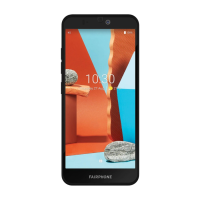
Information on the phone's design and ease of repair.
The Fairphone 3 is a smartphone designed with sustainability and user repairability in mind, offering a unique approach to mobile technology. Its core function is to provide a modern smartphone experience while minimizing environmental impact and promoting responsible consumption.
The Fairphone 3 serves as a fully functional Android smartphone, capable of handling all typical mobile tasks. Users can make calls, send messages, browse the internet, access a wide range of applications from the Google Play Store, capture photos and videos, and manage their daily schedules. It is equipped to connect to cellular networks for communication and data, as well as Wi-Fi for internet access. The device runs on the Android operating system, providing a familiar and intuitive user interface. Beyond its primary communication and computing functions, the Fairphone 3 also embodies a commitment to ethical sourcing of materials and fair labor practices throughout its supply chain, distinguishing it from many other smartphones on the market.
The Fairphone 3 is designed for straightforward and intuitive use, starting from the initial setup. The quick start guide illustrates a simple five-step process to get the phone up and running.
Once powered on, users are guided through the Android setup process, which is familiar to anyone who has used an Android device. For those new to Android, Fairphone provides resources at fairphone.com/androidsetup to assist with the initial configuration.
A notable usage feature is the absence of a charger and USB-C cable in the box. This decision is driven by the company's commitment to reducing electronic waste, assuming that most users already own these accessories. However, if needed, they can be purchased separately from fairphone.com/charger. This approach encourages reuse and minimizes unnecessary production.
The Fairphone 3 also allows for personalization through its accessories. Users can discover a range of accessories at fairphone.com/accessories, enabling them to customize their phone's style and functionality.
Maintenance is a cornerstone of the Fairphone 3's design philosophy, emphasizing repairability and longevity.
In summary, the Fairphone 3 is more than just a smartphone; it's a statement about sustainable technology. Its design prioritizes user empowerment through repairability, ethical sourcing, and a commitment to reducing environmental impact, offering a compelling alternative in the mobile market.
 General
| Screen shape | Flat |
|---|---|
| Pixel density | 427 ppi |
| Display diagonal | 5.65 \ |
| Display resolution | 2160 x 1080 pixels |
| Native aspect ratio | 18:9 |
| Gorilla Glass version | Gorilla Glass 5 |
| Display number of colors | 16 million colors |
| Processor cores | 8 |
| Processor family | Qualcomm Snapdragon |
| Processor frequency | 2.2 GHz |
| RAM capacity | 4 GB |
| Compatible memory cards | MicroSD (TransFlash) |
| Internal storage capacity | 64 GB |
| Rear camera type | Single camera |
| Maximum frame rate | 30 fps |
| Video recording modes | 720p, 1080p, 2160p |
| Rear camera sensor size | 1/2.55 \ |
| Rear camera aperture number | 1.8 |
| Video capture resolution (max) | 3840 x 2160 pixels |
| Rear camera resolution (numeric) | 12 MP |
| Front camera resolution (numeric) | 8 MP |
| 4G standard | LTE |
| 2G standards | EDGE, GPRS, GSM |
| 3G standards | HSDPA, HSPA+, HSUPA |
| SIM card type | NanoSIM |
| Wi-Fi standards | 802.11a, 802.11b, 802.11g, Wi-Fi 4 (802.11n), Wi-Fi 5 (802.11ac) |
| Bluetooth version | 5.0 |
| 3G bands supported | 800, 850, 900, 1700, 1900, 2100 MHz |
| SIM card capability | Dual SIM |
| 2G bands (primary SIM) | 850, 900, 1800, 1900 MHz |
| Mobile network generation | 4G |
| Subscription type | No subscription |
| USB version | 2.0 |
| USB connector type | USB Type-C |
| Headphone connectivity | 3.5 mm |
| Form factor | Bar |
| Product color | Black |
| International Protection (IP) code | IP54 |
| Graphics card | Adreno 506 |
| Wireless charging | No |
| Speakers | stereo |
| Audio formats supported | AAC, AAC+, AIFF, ALAC, AMR-NB, AMR-WB, APE, FLAC, MP3, Vorbis, WMA, WMA-L, WMA-PRO |
| Video formats supported | H.263, H.264, HEVC, MPEG2, MPEG4, VP8, VP9 |
| Platform | Android |
| App distribution platform | Google Play |
| Operating system installed | Android 9.0 |
| Talk time (2G) | 20 h |
| Talk time (3G) | - h |
| Battery capacity | 3060 mAh |
| Standby time (2G) | 300 h |
| Battery recharge time | 3.5 h |
| Body SAR (EU) | 1.405 W/kg |
| Head SAR (EU) | 0.388 W/kg |
| Harmonized System (HS) code | 85171300 |
 Weight and Dimensions
| Depth | 158 mm |
|---|---|
| Width | 71.8 mm |
| Height | 9.89 mm |
| Weight | 187.4 g |

 To Next Page