
 Need help?
Do you have a question about the Famag IM-5S and is the answer not in the manual?
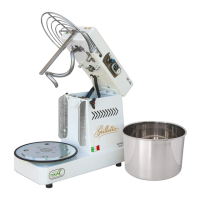
Describes the mixer's construction, materials, and basic functions, including safety features.
Details premises, electrical connection, and unpacking instructions for proper setup.
Steps for cleaning the mixer and securing the bowl and head before operation.
Explanation of power, start/stop buttons, directional controls, and speed adjustment.
Advice on hydration, speeds, time, and temperature management for optimal dough results.
Steps for first-time cleaning, warnings against water jets, and advice on cleaning agents.
Guidance on immediate cleaning after use, dishwasher safety for bowls, and sensor cleaning.
Highlights the importance of periodic inspection and maintenance of drive belts and chains.
Details when to inspect components and provides service intervals for home and commercial users.
Directs users to online videos for detailed maintenance procedures and techniques.
Table detailing dimensions, weight, bowl capacity, motor, speeds, and head type for different mixer models.
Table showing maximum flour, water, and total weight capacities for different models at 60% hydration.
Detailed list of all mixer components with their corresponding reference numbers.
Provides three methods to access online video resources for troubleshooting and maintenance.
Addresses rattling, knocking, ringing, or tinging noises from the mixer head or bowl area.
Diagnoses why the mixer motor fails to start, focusing on sensor and safety switch issues.
Detailed steps for testing and troubleshooting the bowl sensor, including its light and function.
Guidance on ensuring the bowl guard safety switch is properly adjusted and functioning.
Addresses defective control boards and potential incompatibility with home GFCI outlets.
Specific recommendations for GFCI outlets and circuit breakers to resolve tripping issues.
Troubleshooting steps for impaired bowl rotation, possibly due to loose belts.
Diagnosing slow or non-existent dough hook rotation, potentially caused by belts or chain issues.
Addresses problems with the mixer head not lowering completely, related to alignment or hinge issues.
Guidance on bowl contact with the bumper disk, distinguishing normal wear from problematic interference.
Troubleshooting steps for mixer vibration, focusing on ensuring a level and stable surface.
Addresses the issue of the mixer head not staying in the raised position, indicating a worn lift assist cylinder.
Covers replacement of broken external switches and repair of the bowl locking ring.
Details warranty period, covered parts, exclusions like wear parts, and conditions that void the warranty.
Specifies authorized repairers, costs, potential remedies like refunds, and legal jurisdiction.
Identifies U.S. service provider, contact info, and instructions for shipping machines for repair.
Guidelines for proper packaging, emphasizing sufficient void fill and protection of controls.

 To Next Page
 General