03
Ed. 1 - 03/2019Ed. 1 - 03/2019
ENGLISH
EN_10
Checks and inspections
3.b - Checking the tyres
- Check the tyres for signs of external damage,
foreign bodies and wear and tear; the entire
surface of the tyre must conform to the original
prole.
· The cord weft located under the rubber layer
must not be exposed.
· The tyres must not be dented or cracked.
- Remove any foreign bodies (thorns, stones,
fragments of glass, etc.) by hand, or with a
small screwdriver (proceed with caution).
Check for air leaks. In the event of leaks, replace
the inner tube (see paragraph “6” - Section
“07”).
3.c - Checking the tyre valves
- If the bicycle is ridden when the tyre pressure
is too low, it may displace the position of the
tyre and inner tube on the wheel rim, so that
the valve assumes an oblique position. In this
case, the base of the valve may be torn away
from the inner tube while the bicycle is in use,
resulting in a sudden loss of tyre pressure.
· Check the position of the valves: they must
be pointing towards the centre of the wheel
(g. “15“).
· If necessary, deate the tyre, loosen the
valve nut (if present) and attempt to correct
the position.
Re-tighten the valve nut (if present) and
re-inate the tyre.
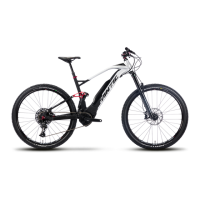
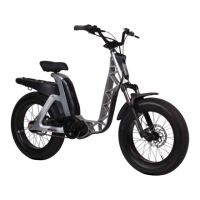
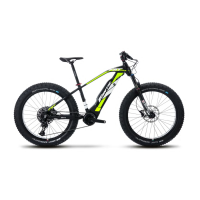
Use Bar
Road 2
Off-Road 1,5
Use Bar
Road 3,5
Off-Road 3
Use Bar
Road 3,5
Off-Road 3,5
3.d - Checking the tyre pressure
- If the tyre pressure is too low:
· it may displace the position of the tyre and
inner tube on the wheel rim, so that the
valve assumes an oblique position. In this
case, the base of the valve may be torn away
from the inner tube while the bicycle is in
use, resulting in a sudden loss of tyre pres-
sure.
· the tyre may become detached from the
wheel rim on curves
· the frequency of faults is increased.
Tyre pressure should be proportional to the
weight of the rider and the total load of the
bicycle.
The table on the right indicates the reference
pressure values.
These values are purely indicative. Contact
your vendor or a tyre specialist for more in-
formation.
Always respect the minimum and max-
imum pressure values indicated on the
tyre.
- Unscrew the safety cap (2) (g. “17“).
- Check the pressure using a pressure gauge, or
a pump with a built-in pressure gauge.
- If necessary, inate or deate the tyre (pressing
against the internal valve “3”) (g. “18“).
- Replace the safety cap (2).
3.e - Checking the wheels
- Raise the front wheel and rotate it manually.
The rim and tyre must rotate in a perfect circle.
Make sure that there no signs of eccentricity or
warping.
- Repeat the above procedure for the rear wheel.
- Check that the wheel assemblies are free from
foreign bodies (e.g.: twigs, strips of cloth, etc.),
and remove them if necessary.
- Make sure that the wheel assemblies have not
been damaged by foreign bodies.
- If the wheels are tted with reectors, make
sure that they are secured correctly; remove
them if they are loose.
3.f - Checking the saddle and saddle
support tube (g. “19“)
If the saddle support tube is not
inserted far enough, it may be-
come detached from the frame
while you are riding your bicy-
cle, resulting in hazardous riding
conditions, falls and accidents.
- Make sure that the saddle support tube has
been inserted to the correct depth (see para-
graph “3” - Section “04”).
Using you hands, attempt to rotate the saddle
and tube inside the frame by applying pressure
to them.
It should not be possible to move
them.
If any of the parts move, secure them correctly.
FAT INTEGRA
XF2
LIVING


 To Next Page
 Loading...