
 Need help?
Do you have a question about the Farr Gold Series and is the answer not in the manual?
Explains hazard symbols and their meanings for safety.
Details importance of warning decals and safety guards for equipment operation.
Outlines OSHA requirements for locking out energy sources before servicing.
Defines purchaser's role in inspecting equipment upon delivery and reporting damage.
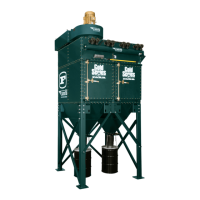
Lists and describes the various components that may be included in the Gold Series dust collection system.
Explains Farr's shipping methods to ensure economical and practical delivery of the dust collector.
Provides instructions for carefully uncrating and inspecting components for damage or shortages.
Guides users on how to locate and understand information on the equipment's serial plate.
Lists necessary tools required for the installation of the Gold Series dust collector.
Details how to locate and separate hardware kits for structural support and assembly.
Instructions for positioning and bolting hopper sections together using support brackets.
Guidance on attaching support legs and cross braces to the collector structure.
Steps for lifting, positioning, leveling, and anchoring the assembled hopper and support structure.
Instructions for preparing and attaching the filter module, including fan mount panel.
Guidance on installing discharge accessories like drum kits, airlocks, or screw conveyors.
Instructions for installing drum kits and slide gates, including hose connections for drums.
Steps for lifting and installing platform and access ladder assemblies.
Guidelines for designing inlet ductwork, including straight length and transition angles.
Details on different inlet flange designs and connection procedures.
Instructions for attaching ductwork to remote mount fan discharge points.
Guidance on attaching ductwork to top mount fan discharge flanges.
Information on attaching accessories to the hopper discharge flange.
Instructions for connecting fan motors and motor starters, including safety precautions.
Guidance on mounting and connecting the automatic timer control for cleaning cycles.
Details on wiring solenoids to the control board and power source for pulse jet cleaning.
Instructions for connecting pressure sensing devices for monitoring differential pressure.
Specifies requirements for compressed air supply, including pressure and air quality.
Instructions for connecting sprinkler systems used for fire suppression.
Clarifies that collector vents are part of a larger system and Farr doesn't guarantee NFPA compliance.
Provides general guidelines for explosion venting and system design considerations.
Defines dusts and factors affecting their combustion properties for explosion risk assessment.
Explains how explosion vents work to limit pressure during a deflagration.
Discusses conditions for recycling filtered air back into buildings, referencing NFPA standards.
Guidelines for locating vents to safely direct discharge and protect personnel.
Specifies requirements for ducting systems handling combustible particulate solids.
Lists common sources of ignition relevant to dust explosion hazards.
Guidelines for designing and installing ducts to safely vent explosion gases.
Outlines inspection and maintenance procedures for explosion vents.
Step-by-step instructions for applying pre-coat dust to filter cartridges for improved efficiency.
Explains the basic airflow and dust collection process within the Gold Series dust collector.
Describes the pulse jet cleaning mechanism for dislodging dust from filter elements.
Details components of the cleaning system like headers, solenoids, and pulsejet blowpipes.
Explains the features and setup for the Dwyer DCT1000 automatic timer controller.
Describes the NCC DT-10 Determinator controller and its differential pressure-based cleaning.
Details the functions of the keypad and navigation for programming the controller.
Explains the operation of Goyen T-4 (timer) and P-4 (DP) controllers for automated cleaning.
Instructions for installing the Goyen timer controllers, including power and pressure connections.
Guidance on programming the Goyen timer controller settings via the digital readout.
A step-by-step example demonstrating how to set ON TIME, OFF TIME, and other parameters.
Information on selecting and operating fans, including performance tables and curves.
Step-by-step guide for safely starting up the dust collector system.
Procedures for safely shutting down the dust collector and preparing for maintenance.
Recommended starting settings for timer controllers for optimal operation.
Discusses filter element lifespan, replacement indicators, and maintenance.
Procedures for checking and maintaining the dust collector hopper and discharge gate.
Guidance on lubricating fan motors, including safety precautions and recommended greases.
Maintenance considerations for solenoid and diaphragm valves based on air quality.
Maintenance recommendations for automatic timer controls, focusing on environment.
General advice on cleaning and repairing external/internal surfaces to prevent corrosion.
Explains the importance of an inspection log and provides a typical example.
A schedule outlining daily, weekly, monthly, quarterly, and annual maintenance tasks.
 General
| Category | Dust Collector |
|---|---|
| Model Series | Gold Series |
| Manufacturer | Farr |
| Filter Type | Cartridge |
| Filter Media | Nanofiber or cellulose blend |
| Filter Configuration | Vertical or horizontal mounting |
| Dust Discharge | Rotary airlock |
| Applications | Welding, metalworking, woodworking |
| Construction Material | stainless steel |
| Features | compact design |

 To Next Page
