3
Power supply: three alkaline batteries LR44, AS44 or replacements.
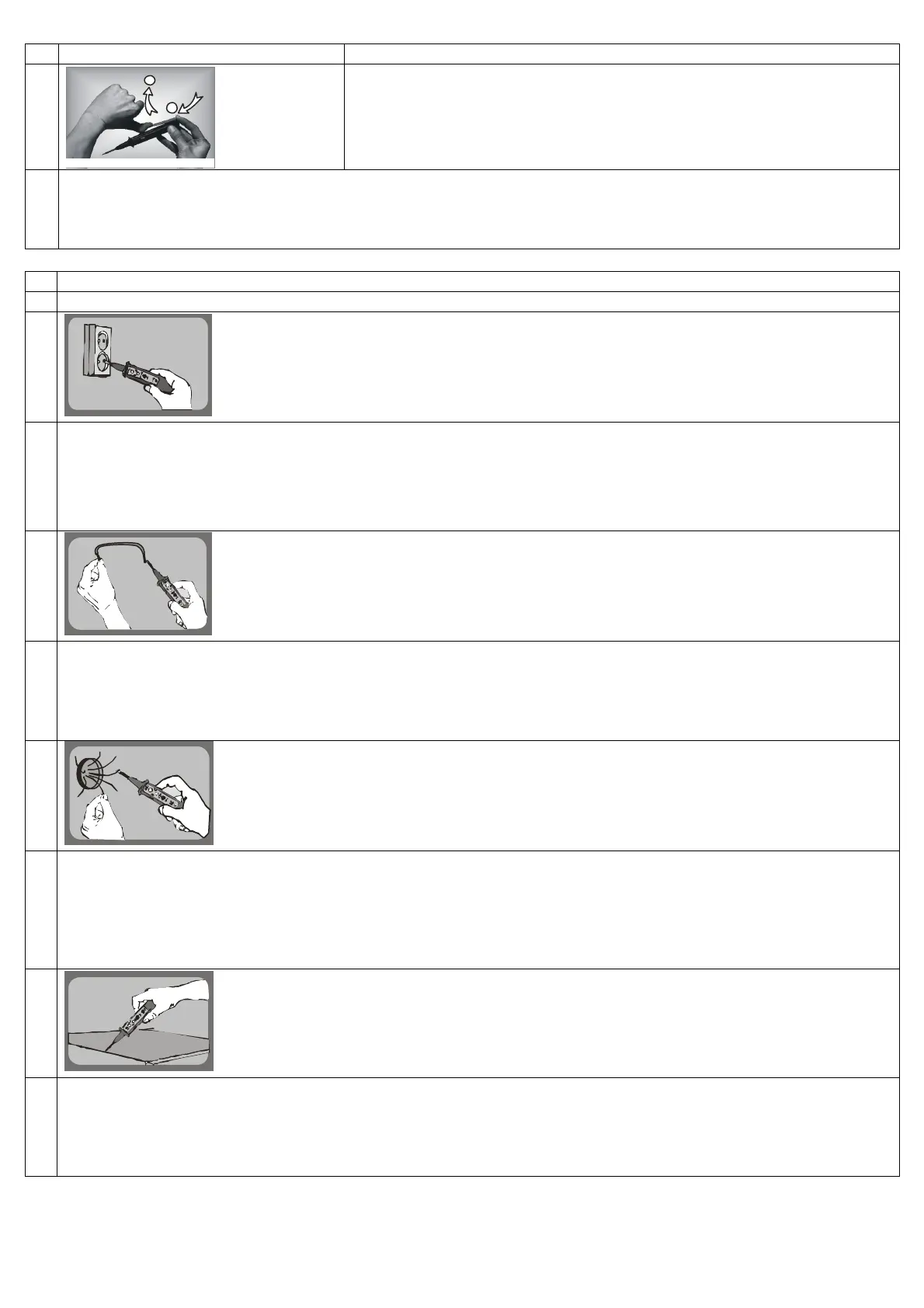
Batteries are located under a cover on the Fazer's bottom side. Pull the
battery cover aside gently. Slide the cover towards the measurement
pin. Replace the batteries. Observe the correct "+" and "-" polarization.
Follow the marks inside the battery chamber.
Battery maintenance
If the device fails to signal the measurement results the batteries' contacts may be dirty. Take the batteries
out, clean them with a dry cloth or spirit and put them back in. Sometimes, it's enough just to move the
batteries around their axis inside the device.
The most frequent applications
220/380V grid, electric installations, devices, electronics, direct current, cars
Detection of PHASE in the PHASE mode
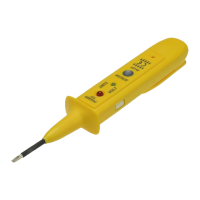
Phase and zero detection is a basic test, equivalent to operations of the so called neon tester, the only
difference being that in case of Fazer there is no need to touch a metal contact. Fazer should be held by its
body. Touch a tested area with the pin. Fazer will react when it detects 220V voltage phase. Fazer will not
react in case of "zero". One should note the voltage induced on wires connected neither to "zero" nor "phase"
but running alongside live wires.
Breaks/shortings detection. Testing cables. The CONT mode
This application allows to control cables, fuses, light bulbs, etc. for current conduction. Touch one of the ends
of a tested object with the measurement pin and grab the other end of the object with you hand. If there is a
break in conduction FAZER will not react. A long cable ruptured inside its insulation - drive a metal pin inside
the cable at a certain distance from one its ends and check for conduction. By moving the pin you can find the
rupture location.
Determining the sequence of wires in a group of conductors - the CONT mode
This application allows to identify wires in large groups of conductors. Example: determining of the sequence
of wires is necessary e.g. when we have two cable boxes (A and B) with several wires of repeated colours
coming out of them.
- take a wire with unique colour in box A and B as the point of reference;
- in the box A, attach any wire to the wire of reference and try to detect it in the box B with the CONT test, and
then assign a sequential number to it (here, 2); - repeat it with remaining wires.
Verification of earthing - the PHASE mode
With this application you can roughly determine the quality of earthing of home devices connected to 220 V
grid. If a metal housing of a washing machine, a refrigerator, etc. is properly earthed, then FAZER will not
react in the PHASE mode. If FAZER reacts it means that the device's earth may not be enough, which may
lead to electric shock. FAZER's positive reaction will not always indicate danger (induced fields). However,
no reaction confirms correct earthing.


 To Next Page
 Loading...