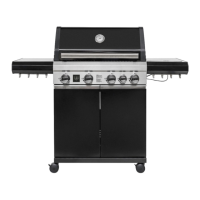
The FCC BBQ Chef's Supreme 4.1 is an outdoor gas barbecue designed for assembly, maintenance, and safe use in well-ventilated areas. It is intended for private households and not suitable for professional use in restaurants or similar settings.
Function Description:
The barbecue features multiple main tube burners and a side burner, allowing for versatile cooking. It includes a lid with a thermometer for temperature monitoring, cast iron grids for even heat distribution, and a warming rack. The appliance is designed for use with gas cylinders and requires a regulator and hose (sold separately) for operation. An electric ignitor facilitates lighting, with a manual lighting option available as a backup. The barbecue incorporates a grease collection system with a drip tray and grease cup to manage fat and residue during cooking, helping to prevent grease fires.
Important Technical Specifications:
- Total Heat Input: 17 kW
- Gas Consumption: 1237 grams/hour
- Valve Size:
- Main Burner: 0.92 mm
- Side Burner: 0.88 mm
- Gas Type: G30 (Butane G31 Propane) and their mixtures
- Gas Category: 13B/P(30)
- Dimensions:
- Width (W): 138 cm
- Height (H): 116 cm
- Depth (D): 60 cm
- Gas Hose Length: Must not exceed 120 cm.
- Gas Cylinder: Standard cylinder approved for use in the Nordic Region. Propane is recommended for Nordic use, though butane can also be used (less suitable for low temperatures). Cylinders of 10 kg or more are recommended.
- Safety Certifications: Manufactured in accordance with European Gas Appliances Regulation (EU) 2016/426.
Usage Features:
- Assembly: Requires two persons for assembly, especially when lifting the stove body. Power tools should not be used to avoid damaging surfaces or loosening pre-assembled nuts. Protective gloves are recommended due to sharp metal parts.
- Gas Connection: Connect the gas hose to the gas inlet and tighten securely. Install the regulator and hose according to the controller set instructions. Do not use sealing tape, glue, or liquid on connections. The gas cylinder should be placed on a firm, level surface, lower than the gas inlet, and always next to the barbecue, never inside the cabinet during use.
- Leak Test: A leak test is mandatory before first use, when replacing the gas cylinder, after long periods of disuse, and before a new barbecue season. This must be performed using a leak spray or soapy water mixture (two parts dishwashing soap to one part water), never an open flame. All controls must be in the OFF position and the regulator set to OFF before connecting to the cylinder.
- Lighting Instructions:
- Set all control knobs to OFF.
- Open the lid (always open when lighting).
- Open the gas valve on the cylinder.
- Push and turn the desired burner knob to the left for automatic ignition.
- Wait for the burner to light, then light subsequent burners.
- If burners do not ignite within 5 seconds, turn all knobs to OFF, close the gas valve, wait 5 minutes, and repeat.
- Manual Lighting: If the electric ignitor fails, use a long match or fireplace lighter. Light the match/lighter, insert it into the burner ports on the left or right sidewall of the firebox, then push and turn the adjacent burner knob to the left.
- Preheating: Preheat the barbecue for 10-15 minutes at maximum temperature. For best cooking results, adjust burners to the "LO" position after preheating.
- Placement: The barbecue must be placed at least 150 cm in all directions from house walls, trees, plants, and other flammable materials or liquids. It should not be placed under a roof or overhang and must be in a well-ventilated area to prevent carbon monoxide poisoning. It must not be used below normal ground level due to explosion and oxygen deficiency risks.
- Safety during Use: Accessible parts become very hot; keep children and supervised individuals at a safe distance. Always supervise the barbecue during use and have extinguishing equipment nearby. Do not operate while intoxicated.
- Grease Fires: In case of a grease fire, immediately close the gas supply on the regulator/barbecue and disconnect the regulator. For minor fires, wait for it to extinguish naturally. For major fires, use a suitable extinguishing agent (CO2 appliance, fire blanket, etc.) to suffocate the fire. NEVER USE WATER TO EXTINGUISH GREASE FIRES.
Maintenance Features:
- General Cleaning: All cleaning and maintenance must be performed when the barbecue is cold, with the gas supply switched OFF and the regulator disconnected. Use a mixture of dishwashing detergent and water, or a separate grill cleaner, with a nylon scrubbing brush/scouring sponge. Rinse well and air dry completely. Avoid caustic soda, alcoholic, or abrasive detergents.
- Grease Management: Regularly check and clean the drip tray and grease cup after each grilling with a nylon brush and dishwashing detergent. Adding cat litter or aluminum foil to the drip tray can simplify cleaning.
- Cooking Grate and Flame Tamers: Brush regularly for rough cleaning. For difficult stains, soak in mild soapy water and use a non-abrasive cleaner. Ensure they are completely dry before placing back in the barbecue. For long-term storage, apply a thin layer of cooking oil to the grill grates.
- Burner Maintenance:
- Ensure all controls are OFF, gas supply is switched off, and regulator disconnected.
- Remove cooking grate, flame tamers, and drip tray.
- Remove burner screws and carefully lift burners out of the valve outlet.
- Clean the outside of the burner with a nylon brush.
- Clear blocked passages/channels with a metal string or paper clip.
- Check for insects, cobwebs, or blockages inside the burner and remove them.
- Inspect burners for damage (cracks, holes) and replace if necessary.
- After cleaning, reassemble burners, flame tamers, grease trays, and grill grate.
- Coated and Stainless Steel Parts: Clean regularly with gentle cleaning agents and warm water to remove salt, grease, and residue. Dry with a soft cloth. Apply polishing agent (e.g., car polish) to coated surfaces and acid-free oil to stainless steel parts 1-2 times per year (more often in coastal areas). Rust perforation is covered by warranty, but surface rust is not.
- Plastic Parts: Clean with clean water and mild detergents, wipe with a clean cloth.
- Storage: Store dry under a roof or cover. Ensure the barbecue is completely dry and cold before applying a cover to prevent rust. Avoid direct sunlight storage for stainless steel or glass parts to prevent reflection and fire risk, and to prevent plastic parts from bleaching.
- Pest Control: After long-term storage, check for insects or vermin blocking gas supply; disassemble and clean burners if irregular flames occur. Check the gas hose for damage from mice or rats.


 To Next Page
 General
