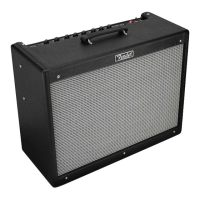
The Fender Hot Rod DeVille™ IV and Hot Rod Deluxe™ IV are tube combo amplifiers designed for guitarists seeking powerful, reliable, and responsive sound. These amps are celebrated for their ability to deliver significant volume, react well to effects pedals, and offer an affordable solution for gigging musicians.
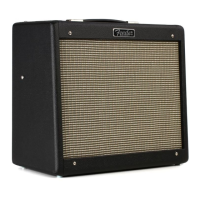
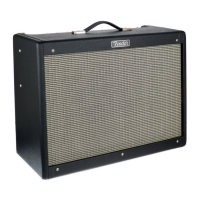
The Hot Rod Deluxe IV is a 40-watt 1x12” tube combo, while the Hot Rod DeVille IV is a 60-watt 2x12” tube combo. Both models share a similar feature set and classic aesthetic, making them ideal for crafting a signature sound.
Function Description
At the core of these amplifiers is a tube-driven circuit that provides rich, dynamic tone. The preamp circuitry has been modified to enhance note definition, particularly in the overdrive channels, allowing for greater clarity even with high gain settings. A smooth spring reverb mod contributes to a lush, ambient effect.
The amplifiers feature Celestion® A-TYPE speakers, known for their balanced tone and ability to handle the amp's output with clarity. The Hot Rod Deluxe IV uses a single 12" speaker, while the Hot Rod DeVille IV employs two 12" speakers for increased projection and spread.
Usage Features
The control panel offers a comprehensive set of adjustments to shape your sound:
- Inputs (A, B): Two input jacks are provided. Input 1 is a normal sensitivity input suitable for most guitars, offering a standard tonal character. Input 2 is a lower sensitivity input (-6dB), designed for cleaner response with high-output or pre-amplified guitars. Both inputs can be used simultaneously, for example, with two guitars or a guitar and a microphone, with sensitivities becoming equal when both are in use.
- NORMAL/BRIGHT (C): This button boosts high-frequency tones of the NORMAL channel, adding sparkle and presence.
- VOLUME (D): Controls the loudness of the NORMAL channel.
- MORE DRIVE (E): Engages an additional gain stage for the DRIVE channel, increasing distortion and sustain.
- DRIVE (F): Adjusts the amount of distortion and sustain in the DRIVE channel. Lower settings produce cleaner sounds, while higher settings yield more aggressive overdrive.
- CHANNEL INDICATOR (G): A visual cue indicating the active channel: off for NORMAL, yellow for DRIVE, and red for MORE DRIVE.
- TREBLE (H), BASS (I), MIDDLE (J): These three controls provide comprehensive tone shaping across the frequency spectrum. TREBLE adjusts high frequencies, BASS controls low frequencies, and MIDDLE fine-tunes mid-range tones.
- CHANNEL SELECT (K): Toggles between the NORMAL channel (out) and the DRIVE channel (in).
- MASTER (L): Adjusts the overall loudness of the DRIVE and MORE DRIVE channels, working in conjunction with the DRIVE control.
- REVERB (M): Controls the intensity of the built-in spring reverb effect.
- PRESENCE (N): This unique tone control operates after the preamp circuitry, allowing for ultra-high-frequency tone shaping to add cut and definition to your sound.
- PREAMP OUT/POWER AMP IN (O): These versatile jacks serve multiple functions:
- Effects Loop: Connect PREAMP OUT to the input of your external effects device and the effects output to POWER AMP IN.
- Multiple Hot Rod Amps: Connect PREAMP OUT of a primary unit to POWER AMP IN of an auxiliary unit. The primary unit then controls all auxiliary units, except for REVERB and PRESENCE, which remain active on each auxiliary unit.
- Recording/Sound Reinforcement: Connect PREAMP OUT to the input of sound equipment for direct recording or live sound reinforcement.
- It's important to note that both PREAMP OUT and POWER AMP IN jacks are located before the Reverb and Presence in the signal path. Use shielded instrument cables with TS (tip-sleeve) plugs for these connections.
- FOOTSWITCH (P): An included two-button footswitch connects here, enabling remote selection of NORMAL/DRIVE/MORE DRIVE channels. When the footswitch is connected, the CHANNEL SELECT button (K) on the control panel is disabled. An unshielded speaker cable is recommended for connecting the footswitch.
- POWER INDICATOR (Q): A red jewel light illuminates when the unit is on. The bulb (type T47) can be replaced by unscrewing the jewel.
- STANDBY (R): This switch allows you to put the amplifier in standby mode during short breaks, avoiding the need to wait for tubes to warm up when you resume playing. It's also recommended to keep the amplifier on STANDBY for the first 30 seconds when initially powering on, to allow the tubes to warm up gently. Using STANDBY extends the lifespan of the amplifier's tubes by reducing the thermal shock from heating and cooling cycles.
- POWER (S): Turns the amplifier on and off.
Maintenance Features
The Hot Rod series is designed with reliability in mind, incorporating several features that contribute to its longevity and ease of maintenance:
- Steel-reinforced strap handle: Ensures durability and secure transport.
- Ivory pointer knobs: Provide a classic look and clear indication of control settings.
- Improved control panel texture and graphics: Enhance usability and aesthetic appeal.
- Lightly aged silver grille cloth: Contributes to the vintage aesthetic.
- Pine cabinet for weight reduction: Makes the amplifier easier to transport without compromising structural integrity.
- Cover and two-button footswitch: Protects the amplifier during transport and provides convenient remote control.
- POWER CORD (T): Connects to a grounded outlet with voltage and frequency ratings specified on the rear panel.
- FUSE (U): A protective fuse guards against electrical faults. Always replace fuses only with the specified type and rating. If the unit repeatedly blows fuses, it should be serviced by an authorized Fender Service Center.
- MAIN SPEAKER JACK (V) and EXTERNAL SPEAKER JACK (W): Proper speaker connection is crucial. One of the specified speaker configurations (internal or external) must always be connected when the unit is ON to prevent damage to the amplifier. The external speaker jack is wired in parallel with the main speaker jack and should only be used with a speaker load or an open plug connected to the main speaker jack, as detailed in the manual.
- TUBES (X): Fender amplifiers are equipped with high-quality tubes from various manufacturers. When replacing output tubes, it's important to note the specific tube markings on the original factory-supplied tubes. Fender tests and sorts many of its output tubes based on measured performance, marking them with labels indicating coarse ratings (blue, white, red) and fine ratings (1-10). For optimal performance and tube life, replacement tubes should match the original's rating. If you have questions about tube replacement, contact your Fender dealer or an authorized service center.
- PREAMP TUBE STABILIZER (Y): A vibration-absorbing stabilizer is installed around the preamp tubes to minimize microphonics that can develop over time. This stabilizer is compatible with all preamp tubes suitable for your Hot Rod amplifier.

 Need help?
 General




 To Next Page