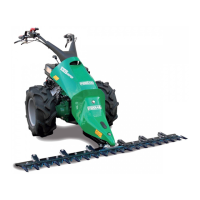
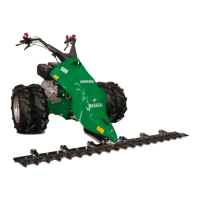
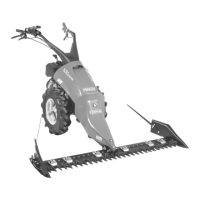
The device described in this manual is the Ferrari 560 HY WS, a hydrostatic motor mower designed for agricultural, maintenance, and gardening uses. It is equipped with a PowerSafe® hydraulic clutch and a hydrostatic transmission, offering versatility and ease of use in various working conditions.
Function Description
The Ferrari 560 HY WS is a motor mower primarily designed for cutting grass and other vegetation. Its hydrostatic transmission allows for continuous speed adjustment, making it suitable for different terrains and tasks. The PowerSafe® hydraulic clutch provides enhanced safety by immediately stopping the implement when the handlebar is released, while the engine continues to run. This feature is crucial for operator safety during work. The device can be fitted with various front-mounted implements such as cutter bars, lawn mowers, snow blades, sweepers, and flail mowers, expanding its functionality beyond just mowing.
Important Technical Specifications
Engine: The manual refers to a table (Table 3, page 32) for specific engine types, power, and RPM. Available engine options include:
- Yanmar L100AE (406 cm³, 7.4/10.1 kW/HP, 3600 rpm)
- Honda GX390 (Alps) (389 cm³, 8.7/11.9 kW/HP, 3600 rpm)
- B&S Vanguard (480 cm³, 11.9/16 kW/HP, 3600 rpm)
All engines are designed to operate at 3600 rpm.
Clutch: The PowerSafe® clutch is hydraulic with multiple discs in an oil bath, mechanically controlled, with a service pressure of 7.5 bar. It features a safety lever that puts the transmission and PTO in neutral while the engine remains on.
Transmission: The hydrostatic transmission is a Kanzaki KHS-13JH compact group with a 13 cm³ pump. It is easily removable without opening the gearbox and features a separate high-pressure circuit with an oil cooling radiator and fan. The charging pump and hydraulic circuit are shared with the PowerSafe® clutch. The gearbox has 2 speed ranges for work and transfer, with hydrostatic inversion and no neutral position. Forward speeds are adjustable from 0 to a maximum indicated in Table 4 (page 32).
Steering: The steering device consists of multiple-disc brakes/clutches in an oil bath, hydraulically controlled by independent levers. It includes a hydraulic brake for early closure, ensuring total control on slopes, and features automatic play recovery. The right steering lever is replicated on the left for enhanced control.
Dimensions and Weights: The overall dimensions and maximum weights vary depending on the tire type (Table 1, page 31). For example, with 5.0-10 tires, the machine measures 1300 mm (A), 990 mm (B), 630 mm (C), 900 mm (D), 550 mm (E), and 96 mm (F), with a weight of 181 kg (M1 for petrol) or 196 kg (M2 for diesel).
Wheels:
- Pneumatic wheels: Available in sizes like 5.0-10, 23x8.50-12, 21x11.00-8, and 20x8.00-10. These are suitable for agricultural and gardening uses, providing good adherence on hard or soft grounds. The 5.0-10 and 23x8.50-12 wheels have adjustable track rims, allowing for track changes by inverting the wheel assembly. The 5.0-10 wheels can be twinned or combined with Superbite metallic wheels.
- Superbite (anti-drift) wheels: Specifically designed for mowing on sloping ground, these wheels can be coupled with 5.0-10 pneumatic tires.
- Back-clawed metal wheels: Available in 3x300 and 3x400 sizes, ideal for work in mountainous areas or on steep slopes, offering maximum traction and safe operation on inclines.
PTO (Power Take-Off): The standard PTO is D=35 mm (1" 3/8), allowing connection of various implements, cardan joints, and pulleys.
Noise and Vibration: The manual provides values for acoustic pressure (LAeq) and acoustic power (LwA) in dB(A), and vibration values in m/sec² according to UNI EN 709 (Table 5, page 86). For machines exceeding 80 dB(A) LAeq, operators are advised to wear appropriate acoustic protection.
Usage Features
Starting and Operation:
- Pre-operation checks: Before starting, ensure air intake grills are clean, engine and gear oil levels are correct, PTO engagement lever is in neutral, air filter is clean, and the mounted implement is clean and sharp.
- Fueling: Use clean, fresh fuel stored in appropriate containers. For diesel engines, it is recommended to start the engine every 30-40 days to keep the injector and pump in working order.
- Starting procedure: Pull the clutch lever, lower the PowerSafe® red lever, select the desired speed range (low/fast), slowly operate the red lever, and then firmly pull the recoil rope.
- Slope operation: Do not use the machine on slopes greater than 30° (58%). If wheels slip, adjust forward movement using steering levers. On slopes, travel crosswise, never directly up or down. Avoid sudden changes in direction and ensure wheels do not encounter obstacles.
- PTO engagement: Engage the PTO a few feet before entering the work area.
- Implement attachment: Implements are attached to the quick hitch. Ensure the hooking pin is correctly locked and the implement is firmly connected. All screws and nuts should be tightened, and greasing performed as necessary. Check the balance between the machine and implement; add weights or PTO spacers if needed.
Safety:
- General safety: Always wear appropriate PPE (safety shoes, ear protection, goggles, work gloves).
- No passengers: Do not carry passengers.
- Operator condition: Do not operate when tired or under the influence of alcohol.
- Work area: Inspect the work area for stones, sticks, or foreign objects that could be ejected by the blades. Keep people away from the machine during operation.
- Hot parts: Avoid touching hot engine parts.
- Exhaust fumes: Ensure good ventilation when operating the engine in enclosed spaces.
- No smoking: Do not smoke or use open flames near the machine.
- Maintenance safety: Never repair or lubricate with moving parts or the engine on. Disconnect battery cables and remove the ignition key before any maintenance.
Maintenance Features
Engine and Air Filter:
- Oil change: Follow the engine manual for oil change intervals. Typically, check oil every 4 hours and replace yearly or every 100 hours.
- Air filter: For dry air filters, clean with compressed air or replace if clogged or damaged. For oil-bath air filters, wash the filtering element and replenish oil every 8 hours.
Gearbox and Steering Clutches:
- Oil change: Discharge oil from the gearbox via three caps. For the first 30 hours, replace the oil filter and check the oil level using the dipstick. Use multigrade hydro-mechanical gear oil (BCS Power Lube H3 SAE 15W-40).
- Magnetic caps: Regularly clean the three magnetic caps with every filter change.
- Radiator: Keep the cooling radiator's steel pipe clean.
- Cooling fan: Clean the centrifugal axial cooling fan from mud and dry grass residues.
PowerSafe® Clutch Adjustment:
- Check play: Ensure the largest eyelet terminal of the clutch lever is 1-2 mm longer than the coupling pin. Adjust the adjusting screw to achieve the desired length, then tighten it.
- Hooking: Hook the large eyelet to the hinge and fit the snap ring retainer.
- Small eyelet: Check the smallest eyelet terminal of the red stop lever is 1-2 mm longer than its coupling pin. Adjust the adjusting screw and then hook the small eyelet to the hinge, fitting the snap ring retainer.
- Warning: Do not attempt to disassemble or adjust PowerSafe® components without proper knowledge; contact an authorized service center for interventions.
Prolonged Inactivity:
- Storage: Store the machine in a dry, sheltered environment, covered with a cloth, ensuring the engine and exhaust pipe are cold.
- Engine run: Start the engine at least every 30 days.
- Long-term storage (over 1 month): Follow the engine manual's instructions, lubricate all joints, and use a fuel additive to protect the engine.

 Need help?
 General

 To Next Page