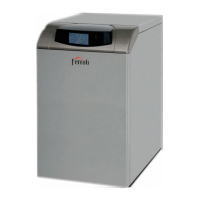
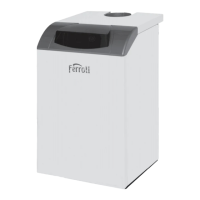
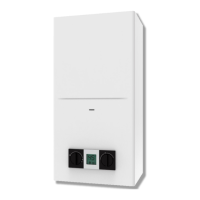
The Ferroli PEGASO ECO is a high-performance, low-emission water heater designed for domestic hot water production. It operates on either natural gas or LPG and features a compact, water-cooled, battery-powered burner with electronic ignition. The unit is suitable for both indoor and outdoor installation, capable of operating in temperatures ranging from -5 °C to +60 °C.
Function Description:
The PEGASO ECO heats domestic hot water on demand. When a hot water tap is opened, the unit automatically ignites the burner to heat the water passing through its copper heat exchanger. The desired water temperature can be set using a knob on the control panel. The unit is designed for continuous operation, igniting automatically whenever hot water is drawn and shutting off when demand ceases. For complete shutdown, a specific knob position is available. In situations where the unit will be inactive for an extended period, especially during winter, it is recommended to drain all water to prevent ice damage.
Important Technical Specifications:
The PEGASO ECO series includes models such as PEGASO ECO 6, PEGASO ECO 11, and PEGASO ECO 14, with varying capacities and dimensions.
- Gas Category: II2HM3+ (IT), II2ELwLs3B/P (PL), II2H3B/P (RO).
- Heat Capacity (PEGASO ECO 6 / PEGASO ECO 11):
- Maximum heat capacity: 11.8 kW / 21.1 kW
- Minimum heat capacity: 6.3 kW / 8.1 kW
- Maximum heat capacity (Qn): 10.4 kW / 18.9 kW
- Minimum heat capacity (Qn): 5.4 kW / 7.0 kW
- Performance at Max. Power: 87% for both models.
- Burner Injectors (G20):
- PEGASO ECO 6: 14 x 0.82
- PEGASO ECO 11: 24 x 0.85
- Gas Supply Pressure (G20/G230): 20 mbar for both models.
- Max. Gas Delivery (G20):
- PEGASO ECO 6: 1.25 m³/h
- PEGASO ECO 11: 2.23 m³/h
- DHW Delivery (△25°):
- PEGASO ECO 6: 6.0 l/min
- PEGASO ECO 11: 10.8 l/min
- DHW Delivery (△30°):
- PEGASO ECO 6: 5.0 l/min
- PEGASO ECO 11: 9.0 l/min
- Max. Operating Pressure: 10 bar.
- Min. Operating Pressure: 0.2 bar.
- Supply Voltage: 3V = (battery-powered).
- Empty Weight:
- PEGASO ECO 6: 8.5 Kg
- PEGASO ECO 11: 9.50 Kg
- Type of Unit: B11BS.
- Maximum Working Temperature: 65 °C.
- NOx Emissions (G20):
- PEGASO ECO 6: < 56 mg/kWh
- PEGASO ECO 11: < 56 mg/kWh
- NOx Emissions (G31/G30):
- PEGASO ECO 6: < 72.8 mg/kWh
- PEGASO ECO 11: < 72.8 mg/kWh
- ErP Product Fiche (Models NG/LPG):
- Water heating energy efficiency class: A+ (for XS load profile), A (for M load profile).
- Water heating energy efficiency (NWh): 58% / 76%.
- Sound power level (LWA): 57 dB / 58 dB.
- Connections:
- Gas inlet: 1/2" (yellow label).
- Cold water inlet: 1/2" (blue label).
- Domestic hot water outlet: 1/2" (red label).
- Minimum Distances for Installation:
- On each side: >2cm
- In front: >2cm
- Above: >50cm
Usage Features:
The control panel is straightforward, featuring:
- DHW temperature indication: Displays the hot water temperature at the boiler outlet.
- Battery charge indication: A fixed symbol indicates very low battery, prompting replacement. A flashing symbol means the battery is dead and must be replaced immediately.
- Burner power adjustment: Allows manual adjustment of burner power.
- Temperature adjustment: Knob for setting the desired water heating level.
- Burner on indication: Light to show when the burner is active.
To turn the unit on, rotate the temperature adjustment knob to the desired water heating level. The unit will automatically operate when hot water is drawn. To turn it off, place the knob in the "off" position. Manual burner power adjustment allows users to fine-tune the heating level, reducing gas consumption at lower settings.
Maintenance Features:
Regular maintenance is crucial for the unit's correct operation and longevity. All adjustments, commissioning, and periodic checks must be performed by an authorized technician.
- Periodic Checks (Annual):
- Verify correct operation of control and safety devices (e.g., gas valve).
- Ensure the exhaust vent is perfectly efficient and free of obstacles or leaks.
- Clean the burner and heat exchanger from dirt and deposits using non-chemical or non-steel brush methods.
- Check the electrode for deposits and proper positioning (electrode gap should be 3.5 mm).
- Confirm tightness of gas and water systems.
- Verify gas delivery and operating pressure values against specifications.
- Cleaning: The casing and exterior parts can be cleaned with a soft, damp cloth and soapy water. Abrasive detergents or solvents should not be used.
- Battery Replacement: The unit is battery-powered, and batteries need to be replaced when indicated by the battery charge symbol on the control panel. The process involves opening the battery box as illustrated in the manual.
- Gas Conversion: If the unit needs to operate with a gas type different from its factory setting (e.g., converting from natural gas to LPG), a conversion kit must be used, and the procedure must be performed by an authorized technician using original components.
- Fume Exhaust Safety Device (Fume Thermostat): This device ensures correct exhaust of flue gases and should never be deactivated or tampered with. In case of a fault, only original replacement parts should be used, and replacement must be carried out by qualified technicians.
- Water Hardness: If the water hardness exceeds 25°Fr (1°F=10ppm CaCO3), the water must be treated to prevent deposits on the unit.
- Water Flow Rate Adjustment: The unit has screws for minimum and maximum water flow regulation, which can be adjusted by a technician.
Safety Warnings:
- Always read the manual carefully before installation and use.
- Installation and maintenance must be performed by a registered technician according to current standards and manufacturer instructions.
- Tampering with sealed adjustment devices is prohibited.
- Improper installation or lack of appropriate maintenance can lead to property damage or injury.
- Before cleaning or maintenance, unplug the unit from the mains power supply.
- In case of malfunction, unplug the unit and have it repaired by qualified personnel.
- Packing materials are a source of danger and should be kept out of reach of children.
- Children aged 8 and above, and persons with reduced capabilities, can use the unit under supervision and after receiving instructions on safe use. Children must not play with the unit.
- The unit is an "open chamber" type and must be installed and operated only in permanently ventilated places to prevent suffocation, intoxication, explosions, and fire due to insufficient combustion air or fume dispersion.
- When the unit is working, the temperature near the peephole may be high; avoid contact to prevent burns.
- Never support the water heater by the water/gas connections.
- Ensure the room where the water heater is installed has an air inlet opening as required by regulations.
- If the unit is installed inside a cabinet or joined laterally to other elements, sufficient space must be allowed for removing the casing and performing normal maintenance activities.
- The CE marking certifies compliance with European directives.

 Need help?


 To Next Page
 General