FES Flight Manual, v1.18 May 2020
Page 28 of 35
5.3.3 Flight polar
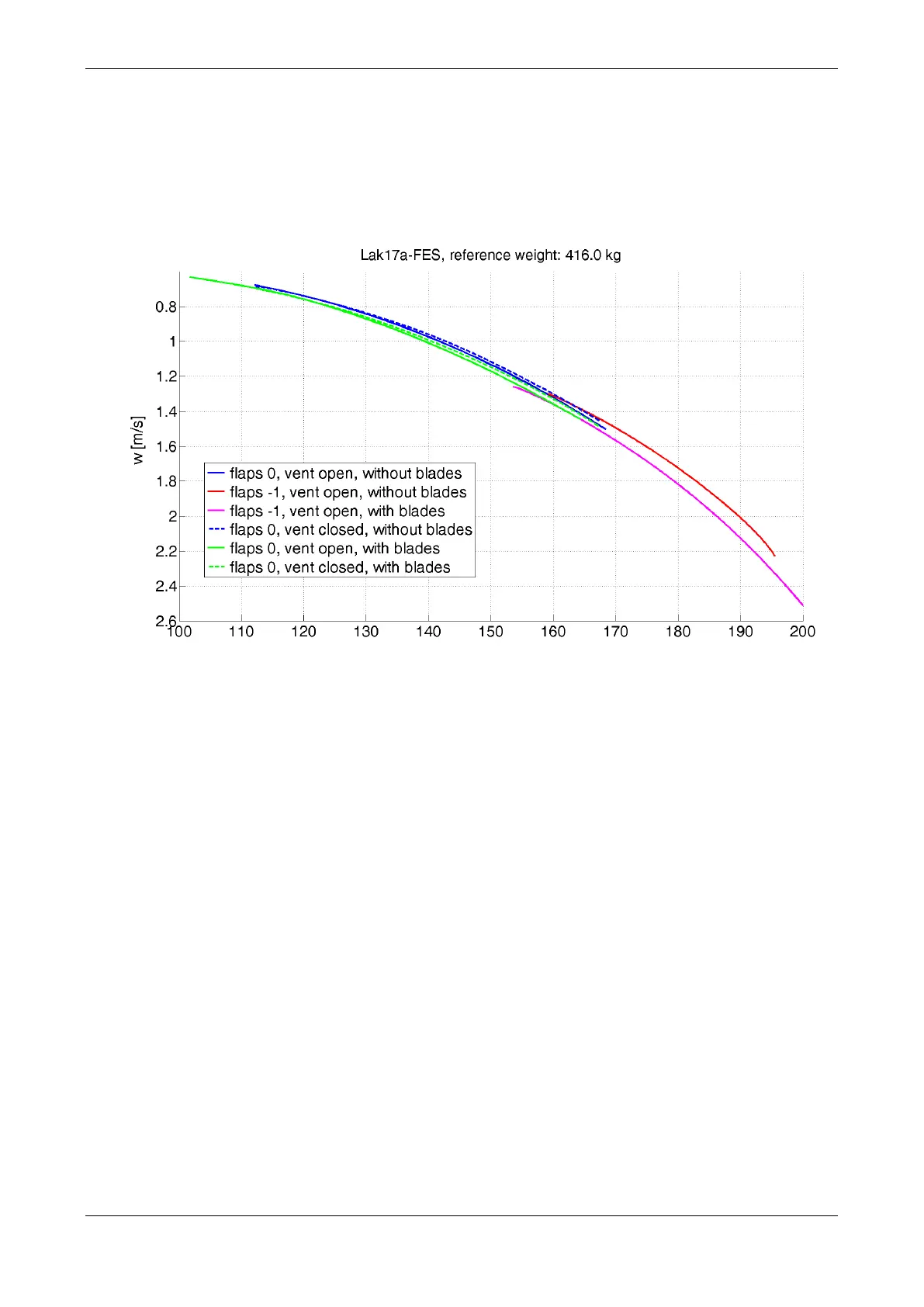
FES equipped sailplane has about 4-5kg/m2 higher minimum wing loading, compared
to a pure glider version which is around 45kg lighter. Additional weight has the same
effect on flight polar as adding water ballast (moving polar to the right). Best L/D speed
and the minimum sink rate speed is about 5km/h higher, compared to a pure glider
version.
The graph above shows the flight polar of LAK17A FES in 18m configuration at 416kg
take-off weight (no water ballast and around 20kg of measurement equipment).
5.3.4 Powered flight performance
5.3.4.1 Rate of climb
The maximum rate of climb is available only for a few minutes with fully charged
battery packs. As battery voltage is reduced, the maximum achievable climb rate is lower.
The average rate of climb depends mostly on the type of sailplane and its take-off weight.
Maximum attainable altitude gain that in standard atmosphere conditions depends on
the type of sailplane, its weight and aerodynamic qualities. To achieve the maximum
altitude gain, use about 15kW of power. Do not use full power as the efficiency of the
system is lower. Usually, 80-85 km/h is best for the climb with positive flap setting (the
same setting as used while thermaling). Here are rough numbers:
• 1600 m (5200 ft) for UL sailplanes at 300kg take-off weight, i.e. Silent 2 Electro
• 1400 m (4500 ft) for the 18m class sailplanes at 400kg take-off weight (without
water ballast), i.e. LAK17A FES
• 1200 m (3900 ft) for the 18m class sailplanes at 450kg take-off weight (without
water ballast); LAK17B FES, Ventus 2cxa FES, Discus 2c FES, HPH 304ES



 To Next Page