
 Need help?
Do you have a question about the Fetal Doppler i100 and is the answer not in the manual?
Explains the meaning of various icons and warning symbols used in the manual and on the device.
Provides critical safety advice for operating the instrument, including handling batteries and usage environments.
Highlights important warnings related to ultrasonic doppler energy, battery disposal, and device maintenance.
Overview of the instrument as a high-performance fetal heart rate test instrument.
Details the differing features and functions across various models of the fetal doppler.
Specifies the target users and applications for monitoring fetal heart rate.
Lists the essential components included in the standard package of the device.
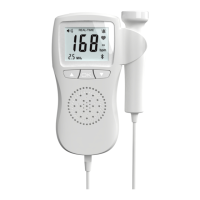
Diagram illustrating the physical structure and components of the fetal doppler device.
Explanation of display menus, parameters, and device symbols for user understanding.
Description of the device's buttons, including volume control and power switch.
Steps for preparing the instrument, checking for damage, and handling packaging materials.
Instructions on how to install, remove, and properly close the battery compartment.
Guidance on handling the probe, including proper connection and disconnection procedures.
Procedure to turn on the instrument and activate its standby condition.
Introduction to various display modes like digital and curve, and function settings.
Details on alarm, voice, storage, playback, and Bluetooth functions, plus menu navigation.
Instructions for manually powering down the device and its automatic shutdown feature.
Guidance on replacing or charging the battery, including charging time and indicators.
Steps for cleaning the instrument, including handling probes and specific cleaning agents.
Solutions for problems like no sound, low sound, noise, and low sensitivity.
Details the warranty liability, scope, and conditions not covered by the warranty.
Information on contacting local dealers for issues related to use, maintenance, or failure.
This document outlines the operation and maintenance of the Fetal Doppler, model i100, a high-performance instrument designed for detecting fetal heart rate.
The Fetal Doppler i100 is primarily used for the detection of fetal heart rate. It is intended for use by nurses, midwives, and other professionals in hospitals, clinics, communities, and homes to monitor fetal heart rate. The device consists of a main engine and an ultrasonic Doppler probe. Different models (i100-I, i100-II, i100-III, i100-IV) offer varying features such as display type (B/W or Colour), backlight, built-in speaker, battery indicator, curve display, auto power off, and compatibility with different battery types (Alkalinity or Ni-MH). Optional features include adapters, USB charging lines, earphones, 2.5MHz/3.0MHz probes, Apple APP connectivity, infrared temperature measurement, PC connection, and additional batteries. The 2.5MHz and 3MHz probes are specifically used for fetal heart rate detection.
The instrument is an internal power supply equipment with an electric shock protection grade of BF type, complying with GB 9706.1-2007 for leakage current and dielectric strength. It utilizes low energy ultrasonic Doppler technology, deemed safe for fetuses, pregnant women, and others through laboratory testing, clinical trials, and applications. The device has an IPX4 waterproof level, indicating protection against splashing water. The basic frequency of the probe is 2.0MHz and 3MHz, with options available. The full battery life is approximately 5 hours. The lifetime of the instrument is 5 years.
Before use, users are instructed to carefully read the manual, paying attention to notices, information prompts, and warnings. The manual highlights icons for electric shock prevention (BF type equipment), waterproof level (IPX4), attention points (mild danger), information prompts, and warnings (potentially harmful information).
Before operation, users must check the equipment for damage and ensure all attachments are intact. If any damage is found, use should cease, and the local distributor should be contacted. Packaging materials should be retained for future transportation or storage. For battery installation, the instrument is flipped, the battery cover opened, and the battery inserted, ensuring correct polarity. To remove the battery, the fuselage is held in one hand, and the battery cover is slid in the direction of the battery, then moved in the direction of the arrow. Closing the battery compartment involves pushing the cover in the opposite direction of the battery. If using rechargeable batteries, they must be fully charged before first use, typically requiring more than 2 hours of continuous charging or following specific battery instructions. Short-circuiting or reverse loading the battery is prohibited.
The probe is held in one hand, with the other hand on top of the probe. The head is removed first, then the entire probe is removed along the direction of the arrow. A critical warning states that the probe should not be removed or reloaded while the instrument is turned on. Probes should be removed before turning on and reattached after shutdown.
To power on, the switch machine key is pressed once; the work indicator will illuminate, and the instrument will be in standby. To power off, the switch machine key is pressed for three seconds. The device also features an automatic shutdown if there is no operation for one minute.
The i100 offers various display modes and functions:
The probe key acts as a counter for fetal movements. Pressing it once when fetal movement is felt accumulates a value on the screen. The counting time is displayed in the lower right corner, not exceeding one hour. After 10 seconds of fetal movement display, the main frequency displays the fetal heart rate.
When the battery is low, it should be replaced or recharged. For charging, the adapter's DC port is plugged into the instrument's charging port, and the AC port into a 110-240V, 50/60 Hz AC power outlet. Full charging takes approximately two hours, indicated by a green LED. Warning: Rechargeable 1.2V NiMH batteries cannot be charged while the instrument is working. The instrument cannot operate while charging. The instrument only works when the adapter is not connected.
Before cleaning, the machine must be turned off, and the battery removed. A soft cloth should be used to wipe off any remaining coupling agent from the probe. The outer surface of the instrument, including the LCD display, should be kept clean and dust-free. If necessary, a neutral cleaner or alcohol can be used, taking care to prevent liquids from entering damaged parts of the machine. Warning: Ultrasonic probes are delicate and must be handled carefully. After use, the coupling agent must be wiped off the probe. Periodic Safety Testing: The instrument should undergo periodic safety testing, including leakage current insulation and measurement, in accordance with public organization specifications and inspection procedures. Accuracy: The accuracy of the fetal heart rate is controlled by the instrument and cannot be adjusted by the user. If the fetal heart rate outcome is not credible, other methods (e.g., stethoscope) should be used for verification, or local agents should be contacted.
The manual provides solutions for common issues:
The warranty covers the product or parts within the specified warranty period and scope.
 General
| Brand | Fetal Doppler |
|---|---|
| Model | i100 |
| Category | Security Sensors |
| Language | English |

 To Next Page