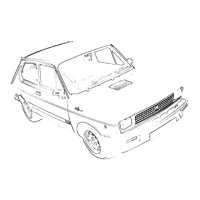
FIAT 124 Spider
Engine Maintenance + Modification
80
11. Improvements*
* Ask yourself if things need improving.
Performance is a relative term. You need to define how you want your engine to
perform so that it suits your needs. A high performance engine is not necessarily fast
and a poorly performing engine is not always slow. Lots of car companies state that
their engines are “high performance” just because they produce more than “x”
horsepower or “y” torque. But look at what these companies do to produce this power -
enormous V6 and V8 engines that barely produce ¾ of a horsepower per inch of engine
displacement. These can be 350 and 400 cu. in engines producing less than 300 HP.
Alfa Romeo and FIAT were producing 1HP per cubic inch of displacement in the 1960’s.
Sure, the engines produced around 100 to 120HP, but which one is higher performance?
It's up to you to define performance in terms of what you want your car to do.
Performance is relative to your needs.
Do you want to build a 200HP Spider? It can be done, with a standard FIAT engine
block, cylinder head modifications, high compression pistons, lightened flywheel and
connecting rods, supercharging, etc. Guy Croft has been building race-prep FIAT twin-
cam motors from his shop in the United Kingdom for many years. He wrote a book on
the subject (which is now quite hard to find) in case you want to do it all yourself, or you
can pay upwards of $8,000.00 to get it done right by Guy personally. Alternatively, there
are numerous things you can do with a relatively stock FIAT Spider and really improve
your driving experience. The interchangeability of parts between model years allows you
to use off-the-shelf FIAT parts to truly transform your Spider.
The good news is that many Spider parts can be interchanged between engine series or
upgraded with new parts. These interchanges can be done to improve things such as
acceleration, horsepower, and torque. Parts availability and installation ease are both
very good; in other words, you may be able to mix and match parts at a minimal expense
and create an improved driving experience. This section deals with some improvements
that have been proven to be successful in delivering improved performance and
reliability.
You should approach performance improvements with some caution. There is a financial
trap you can easily fall into, with your improvements quickly reaching the point of
diminishing returns. A set of new carburetors, head work, pistons, camshafts seals,
rings, and all of the other parts can easily set you back three or four thousand dollars. It
is very easy to say “since I’m pulling the motor anyway, I’ll go ahead and install new,
high compression pistons and those lightened connecting rods.” Consider that your
tired engine may improve dramatically by rebuilding to stock (or near stock). There are
exceptions, such as the Spider 2000 fuel system, but for the most part these cars were
very nice performers in stock form, and some relatively inexpensive changes may meet
all of your needs.


 To Next Page
 Loading...